
Unfair Truth: Retail Media Doesn't Have a Demand Problem. It Has an Execution Problem.
Key Takeaways
- Retail media growth is often constrained by operational bottlenecks—not advertiser demand.
- As retail media networks mature, campaign execution becomes just as important as inventory and audience data.
- Manual workflows create friction that slows revenue, frustrates advertisers, and limits scalability.
- The most successful retail media businesses invest in operational infrastructure early.
- AdButler helps retailers streamline campaign management, inventory, approvals, reporting, and self-service to support long-term growth.
Retail media has become one of the fastest-growing channels in advertising.
Brands continue shifting budgets toward retailers because they offer something increasingly difficult to find elsewhere: first-party commerce data, closed-loop measurement, and high-intent audiences.
Industry forecasts continue to predict strong investment growth over the coming years, making retail media one of the most attractive areas of digital advertising.
Yet despite this momentum, many retail media networks struggle to scale.
The common assumption is that the problem is demand.
"We need more advertisers." "We need more agencies." "We need a bigger sales team."
Sometimes that's true.
But for many retailers, the bigger challenge isn't attracting advertisers.
It's serving them.
That's the unfair truth.
The limiting factor for many retail media networks isn't market demand—it's operational capacity.
Advertisers Want to Buy
Retail media is becoming a core part of media planning.
Brands are actively looking for opportunities to reach shoppers closer to the point of purchase, while retailers continue expanding the inventory they make available across websites, mobile apps, email, in-store screens, loyalty programs, and off-site media.
Demand isn't disappearing. Competition is increasing.
Advertisers now have more retail media networks to choose from than ever before.
When every retailer offers similar audiences and similar ad formats, the buying experience becomes a competitive advantage.
The easiest network to work with often wins.
Growth Doesn't Stop Because of Demand
It stops Because of Operations.
Most retail media networks launch successfully.
The first advertisers come onboard. Campaigns perform well. Everyone sees the opportunity. Then growth begins.
And that's usually when the cracks appear;
Campaign requests start arriving faster.
More suppliers want visibility.
Sales teams promise custom campaigns.
Creative approvals multiply.
Reporting requests increase.
Inventory becomes more difficult to manage.
What once felt manageable quickly becomes overwhelming. Suddenly, every campaign requires another spreadsheet.
Another approval email, manual report, ansd meeting.
The problem isn't attracting advertisers anymore.
It's keeping up with them.
The Retail Media Growth Bottleneck
Every retail media network eventually hits a point where the challenge changes. What gets you launched isn't necessarily what gets you to scale.
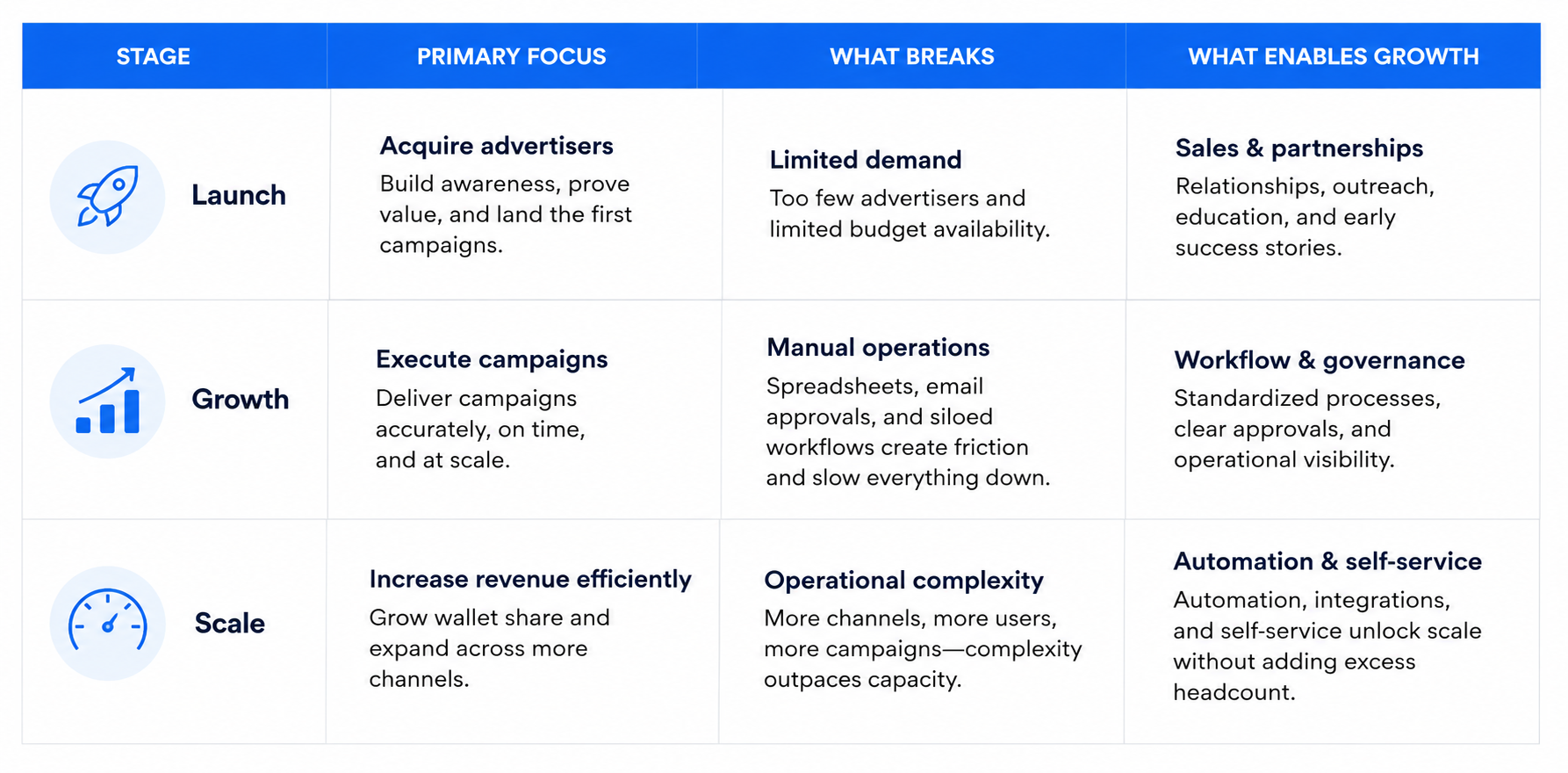
Most conversations focus on the first stage: How do we get more advertisers?
But once demand exists, adding more advertisers without improving the infrastructure underneath them can actually make the problem worse.
More demand on top of broken operations doesn't create scale. It creates a bigger bottleneck.
That's why operational efficiency eventually becomes revenue infrastructure.
Retail Media Is Becoming an Operations Business
For years, retailers have viewed retail media primarily as a sales initiative.
- Sell more campaigns.
- Sign more brands.
- Increase sponsorship revenue.
Those objectives still matter. But they're no longer enough.
As networks mature, retail media starts looking less like a marketing program and more like an operational business.
Success depends on how efficiently campaigns move from proposal to launch.
- How quickly creative is approved.
- How accurately inventory is managed.
- How easily advertisers can understand performance.
- How consistently reporting is delivered.
These are operational capabilities.
And they're often what determines whether a retail media business can double in size—or stalls under its own complexity.
Operational Friction Costs More Than Time
Every manual workflow introduces friction.
A campaign delayed by two days may not seem significant.
Multiply that across hundreds of campaigns each year, however, and the hidden cost becomes substantial.
Sales teams spend more time chasing approvals.
Ad operations teams become overwhelmed by repetitive tasks.
Advertisers wait longer for campaigns to launch.
Reporting consumes hours instead of minutes.
Inventory conflicts become more frequent.
None of these issues make headlines. But collectively, they slow revenue growth.
More importantly, they change the advertiser experience.
Brands don't compare your retail media network only against another retailer.
They compare it against every advertising platform they use.
If buying from one retailer requires ten emails while another offers streamlined workflows and near real-time campaign visibility, the decision becomes much easier.
Convenience has become part of the product.
The Best Retail Media Networks Are Easy to Buy From
Retail media leaders are building better operating systems.
The goal isn't to replace people. It's to remove unnecessary friction.
That means giving sales teams faster campaign execution.
- Giving advertisers greater transparency.
- Giving ad operations better workflows.
- Giving leadership clearer reporting.
And giving suppliers the confidence that campaigns can launch quickly and perform as expected.
Operational excellence isn't an internal efficiency project.
It's part of the customer experience.
The easier you make it to buy media, the easier it becomes to grow media revenue.
Where AdButler Fits
This is where retail media platforms become much more than ad servers.
They become operational infrastructure.
Instead of relying on disconnected spreadsheets, manual trafficking, email approvals, and fragmented reporting, retailers can centralize campaign management within a single platform.
With AdButler, retailers can manage inventory across digital properties, streamline campaign creation, automate approvals, control user permissions, provide comprehensive reporting, and gradually introduce self-service capabilities—all while maintaining governance over their media business.
The result is a retail media operation that's designed to scale alongside advertiser demand.
The Real Unfair Truth
Retail media fails when buying media becomes harder than buying it somewhere else.
Advertisers aren't simply looking for audience reach or sponsored product placements anymore. They're looking for retail media partners that can execute campaigns quickly, provide transparent reporting, manage inventory effectively, and adapt as programs grow.
The retailers winning today are the ones that are easiest to do business with.
As retail media continues to mature, operational excellence will become just as important as audience quality.
The conversation is changing.
The question is no longer:
"Can we build a retail media network?"
It's becoming:
"Can we operate one at scale?"
That's the unfair truth.
And for many retailers, the answer won't be determined by advertiser demand.
It will be determined by the infrastructure behind it.
Is Your Retail Media Operation Built to Scale?
Launching a retail media network is only the beginning. As advertiser demand grows, campaign execution, inventory management, reporting, and governance become critical to long-term success.
AdButler helps retailers build scalable retail media operations through centralized campaign management, flexible inventory controls, robust reporting, workflow automation, and self-service capabilities—all from a single platform.
Learn how AdButler powers scalable retail media networks, reach out to us.
FAQs
Why do some retail media networks struggle to grow?
Many retailers assume growth depends on attracting more advertisers. In reality, growth often slows because campaign operations become increasingly manual and difficult to scale. Bottlenecks in approvals, trafficking, reporting, and inventory management can limit revenue even when advertiser demand is strong.
What are retail media operations?
Retail media operations are the processes and technology that enable a retailer to run its media business efficiently. This includes campaign creation, inventory management, approvals, reporting, advertiser support, user permissions, billing workflows, and self-service capabilities.
Why is operational efficiency important in retail media?
Operational efficiency allows retailers to launch campaigns faster, reduce manual work, improve advertiser satisfaction, and support more campaigns without proportionally increasing headcount. As retail media networks mature, efficient operations become a competitive advantage.
What causes operational bottlenecks in retail media?
Common bottlenecks include spreadsheet-based workflows, manual campaign trafficking, fragmented reporting, disconnected systems, inventory conflicts, lengthy approval processes, and limited automation.
How does self-service improve retail media operations?
Self-service allows advertisers and suppliers to create campaigns, upload creative, monitor performance, and manage budgets independently while retailers maintain governance through permissions and approval workflows. This reduces operational overhead while improving the advertiser experience.
How does AdButler support retail media operations?
AdButler provides the operational infrastructure behind retail media networks, including campaign management, inventory controls, targeting, reporting, user permissions, workflow support, and optional self-service capabilities. Retailers can manage multiple digital properties from a centralized platform while maintaining full control over their media business.
