
Unfair Truth: Programmatic Solved Scale. It Didn't Solve Control.
Key Takeaways
- Programmatic solved one of digital advertising's biggest challenges: scale.
- It wasn't designed to maximize publisher control, premium inventory, or direct advertiser relationships.
- The publishers creating the most sustainable businesses are combining programmatic with direct monetization—not choosing between them.
- Hybrid monetization gives publishers greater flexibility, ownership, and long-term revenue opportunities.
- AdButler helps publishers balance automation with direct sales, premium campaigns, and complete inventory control.
Programmatic transformed digital advertising. It made media buying faster, smarter, more efficient, and dramatically more scalable.
But somewhere along the way, publishers started expecting programmatic to solve a different problem; control.
It never did. Programmatic was designed to automate transactions—not build advertiser relationships, protect premium inventory, or help publishers differentiate themselves.
Those aren't auction problems. They're business problems.
That's an important distinction because many of today's most successful publishers aren't moving away from programmatic.
They're moving beyond an either/or mindset.
Scale Was Never the End Goal
The original promise of programmatic was simple:
- Reduce friction.
- Increase fill rates.
- Expand advertiser demand.
- Automate buying.
Mission accomplished.
Today, programmatic accounts for the majority of digital display advertising transactions across many mature markets, fundamentally changing how advertising is bought and sold.
But automation also created something else; standardization.
If every publisher has access to similar exchanges… Similar SSPs… Similar demand...
Then what actually differentiates one publisher from another? The audience.
Premium Inventory Was Never Meant for an Auction
Think about the placements your best advertisers actually want.
- Homepage sponsorships.
- Newsletter placements.
- Custom branded campaigns.
Those are premium advertising products built around trusted audiences, editorial environments, and direct relationships. No auction can replicate that.
That's why publishers continue investing in direct sales even as programmatic grows.
The two models solve different problems.
Programmatic maximizes efficiency.
Direct relationships maximize value.
The strongest monetization strategies recognize you need both.
The Publisher Monetization Model
One way we think about publisher monetization at AdButler is through a simple framework.
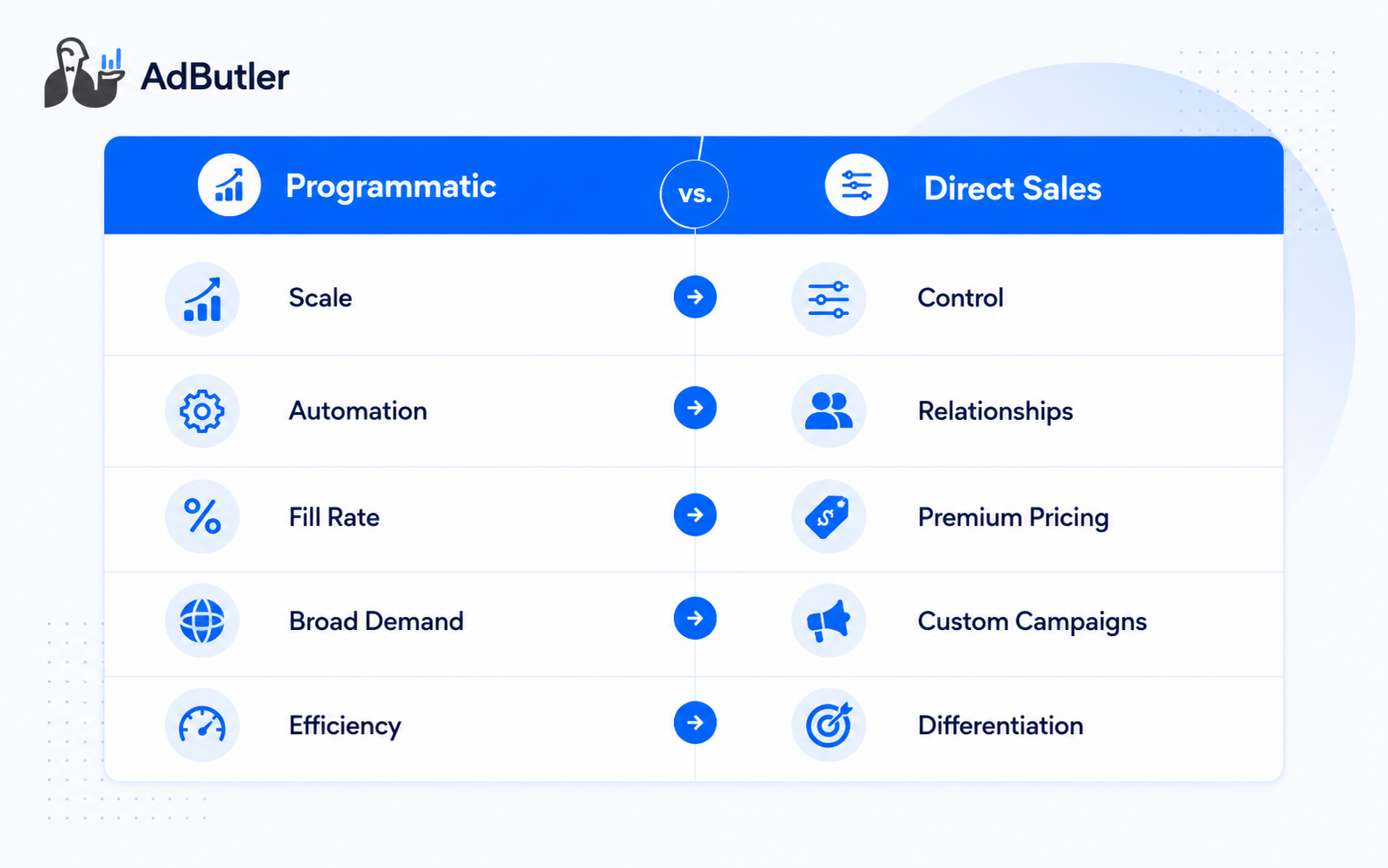
Neither side is better. They're simply optimized for different outcomes.
The mistake is expecting programmatic to deliver everything.
Publishers don't need to choose one over the other. They need to understand where each creates the most value.
That's what hybrid monetization is really about.
Hybrid Monetization Is Becoming the New Standard
The conversation is changing.
Publishers are asking fewer questions about replacing programmatic.
They're asking better questions.
- Which inventory should remain automated?
- Which campaigns deserve premium pricing?
- How do we package first-party audiences into higher-value advertising products?
As privacy regulations reshape digital advertising and first-party data becomes increasingly valuable, publishers are investing more heavily in owned audiences and direct advertiser relationships.
Programmatic remains essential, but it no longer defines the entire monetization strategy.
Control Is Becoming a Competitive Advantage
Publishers already own something many platforms don't.
- Trust.
- Context.
- Audience relationships.
- Editorial credibility.
Those assets become significantly more valuable when publishers control how they're packaged, sold, and measured.
That's why hybrid monetization is about deciding where automation creates efficiency...
...and where direct relationships create more value.
The publishers that understand that distinction are building businesses that are harder to commoditize.
The Real Unfair Truth
Programmatic changed how digital advertising is bought. It never changed what makes media valuable:
- Audiences.
- Trust.
- Relationships.
Those are the assets advertisers remember. Those are the assets competitors can't easily copy.
And those are the assets worth building a business around.
That's why we believe the future of publisher monetization is programmatic plus direct.
Automation where automation creates value. Human relationships where relationships create more value.
The real question is:
How do we use each where it creates the most value?
The publishers that grow over the next decade won't abandon programmatic. They'll simply stop expecting it to solve problems it was never designed to solve.
Because scale was never the destination, building a resilient, diversified media business was.
Where AdButler Fits
We don't believe publishers should have to choose between efficiency and control.
The strongest monetization strategies combine both.
Programmatic continues to maximize scale and fill rates.
Direct campaigns continue to drive premium pricing, stronger advertiser relationships, and differentiated advertising experiences. AdButler gives publishers the flexibility to manage both from a single platform.
Whether you're serving direct campaigns, homepage takeovers, newsletter sponsorships, sponsored content, commerce media, or integrating with programmatic demand, your ad server should adapt to your monetization strategy—not dictate it.
That's what hybrid monetization looks like.
Not replacing programmatic.
Ready to Build a Hybrid Monetization Strategy?
If you're looking to balance automation with direct relationships, premium inventory, and greater control over your advertising business, AdButler can help.
Talk to our team to learn how AdButler supports hybrid monetization with direct ad serving, premium campaign management, commerce media, and programmatic integrations—all from a single platform.
FAQs
What is programmatic advertising?
Programmatic advertising is the automated buying and selling of digital advertising using technology platforms and real-time auctions. It improves efficiency, scale, and access to advertiser demand.
Is programmatic advertising replacing direct sales?
No. Most premium publishers use a combination of both. Programmatic delivers automation and scale, while direct sales create premium partnerships, custom campaigns, and stronger advertiser relationships.
What is hybrid monetization?
Hybrid monetization combines programmatic advertising with direct-sold campaigns to maximize revenue. Publishers use automation where it creates efficiency while reserving premium inventory and custom advertising opportunities for direct relationships.
Why is publisher control becoming more important?
As first-party data, premium audiences, and contextual advertising become more valuable, publishers are looking for greater control over inventory, pricing, advertiser relationships, and campaign experiences rather than relying exclusively on automated transactions.
How does an ad server support hybrid monetization?
An ad server provides centralized control over inventory, campaign delivery, targeting, reporting, and direct advertising while integrating with programmatic demand sources. This allows publishers to operate multiple revenue models from a single platform.
