
Commerce Data Explained: Why Media Networks Are the Future of Monetizing Intent
Why the Future of Commerce Media Belongs to Businesses That Own the Audience, the Data, and the Outcome
For years, commerce data has been treated as the holy grail of advertising.
Retailers collect it.
Advertisers chase it.
Publishers want to monetize it.
Platforms promise to unlock it.
But here's the uncomfortable truth:
Commerce data has become table stakes. The advantage comes from what you do with it.
Almost every retailer, publisher, marketplace, travel company, and digital platform has access to valuable audience signals. The real advantage comes from what happens next.
Who owns the audience?
Who controls the inventory?
Who activates the data?
And ultimately, who captures the revenue?
That's the conversation more businesses are starting to have and it's why commerce media is evolving beyond audience targeting into something much bigger.
It's becoming a business model.
Key Takeaways
- Commerce data captures consumer intent throughout the buying journey, including searches, product views, comparisons, cart activity, and purchases.
- Commerce data differs from transaction data because it reveals why consumers make decisions, not just what they bought.
- Commerce data has become table stakes. The real competitive advantage comes from owning, activating, and monetizing audience insights.
- Commerce media is expanding beyond retail, creating opportunities for publishers, marketplaces, travel platforms, membership organizations, and other audience owners.
- Media networks transform commerce data into revenue by connecting audiences, inventory, advertisers, and activation capabilities.
- Ownership matters. Businesses that control their audience relationships, inventory, and monetization strategies capture more long-term value.
- Commerce Catalyst helps organizations turn audience signals into scalable media businesses while maintaining ownership of their data, inventory, and advertiser relationships.
Commerce Data Is Creating a New Asset Class: Monetizable Intent
Most businesses don't think about their audience this way.
They see website visitors, customers, subscribers, members, readers, and shoppers.
What they often overlook is that every interaction generates signals that reveal intent.
Those signals are valuable.
Not because they're data points. Because they're indicators of future behavior.
- Someone researching laptops is demonstrating purchase intent.
- Someone reading destination guides is revealing travel intent.
- Someone browsing product reviews is signaling buying intent. -- Someone comparing suppliers on a B2B marketplace is expressing procurement intent.
Intent has become one of the most valuable currencies in modern advertising.
Commerce data is how businesses capture intent. Activating that intent is where competitive advantage is created.
What Is Commerce Data?
Commerce data is the collection of signals generated throughout a consumer's decision-making journey.
That includes:
- Product searches
- Category browsing
- Product page views
- Add-to-cart activity
- Wishlist interactions
- Product comparisons
- Purchase behavior
- Inventory engagement
- Promotional responses
- Repeat purchase activity
These signals tell a much richer story than a completed transaction ever could.
A purchase tells you what happened.
Commerce data helps explain why it happened and what might happen next.
That's what makes it so powerful.
The Difference Between Transaction Data and Commerce Data
Many organizations still treat transaction data as their primary source of customer intelligence.
That's increasingly limiting.
Transaction data tells you:
- What was purchased
- When it was purchased
- Where it was purchased
Commerce data reveals:
- What consumers were considering
- How they researched
- Which products they compared
- What influenced their decisions
- What they may purchase next
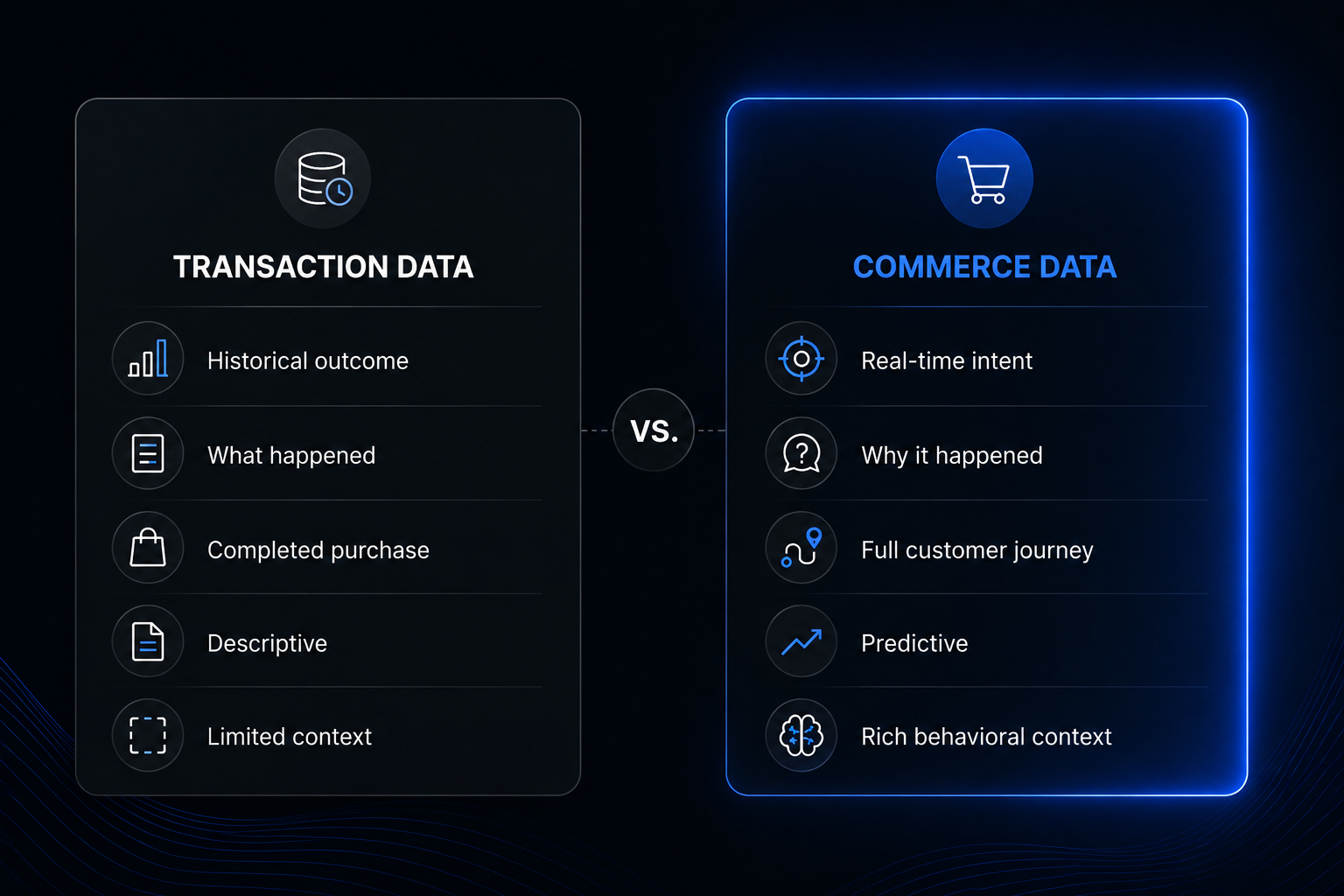
The difference matters because modern advertising is about understanding tomorrow's customer.
The Future Is Audience-Owned Media.
Retail media networks proved something incredibly important; audience attention can be monetized.
Brands were willing to pay for access to shoppers who were actively researching and buying products.
The model worked so well that retail media became one of the fastest-growing sectors in advertising.
But something bigger is happening now.
Businesses across every industry are realizing they have the same ingredients:
- A technology publisher reviewing laptops generates purchase intent.
- A travel platform captures booking intent.
- A marketplace captures transaction intent.
- A membership organization captures behavioral intent.
- A streaming platform captures engagement intent.
The opportunity isn't limited to retailers anymore.
The future belongs to businesses that recognize the value of the audiences they've already built.
Every Business Is Becoming a Media Owner
Businesses of all kinds are discovering they already possess the ingredients needed to build media businesses.
They have:
- Valuable audiences
- First-party data
- Commerce signals
- Owned digital properties
- Advertiser demand
The missing piece is often infrastructure. Because collecting commerce data is one thing.
Turning it into a monetizable business is something else entirely.
The Real Value of Commerce Data Is Ownership
This is where many commerce data conversations fall short.
For years, businesses have relied on third-party platforms to monetize their audiences.
The result?
- The platform often owns the advertiser relationship.
- The platform controls the buying experience.
- The platform dictates monetization rules.
- The platform captures a significant share of the value.
Meanwhile, the business that generated the audience is left with only part of the opportunity.
That's beginning to change.
Organizations increasingly want to own:
- Their audience relationships
- Their advertiser relationships
- Their inventory strategy
- Their revenue streams
- Their data activation capabilities
Because commerce data becomes significantly more valuable when businesses control how it's monetized.
Commerce Data Without Activation Is Just Storage
Let's be honest.
Most organizations are suffering from a lack of activation.
They've invested in analytics, built audience segments, implemented first-party data strategies, and created reporting dashboards; yet many still struggle to answer a simple question:
How does this create revenue?
Commerce data only becomes valuable when it can be activated.
Activation means:
- Sponsored advertising
- Audience targeting
- Commerce media campaigns
- Self-service advertiser experiences
- Personalized ad delivery
- Offsite audience extension
- Revenue attribution
Without activation, commerce data remains an unrealized asset.
The businesses winning today are building systems that turn signals into outcomes.
From Commerce Data to Commerce Media: Where Commerce Catalyst Fits
At AdButler, we've spent years helping organizations monetize audiences through advertising infrastructure.
What we've seen is that businesses don't just need more data. They need a way to operationalize it.
That's exactly why we built Commerce Catalyst.
Commerce Catalyst is designed for organizations that want to transform audience insights into scalable commerce media businesses without sacrificing ownership of their data, inventory, or advertiser relationships.
Rather than stitching together multiple technologies, Commerce Catalyst provides the infrastructure needed to connect:
- Audience data
- Commerce signals
- Inventory
- Advertisers
- Campaign management
- Revenue measurement
Within a single ecosystem.
Whether you're a retailer launching a retail media network, a publisher building premium audience products, a marketplace introducing sponsored advertising, or a travel platform looking to monetize booking intent, the challenge is fundamentally the same:
How do you turn audience attention into a sustainable revenue stream?
Commerce Catalyst helps answer that question.
Organizations can:
- Launch commerce media programs faster
- Build sponsored advertising products
- Support self-service advertiser buying
- Monetize onsite and offsite inventory
- Activate first-party audiences
- Manage advertiser relationships directly
- Measure revenue outcomes
- Maintain ownership and control
Because the goal isn't simply understanding consumer intent. It's building a business around it.
What Makes Commerce Data Truly Useful?
The most valuable commerce data strategies share four characteristics.
It's Connected
Products, audiences, content, inventory, and outcomes work together to create meaningful intelligence.
Disconnected data creates fragmented decisions.
It's Actionable
Insights should directly influence targeting, monetization, optimization, and business outcomes.
It's Timely
Intent changes quickly.
Fresh signals outperform historical assumptions.
It's Owned
The organizations generating audience value should be able to capture the value they create.
Ownership is increasingly becoming a competitive advantage.
The Companies That Win Won't Have the Most Data
They'll have the best systems for monetizing it.
Commerce data reveals intent.
Media networks monetize it.
And the businesses that can connect those two outcomes—while maintaining ownership of their audiences, inventory, and advertiser relationships—will be best positioned to lead the future of commerce media.
Ready to Turn Audience Signals Into a Scalable Media Business?
If your business already has valuable audience signals, Commerce Catalyst helps you turn them into a scalable media business while keeping ownership of your data, inventory, and advertiser relationships.
FAQs
What is commerce data?
Commerce data is information generated throughout a consumer's shopping journey, including searches, product views, category browsing, product comparisons, cart activity, purchases, and other behavioral signals that reveal buying intent.
Why is commerce data important?
Commerce data helps businesses understand intent before a transaction occurs. Instead of only knowing what consumers bought, organizations can understand what they're researching, comparing, and considering in real time.
This enables better targeting, more relevant advertising, stronger personalization, and new monetization opportunities through commerce media and media networks.
What is the difference between commerce data and transaction data?
Transaction data records completed purchases. Commerce data captures the entire decision-making journey leading up to those purchases, providing deeper insight into consumer behavior, purchase intent, and future opportunities for engagement.
Why has commerce data become table stakes?
Most retailers, publishers, marketplaces, and digital businesses already have access to valuable audience and behavioral signals.
Commerce data alone is no longer a competitive advantage. The differentiator is how effectively businesses activate, monetize, and maintain ownership of those insights through commerce media programs and media networks.
How is commerce data used in advertising?
Advertisers use commerce data to identify high-intent audiences, personalize ad experiences, improve targeting, optimize campaigns, and measure performance against business outcomes.
Because commerce data captures intent while it's forming, it helps advertisers reach consumers with greater relevance and efficiency.
Who can benefit from commerce data?
Retailers, publishers, marketplaces, travel companies, streaming platforms, membership organizations, advertisers, and agencies can all use commerce data to better understand audiences, improve advertising performance, and create new revenue opportunities.
What is commerce media?
Commerce media is the use of commerce data and audience insights to deliver relevant advertising experiences and generate revenue through owned advertising channels, media networks, and sponsored advertising programs.
What is a media network?
A media network is a monetization model that allows organizations to generate advertising revenue from their audiences, inventory, and first-party data.
Retailers pioneered the concept through retail media networks, but publishers, marketplaces, travel companies, and other audience owners are increasingly building media networks of their own.
Why does ownership matter in commerce media?
Ownership allows businesses to control their audience relationships, advertiser partnerships, inventory strategy, and monetization opportunities.
Organizations that maintain ownership of their data and advertising ecosystem are better positioned to capture long-term value and build sustainable revenue streams.
How does Commerce Catalyst help businesses monetize commerce data?
Commerce Catalyst helps retailers, publishers, marketplaces, and media owners transform audience insights into scalable commerce media businesses.
It provides the infrastructure needed to activate first-party audiences, launch sponsored advertising programs, support self-service advertiser experiences, monetize inventory, measure performance, and maintain ownership of data and advertiser relationships.
