
How Do I Run Direct Deals Alongside Programmatic?
Key Takeaways
- Direct deals and programmatic are not competing channels—they’re complementary
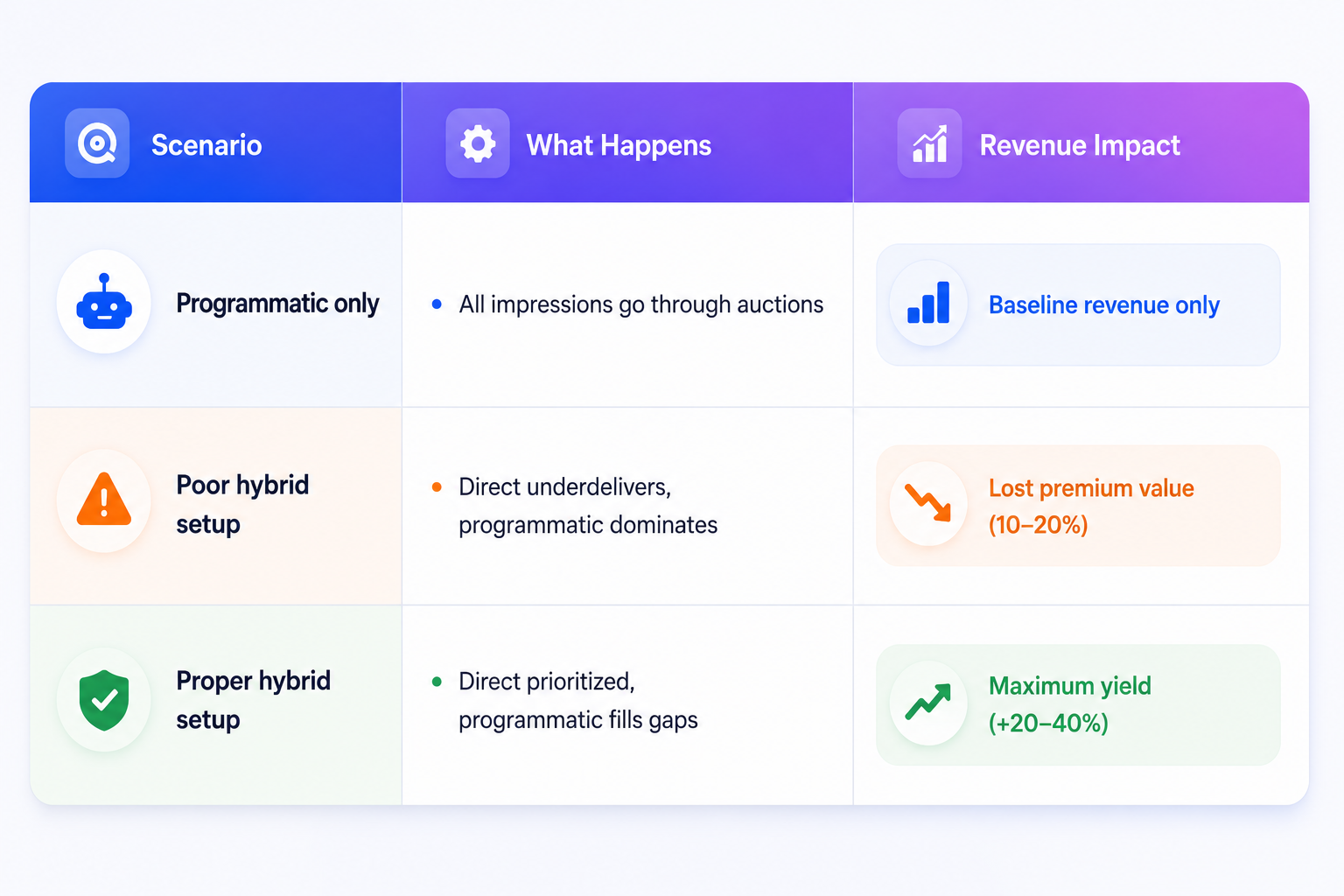
- Most teams lose 10–20% of potential revenue due to poor prioritization and fallback logic
- Hybrid monetization (direct + programmatic) can increase total yield by 20–40%
- Programmatic should act as a fallback layer, not the default
- AdButler enables precise control over how and when each demand type is used
The Problem Most Teams Run Into
At some point, every monetization team hits this moment:
“We want to run direct deals… but programmatic is already working. What happens if we mess it up?”
So they hesitate.
Or worse:
they keep everything programmatic
or they bolt on direct deals without structure
Both lead to the same outcome:
missed revenue and messy operations
The Biggest Misconception
Most teams think:
“If we prioritize direct deals, we’ll lose programmatic revenue.”
That’s only true if your setup is wrong.
The Reality
Direct and programmatic don’t compete—if orchestrated correctly, they amplify each other.
- Programmatic = liquidity + baseline revenue
- Direct deals = margin + upside
The problem isn’t choosing one.
It’s knowing how to run both at the same time.
Why This Is Hard (And Where It Breaks)
On paper, it sounds simple:
- sell direct when possible
- use programmatic for the rest
In practice, teams run into:
1. Priority Confusion
- Which campaigns should serve first?
- When should programmatic step in?
2. Revenue Cannibalization
- direct deals underdeliver
- programmatic eats premium inventory
3. Operational Complexity
- manual overrides
- broken pacing
- inconsistent reporting
This is where most hybrid setups fail, not because of demand, but because of orchestration.
The Core Principle: Priority + Fallback
If you understand one thing, it should be this:
Hybrid monetization = priority + fallback done correctly.
Step 1: Prioritize Direct Deals
Direct deals should take priority when:
- they’re higher value (CPM or total deal size)
- they’re guaranteed campaigns
- they involve strategic partnerships
Why?
Because this is where your highest-margin revenue lives.
Step 2: Use Programmatic as Fallback
When direct demand isn’t available:
- programmatic fills the impression
- ensures no inventory goes unsold
- maintains baseline revenue
Simple Model
Can this impression be sold direct?
→ YES → serve direct
→ NO → send to programmatic
What This Looks Like in Practice
What Actually Goes Wrong in Real Setups
1. Direct Deals Don’t Get Proper Priority
Teams:
- treat direct like just another campaign
- don’t enforce priority rules
Result:
- programmatic outserves premium placements
- high-value inventory is lost
2. Poor Pacing Breaks Everything
If direct deals aren’t paced correctly:
- they underdeliver
- you owe makegoods
- revenue becomes unpredictable
3. Programmatic Becomes the Default
This happens gradually:
- easier to manage
- always “on”
- less operational effort
But over time:
you train your system to rely on lower-margin revenue
4. Ad Ops Teams Compensate Manually
When orchestration breaks:
- teams step in manually
- workflows become fragile
- errors increase
At this point, you don’t have a monetization system; you have a workaround.
What High-Performing Teams Do Differently
They don’t treat direct and programmatic as separate systems.
They treat them as: a coordinated monetization strategy
Their Setup Looks Like This:
1. Direct Deals First
- sponsorships
- premium placements
- guaranteed campaigns
2. Programmatic as Safety Net
- fills unsold inventory
- ensures 100% utilization
3. Clear Priority Rules
- direct always wins when applicable
- fallback is automatic
4. Centralized Control Layer (This Is Key)
They use an ad server (like AdButler) to:
- define priority logic
- control delivery
- manage pacing
- unify reporting
This is what turns hybrid monetization from “messy” into scalable.
Where AdButler Fits
AdButler acts as the control layer between:
- your direct deals
- your programmatic demand
What That Enables
1. Precise Priority Control
- guarantee direct campaigns serve first
- protect premium inventory
2. Reliable Fallback Logic
- programmatic fills instantly when needed
- no revenue gaps
3. Proper Pacing + Delivery
- no underdelivery
- no manual intervention
4. Clean, Unified Reporting
- one source of truth
- no discrepancies between systems
Instead of choosing between direct and programmatic, you orchestrate both.
Real-World Outcome
Without structure:
- programmatic dominates
- direct deals struggle
- revenue plateaus
With proper orchestration:
- direct deals capture premium inventory
- programmatic fills efficiently
- total revenue increases
Most revenue gains don’t come from better demand—they come from better control.
Why This Matters More Now
The shift is already happening:
Which means:
programmatic alone is no longer enough to maximize revenue
The Bottom Line
If you rely only on programmatic: you’re optimizing revenue.
If you combine direct deals with proper orchestration: you’re maximizing it.
If You’re Trying to Make This Work
If you’re:
- introducing direct deals
- struggling with delivery conflicts
- trying to increase revenue without adding more ads
It’s worth talk to us about how AdButler gives you that control layer— without disrupting your existing stack.
FAQs
Do direct deals reduce programmatic revenue?
Not when implemented correctly. They increase total revenue by capturing higher-margin opportunities.
How do I prevent cannibalization?
By enforcing clear priority rules and using programmatic as fallback—not default.
What’s the biggest mistake teams make?
Treating direct and programmatic as separate systems instead of one coordinated strategy.
Do I need an ad server for this?
Yes—without one, managing priority, pacing, and fallback becomes manual and error-prone.
