
Unfair Truth: Most Retailers Don't Have a Retail Media Strategy. They Have Sponsored Products.
Key Takeaways
- Sponsored products are an advertising format; not a retail media strategy.
- The retailers building the most valuable media businesses monetize customer attention across the entire buying journey.
- Advertisers increasingly prioritize transparency measurement, and omnichannel activation; not simply more sponsored listings.
- The next competitive advantage in retail media isn't another ad format; it's scalable infrastructure.
- AdButler helps retailers, publishers, marketplaces, and commerce businesses build media businesses instead of simply serving ads.
Here's an uncomfortable truth. Launching sponsored products doesn't mean you've built a retail media network.
It means you've launched one advertising format. Somewhere along the way, our industry started confusing ad formats with business models.
Sponsored products help brands promote products. A retail media strategy creates an entirely new revenue business. Yet they're often spoken about as if they're interchangeable.
A retailer launches sponsored listings, updates the website, announces a retail media network—and suddenly believes it's competing with Amazon Ads or Walmart Connect.
Because advertisers have already moved beyond asking: "Can I sponsor a product?"
Increasingly, they're asking: "How can I reach your customers throughout their buying journey?"
That's a much bigger question. And it requires a much bigger strategy.
The Industry Is Solving the Wrong Problem
One pattern we consistently see is organizations spending months evaluating sponsored product solutions.
Far fewer step back and ask a more strategic question: What kind of media business are we actually trying to build?
According to EMARKETER, U.S. retail media ad spend is projected to reach $69.33 billion in 2026, up from $58.79 billion in 2025, as brands continue shifting budgets toward media powered by first-party data and measurable commerce outcomes.
The market is growing. Advertiser expectations are growing even faster.
The competitive advantage is no longer offering sponsored products. It's offering something advertisers can't easily find elsewhere.
Advertisers Aren't Buying Placements. They're Buying Access to Customers.
This is where the conversation needs to change. Retail media discussions still revolve around inventory, homepage takeovers, category sponsorships, search placements, display ads and product detail pages.
But advertisers rarely think that way. They're buying influence, discovery, consideration, conversion, and loyalty.
The placement is simply how those outcomes are delivered.
The real product isn't a banner or a sponsored listing. It's access to audiences with genuine purchase intent.
That's what makes retail media so valuable.
Retailers possess assets few advertising platforms can replicate:
- First-party customer relationships
- Purchase behaviour
- Loyalty data
- Shopping intent
- Closed-loop measurement
Those assets become exponentially more valuable when they can be activated across multiple customer touchpoints not only through search.
The Retail Media Maturity Curve
At AdButler, we often think about retail media as a progression rather than a destination.
We call it the Retail Media Maturity Curve.
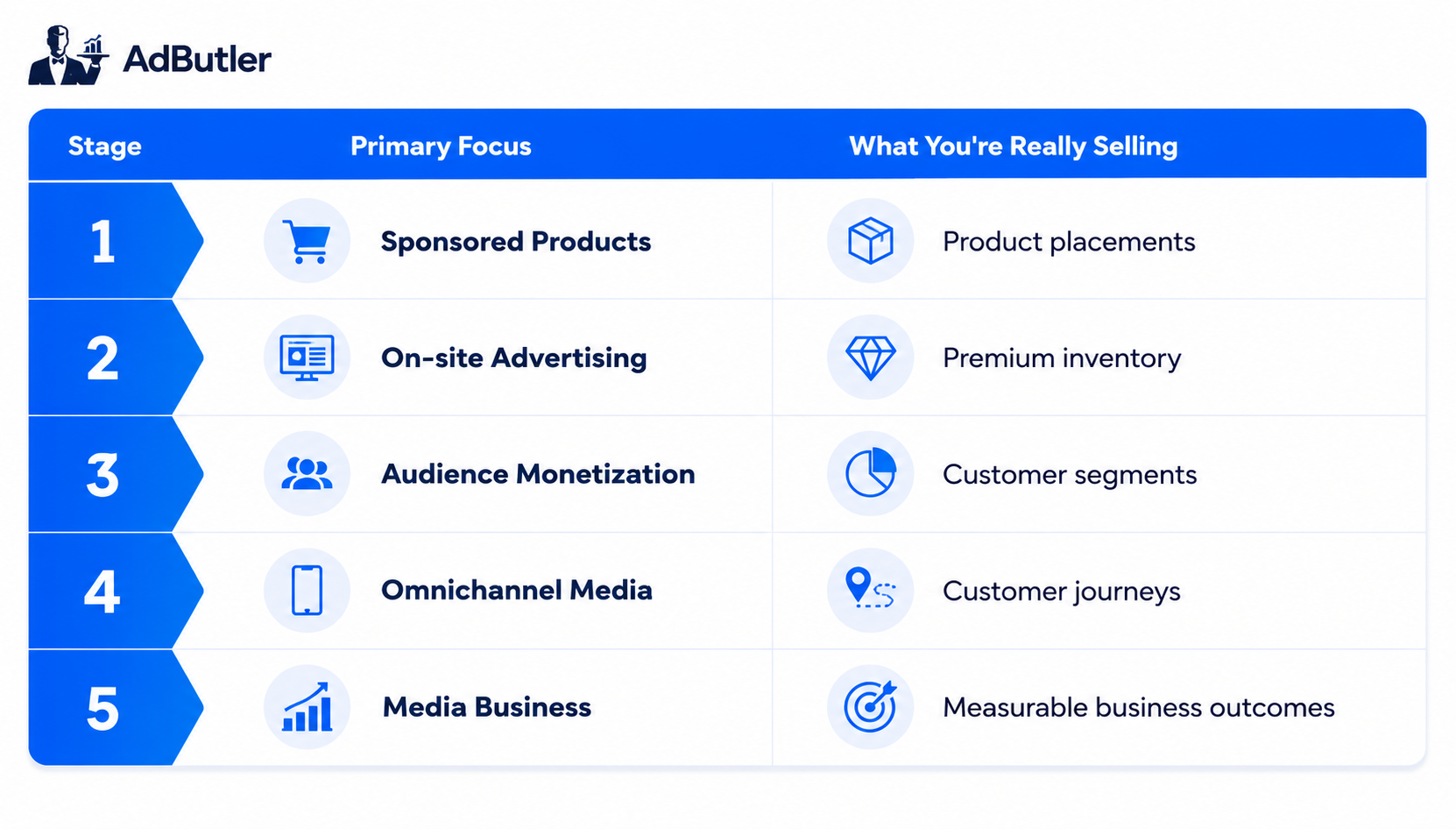
Notice something, sponsored products sit at the very beginning.
Every stage increases the value you create for advertisers. You move from selling visibility...
...to selling audiences ...then customer journeys ...and ultimately measurable business outcomes.
That's the difference between launching an advertising feature and building a media business.
Advertisers Have Already Moved Beyond Sponsored Products
The data supports this shift.
According to the IAB Europe Attitudes to Retail Media Report 2025, 82% of buyers prioritize transparency, 76% prioritize performance, and 75% value measurement capabilities when evaluating retail media partners.
Even more telling, the proportion of brands working with four to six retail media networks more than doubled—from 10% in 2024 to 24% in 2025—showing that advertisers are diversifying their retail media investments instead of relying on a single network.
That tells us something important. Advertisers aren't looking for another sponsored listing. They're looking for trusted media partners.
Partners that offer:
- Better reporting.
- Better measurement.
- Better audience activation.
- Better operational experiences.
- Better business outcomes.
Sponsored products get you into the conversation. Everything else determines whether advertisers keep investing.
Retail Media Stops Being a Merchandising Problem
Every successful retail media business eventually reaches the same point.
- Growth creates complexity.
- Campaign approvals slow down.
- Inventory becomes fragmented.
- Different teams manage different channels.
- Advertisers want self-service.
- Sales teams want flexibility.
- Leadership wants better reporting.
At that point, retail media stops being a merchandising initiative. It becomes an infrastructure challenge.
That shift is already visible across the industry.
53% of industry stakeholders identify the lack of standardization across retail media networks as one of the biggest barriers to growth, while 51% point to network fragmentation.
Those are operational problems. And they're exactly the kind of problems infrastructure is designed to solve.
Infrastructure Is Becoming the Competitive Advantage
Here's where the conversation gets interesting. Retail media becomes more difficult because success creates complexity.
More advertisers. More suppliers. More inventory. More campaign types. More teams. More channels.
Eventually, every retail media business reaches the same inflection point.
It stops asking:
"How do we launch sponsored products?"
And starts asking:
"How do we scale everything around them?"
- Can campaigns launch in hours instead of weeks?
- Can advertisers access inventory without creating operational bottlenecks?
- Can sales teams package inventory differently for different brands?
- Can reporting be generated without pulling data from five different systems?
- Can governance scale as more internal teams become involved?
Those questions have infrastructure answers.
Inconsistent standards and network fragmentation remain among the biggest barriers to retail media maturity, reinforcing that operational scalability—not advertiser demand—is becoming the industry's next challenge.
That's why we believe the next generation of retail media leaders won't necessarily be the companies with the most inventory. They'll be the companies with the best operating model.
Retail Media Thinking Doesn't Stop at Retail
Another unfair truth. Retail media isn't really about retail anymore. It's about organizations that own valuable audiences.
Retailers simply proved the model first. We're now seeing the same approach adopted across industries.
Travel companies are building travel media networks around booking intent. Marketplaces are monetizing buyer and seller activity.
Publishers are combining content with commerce. Financial institutions are exploring commerce media opportunities based on transaction data.
Membership organizations are creating premium sponsorship environments around trusted communities.
Different industries. Same playbook. Own the audience. Monetize attention responsibly. Measure outcomes.
Whether you're a publisher, marketplace, travel company, financial institution, or membership organization, the opportunity isn't simply to optimize existing advertising revenue—it's to package your audience, inventory, and first-party data into higher-value advertising products.
Retail media has simply given the industry a blueprint. That's why terms like commerce media and owned media networks are becoming increasingly common—they describe a strategy that's no longer limited to traditional retail.
At AdButler, we've seen this firsthand.
The organizations asking the most interesting questions today aren't always retailers. They're airlines, publishers, marketplaces, financial platforms, and associations.
They're all asking the same question:
How do we turn our first-party audience into a sustainable advertising business?
Why AdButler Focuses on Infrastructure Instead of Features
This is where we believe the conversation needs to evolve.
Too many technology evaluations begin with one question:
"Does it support sponsored products?"
That's the wrong question. The better question is:
"Can it support the media business we want to become?"
Technology decisions shouldn't lock organizations into a single advertising format.
They should create flexibility. That's the philosophy behind AdButler.
Rather than focusing on one use case, AdButler provides the infrastructure to manage advertising across websites, mobile apps, email, newsletters, sponsored products, display, native, video, direct-sold campaigns, and emerging commerce media experiences.
That flexibility matters because media businesses evolve. Today's sponsored listing becomes tomorrow's self-service marketplace.
Today's homepage takeover becomes tomorrow's omnichannel campaign. Today's retailer becomes tomorrow's media owner.
The infrastructure should already be ready.
The Real Unfair Truth
Let's end where we began. Eventually, every retailer will offer sponsored products. Just as every publisher adopted programmatic. Just as every ecommerce business invested in search. Those capabilities become expected.
They stop being differentiators. The organizations that win won't be the ones with one more ad placement. They'll be the ones that build something much harder to copy.
A media business: one built on first-party audiences, operational excellence, flexible technology, transparent measurement, and the ability to evolve as advertisers evolve.
Because sponsored products are where retail media begins. They were never meant to be where it ends.
Ready to see what's possible? Talk to our team about building a scalable retail media ecosystem with AdButler.
FAQs
What is a retail media strategy?
A retail media strategy is a long-term approach to monetizing a retailer's owned audiences, digital properties, and first-party data through advertising. It extends beyond sponsored products to include display, native, video, email, mobile apps, audience targeting, reporting, and operational workflows.
Are sponsored products the same as retail media?
No. Sponsored products are one advertising format within a retail media strategy. A mature retail media business also monetizes other customer touchpoints, supports multiple campaign types, and provides advertisers with broader audience access and measurement capabilities.
Why are advertisers investing more in retail media?
Retail media combines high-intent audiences, first-party customer data, and closed-loop measurement, giving advertisers better visibility into campaign performance and commerce outcomes than many traditional digital channels.
Why is retail media infrastructure important?
As retail media businesses grow, they need technology that can manage more advertisers, inventory, channels, reporting, governance, and workflows. Infrastructure enables organizations to scale efficiently while delivering better advertiser experiences.
Can publishers use retail media principles?
Yes. Publishers can apply the same audience monetization principles by packaging premium inventory, first-party data, and direct advertiser relationships into higher-value advertising products, complementing existing programmatic revenue.
How does an ad server support a retail media strategy?
An ad server provides the infrastructure to manage advertising inventory, deliver campaigns, control targeting, centralize reporting, and support multiple advertising formats across owned digital properties. This gives organizations the flexibility to scale their media business as advertiser needs evolve.
