
Retail Media RFP Guide (2026): What to Include, Questions to Ask, and How to Evaluate Vendors
Key Takeaways
- A Retail Media RFP should evaluate long-term business capabilities, not just ad serving features.
- Modern Retail Media platforms should support Sponsored Products, Sponsored Search, Display, self-service, reporting, APIs, and governance.
- A structured vendor evaluation process helps retailers make objective technology decisions.
- Choosing scalable infrastructure today reduces costly migrations as your Retail Media Network grows.
- The strongest RFPs align technology requirements with business goals, supplier experience, and future monetization opportunities.
Planning a Retail Media RFP?
Launching a Retail Media Network is about far more than choosing an ad server.
The platform you select will influence how suppliers buy advertising, how campaigns are managed, how performance is measured, and how your retail media business grows over the next several years.
That is why a well-written Request for Proposal (RFP) is so important.
Rather than comparing vendors on feature lists alone, a Retail Media RFP should help your organization evaluate long-term scalability, operational efficiency, supplier experience, reporting, integrations, and future growth opportunities.
Whether you are launching your first Retail Media Network or replacing existing technology, this guide explains what to include in your RFP and the questions every retailer should ask before selecting a platform.
What Should Your Retail Media RFP Cover?
Before comparing vendors, make sure your RFP addresses the business, technical, and operational requirements that will determine the long-term success of your Retail Media Network
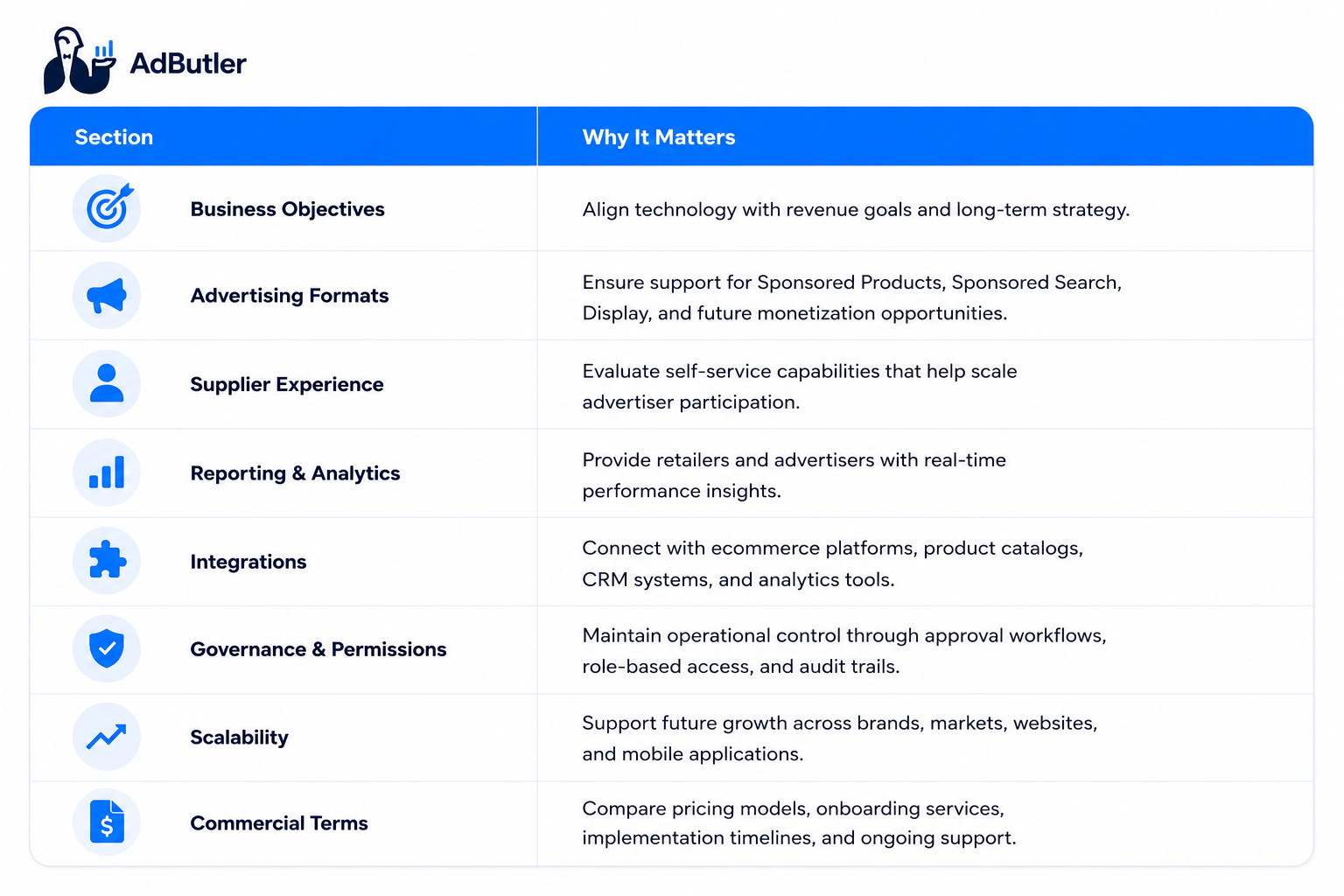
Think of this table as your RFP table of contents. It gives internal teams a clear framework for what the evaluation should cover before vendor conversations begin.
Why Retailers Issue Retail Media RFPs
Retailers typically issue an RFP when they want to:
- Launch a Retail Media Network
- Replace legacy advertising technology
- Expand supplier advertising programs
- Introduce supplier self-service
- Improve advertiser reporting
- Support multiple ecommerce brands or banners
- Monetize mobile applications
- Reduce operational workload
- Future-proof their advertising technology
An RFP provides a consistent framework that allows procurement, ecommerce, marketing, IT, and commercial teams to evaluate vendors against the same business objectives.
Without that structure, platform selection can become overly focused on individual features instead of the broader business model the retailer is trying to build.
Before Writing Your RFP
Before speaking with vendors, align internally on your goals.
A strong RFP starts with clarity around business objectives, advertising strategy, operational needs, and technical requirements.
Business Objectives
Ask questions such as:
- What revenue goals are we trying to achieve?
- Are we launching a new Retail Media Network or expanding an existing one?
- What advertising products do we want to offer?
- How quickly do we want to launch?
- Which teams will own the platform?
- What does success look like after 12 months?
Advertising Strategy
Consider whether your Retail Media Network should support:
- Sponsored Products
- Sponsored Search
- Display Advertising
- Homepage Sponsorships
- Product Detail Page Advertising
- Mobile App Advertising
- Email Advertising
- Brand Campaigns
- Off-site audience extension
Your first launch may not include every format, but your platform should be able to support future expansion.
Operational Requirements
Determine:
- Will campaigns be managed internally?
- Will suppliers launch campaigns themselves?
- Will you use a managed service, self-service, or hybrid model?
- Do approval workflows need to be built in?
- Which stakeholders require reporting access?
- Who will manage creative approvals?
- How will supplier conflicts be handled?
These questions help ensure the RFP reflects how your teams will actually use the platform after launch.
The 10 Most Important Platform Evaluation Categories
Every Retail Media platform will claim to offer a comprehensive solution.
These ten categories will help you compare vendors more effectively.
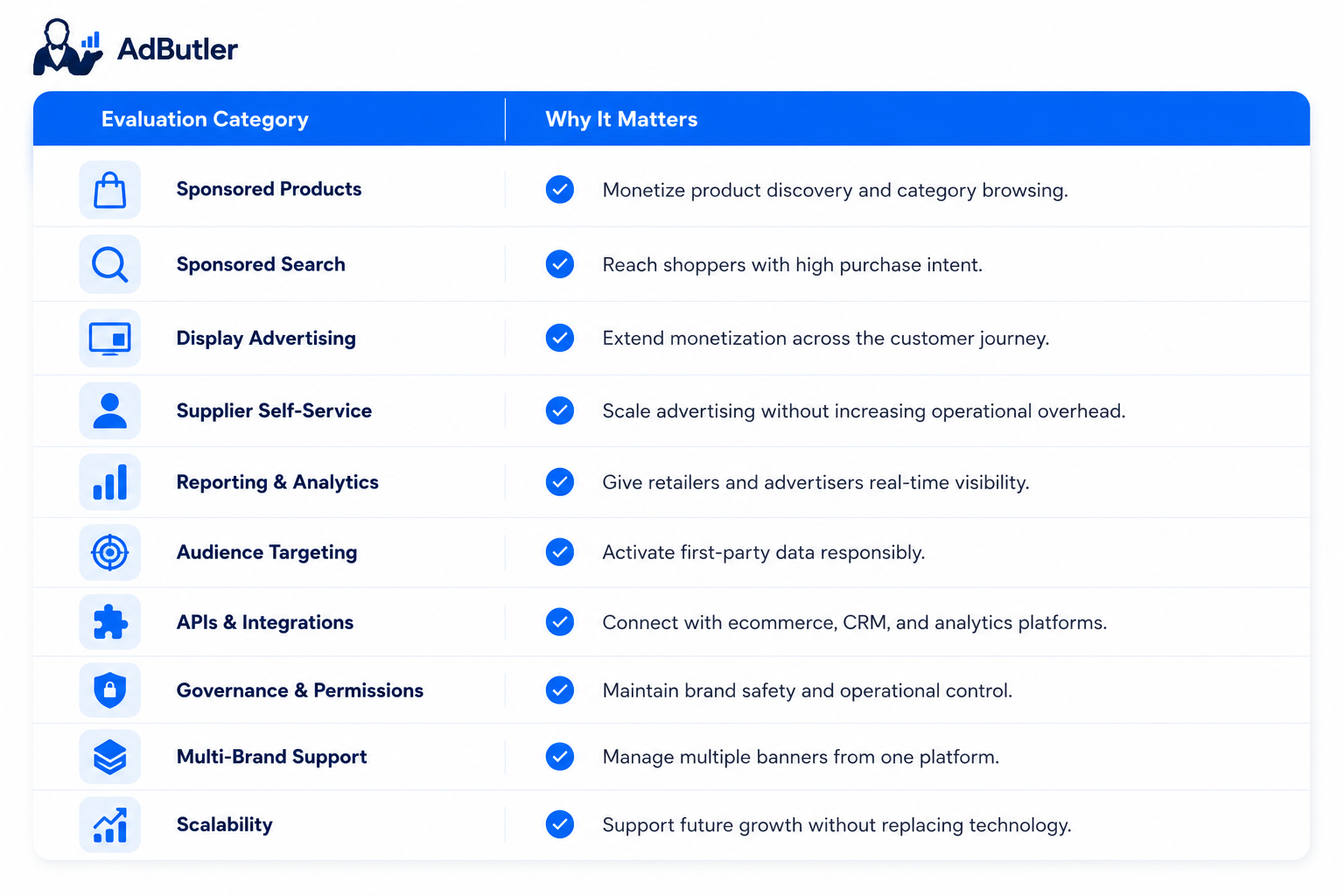
A strong Retail Media RFP should not simply ask whether these capabilities exist. It should ask how they work, how configurable they are, and how they support your long-term roadmap.
Retail Media Platform vs Traditional Ad Server
Not every ad server is designed for Retail Media.
While traditional ad servers focus primarily on campaign delivery, Retail Media platforms are designed to support supplier relationships, commerce data, and scalable monetization.
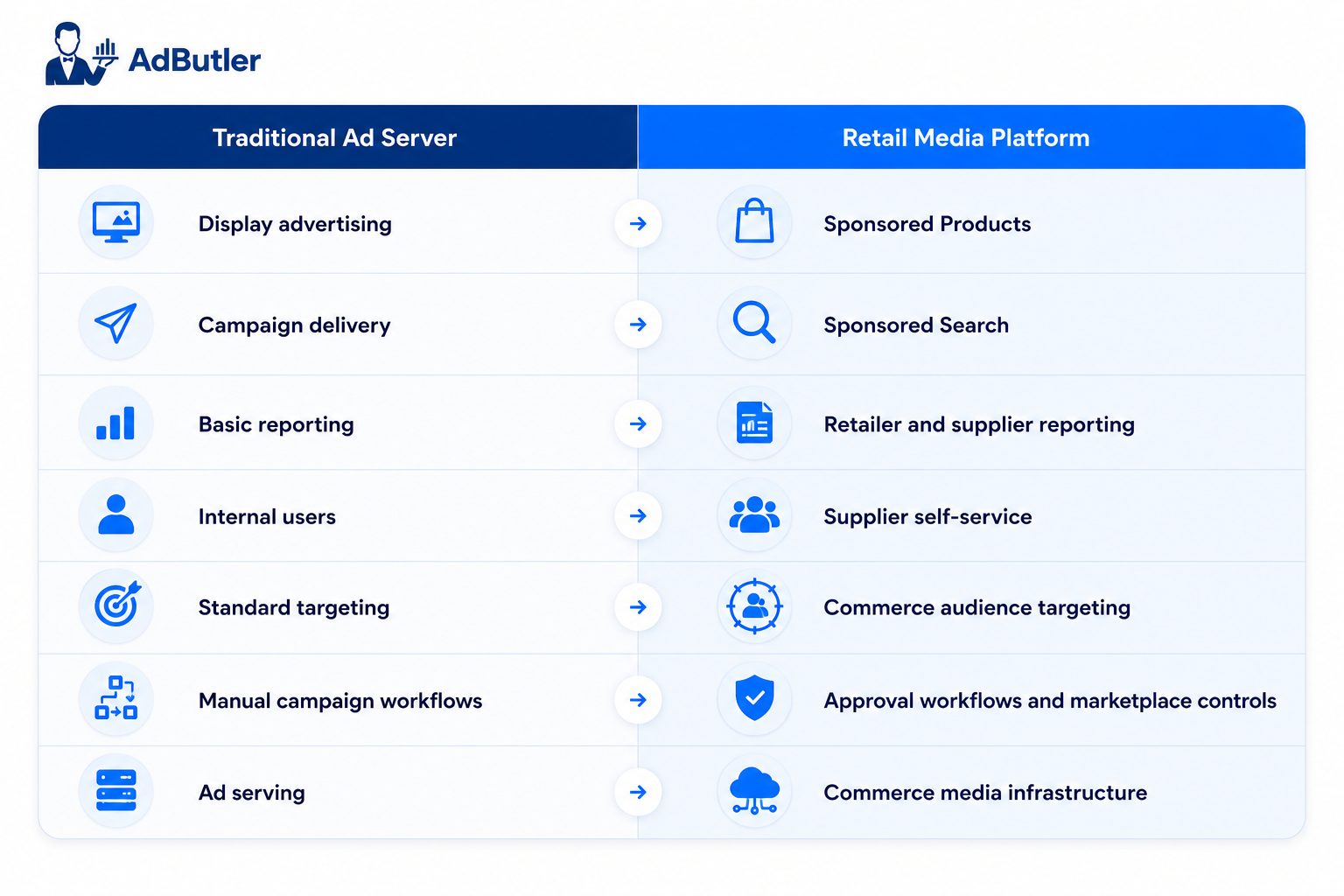
Understanding this distinction helps retailers avoid selecting technology that meets today’s advertising needs but limits future Retail Media growth.
A traditional ad server may be enough for basic display campaigns. But as supplier demand increases, retailers often need additional capabilities such as self-service access, sponsored listings, product catalog integrations, role-based permissions, and advertiser-facing reporting.
20 Essential Questions to Ask Retail Media Vendors
Use these questions during vendor demonstrations and proposal evaluations.
Platform
- Is your platform purpose-built for Retail Media?
- Can it support multiple ecommerce brands or banners from one platform?
- How quickly can implementation be completed?
- Can the platform scale as supplier participation grows?
Advertising Capabilities
- Does the platform support Sponsored Products?
- Does it support Sponsored Search?
- Can campaigns run across websites and mobile apps?
- Can the platform support display advertising across key retail placements?
- Can suppliers manage their own campaigns through a self-service portal?
Reporting
- Are reporting dashboards available in real time?
- Can advertisers access their own reporting?
- Can reports be customized, scheduled, and exported?
Integrations
- Does the platform integrate with our ecommerce platform?
- Are APIs available for future integrations?
- Can product catalogs synchronize automatically?
Governance
- Does the platform support approval workflows?
- Are role-based permissions available?
- Is single sign-on supported?
Commercial and Support
- How is pricing structured?
- What implementation, onboarding, and customer success resources are included?
These questions are not meant to replace your full procurement process. They are a starting point for identifying which vendors understand Retail Media as a business model, not just an advertising channel.
Common Retail Media RFP Mistakes
Even well-resourced teams can run into challenges when evaluating Retail Media technology.
Here are some of the most common mistakes to avoid.
Focusing only on current requirements
A platform that solves today’s campaign needs may not support tomorrow’s growth opportunities. Look for technology that can expand across formats, teams, suppliers, and channels.
Prioritizing features over business outcomes
Instead of only asking what a platform can do, ask how it helps increase supplier participation, improve efficiency, strengthen reporting, and grow advertising revenue.
Ignoring supplier experience
Supplier self-service has become a major driver of Retail Media scalability.
If advertisers cannot easily launch campaigns, access reporting, or manage budgets, program growth can slow.
Underestimating governance
Approval workflows, permissions, and audit trails become increasingly important as Retail Media operations expand.
Governance is especially important when multiple teams, suppliers, agencies, and banners are involved.
Treating Retail Media as a short-term project
Retail Media is an infrastructure decision.
The platform you choose should support your long-term monetization strategy, not just your first launch.
Planning Your Retail Media Strategy?
A thoughtful RFP helps your organization evaluate vendors based on long-term business value.
For more insight into how the market is evolving, explore our upcoming State of Retail Media in Canada Report.
The report examines the trends, opportunities, and challenges shaping the next phase of Retail Media growth.
Retailers that invest in scalable, flexible infrastructure today will be better positioned to expand into new advertising channels, onboard more suppliers, and unlock new monetization opportunities tomorrow.
Learn how you can stay ahead of the curve.
FAQs
Do all retailers need an RFP?
Not necessarily. Smaller organizations may evaluate platforms directly, while enterprise retailers often use RFPs to create procurement consistency and stakeholder alignment.
How many vendors should we evaluate?
Comparing three to five vendors is usually enough to make an informed decision without overcomplicating the selection process.
What capabilities matter most in a Retail Media platform?
Look beyond ad serving. Prioritize self-service, reporting, integrations, governance, first-party data activation, scalability, and support for multiple advertising formats.
Should our Retail Media platform support mobile apps?
Yes. As mobile commerce continues to grow, supporting both websites and mobile applications helps future-proof your Retail Media strategy.
Is Sponsored Products enough to build a Retail Media Network?
Sponsored Products are important, but they are only one part of a broader Retail Media strategy. Many retailers also need Sponsored Search, display, mobile, email, reporting, supplier access, and governance tools.
How long does implementation usually take?
Implementation timelines vary depending on integrations and organizational complexity. Many retailers adopt a phased rollout to begin generating revenue sooner while expanding capabilities over time.
