
What Platforms Power Retail Media Networks? (Complete 2026 Guide)
Key Takeaways
Retail media is growing fast, but many platforms limit data ownership, pricing control, and flexibility
The right platform should help you build a media business — not just plug into a network
Control, transparency, self-serve capabilities, and workflow flexibility are critical
AdButler is often used by retailers that want full ownership of their retail media strategy
Retail media is booming but the tech choices matter more than ever
Retail media is no longer a side initiative.
Retailers are becoming media companies. First-party data is becoming inventory. Ad placements are becoming products that can be packaged, priced, and sold.
Retailers building media businesses often start by evaluating the best ad servers for publishers.
But not all retail media platforms are built with that in mind.
Some are designed to help you monetize quickly within an existing network. Others are designed to help you build a long-term media business.
That distinction has long-term implications for control, margins, and scalability.
What is a retail media ad serving platform?
A retail media ad serving platform is a system that allows retailers to manage, deliver, and monetize advertising across their owned properties using first-party data.
At a basic level, it enables you to:
manage sponsored placements
sell advertising to brands
deliver ads across your site or app
track performance and revenue
But modern retail media goes further.
It requires control over data, the ability to manage advertiser relationships directly, and infrastructure that supports both manual and self-serve sales models.
In simple terms: it’s the system that turns your commerce environment into an advertising business.
What most retail media platforms get wrong
Before choosing a platform, it’s worth understanding where many fall short.
Limited control over data
For retailers, data is the asset.
Some platforms require you to operate within a network or share access to your data, which can limit visibility and long-term value creation. Over time, this reduces your ability to differentiate your offering.
If you don’t control your data, you don’t fully control your media business.
Revenue share complexity
Retail media is often positioned as a high-margin opportunity.
But that changes when revenue-share models, hidden fees, or unclear cost structures are introduced. These can make it difficult to forecast revenue and understand profitability as you scale.
Transparency becomes critical not just for cost, but for confidence in your growth model.
Rigid workflows
Retail media isn’t standardized.
Different retailers need different placements, campaign structures, and advertiser experiences. Platforms that enforce rigid workflows quickly become limiting, especially as your offering evolves.
This is where understanding how ad servers work with SSPs becomes important.
Flexibility is what allows you to grow beyond basic sponsorships.
Lack of self-serve capabilities
As demand grows, manual sales becomes a bottleneck.
Without self-serve capabilities, onboarding advertisers takes longer, operational overhead increases, and scaling becomes harder. Retail media programs that grow efficiently typically include a self-serve layer.
What to look for in a retail media platform
The right platform should support how your business operates today and how it will evolve.
Control over first-party data
You should be able to own, segment, and activate your data without relying on external systems. This is what enables targeted campaigns, better reporting, and long-term value creation.
Transparent pricing
You should clearly understand how revenue flows through the platform — what you pay, what you keep, and how margins evolve over time.
Transparency is strategic.
Flexible inventory and campaign management
Retailers need the ability to create custom placements, package inventory differently for different brands, and run both direct and programmatic campaigns within the same system.
This flexibility is what allows you to scale beyond standard ad formats.
Self-serve advertiser experience
Modern retail media increasingly relies on self-serve workflows.
Advertisers expect to:
browse available inventory
launch campaigns
manage budgets
track performance
Platforms that support this reduce operational overhead and increase revenue velocity.
Integration with your existing systems
Your ad platform should fit into your broader ecosystem, not replace it.
That includes integrations with ecommerce platforms, analytics tools, data systems, and programmatic demand sources.
Retail media doesn’t operate in isolation—it sits at the intersection of commerce, data, and advertising.
Retail media ad serving platforms to consider
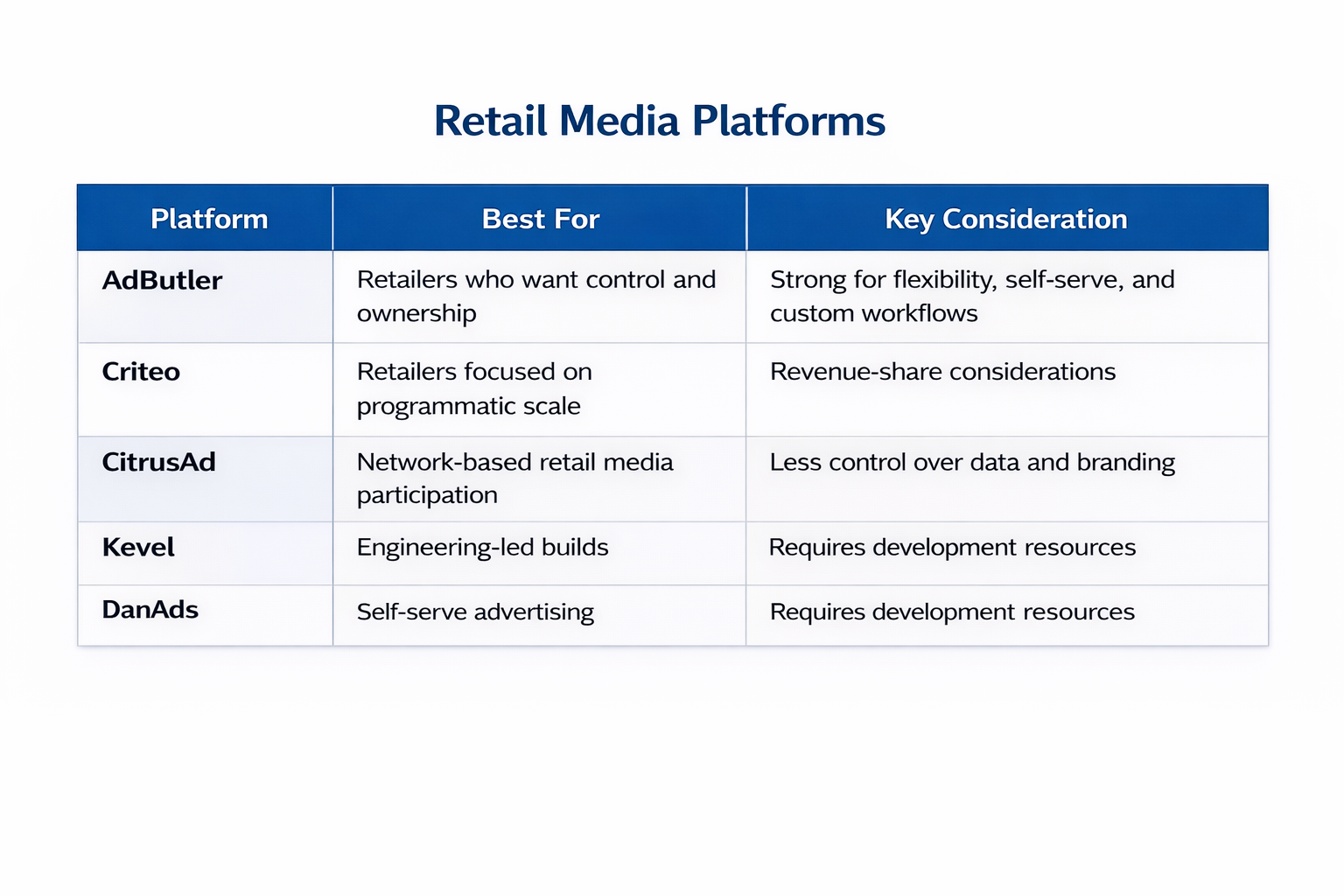
Here’s how some of the most common options compare.
Where AdButler fits
AdButler is typically used by retailers who want to build and control their own retail media business.
It allows teams to manage sponsored placements, define pricing, structure inventory, and integrate with programmatic demand — all while maintaining ownership of data and advertiser relationships.
It also supports self-serve advertiser workflows, which makes it easier to scale without increasing operational complexity.
Instead of plugging into an external network, you build your own ecosystem.
A simpler way to think about it
Some platforms help you participate in retail media.
That’s the real decision.
Final thought
Retail media isn’t just another revenue stream.
It’s a long-term business model built on data, relationships, and control.
The platform you choose will determine:
how much control you retain
how much revenue you keep
how easily you can scale
Choose accordingly.
Talk to us about your retail media strategy.
FAQs
What is a retail media ad platform?
A retail media ad platform allows retailers to sell advertising space on their digital properties, manage campaigns, and track performance using first-party data.
What is the best retail media ad platform?
It depends on your goals. Retailers focused on control, flexibility, and ownership often choose platforms like AdButler, while others may opt for network-based solutions.
Do I need self-serve capabilities for retail media?
In most cases, yes. Self-serve tools help scale advertiser onboarding, reduce manual work, and increase revenue efficiency.
Can AdButler support retail media?
Yes. AdButler supports sponsored placements, self-serve advertiser portals, and flexible workflows, making it well-suited for retail media operations.
What is the biggest mistake retailers make with retail media?
Relying too heavily on network-based platforms that limit control over data, pricing, and advertiser relationships.
