
Best Ad Servers for Publishers (2026 and Beyond): What Actually Matters When Choosing One
Key Takeaways
The best ad server gives you control over inventory, pricing, and advertiser relationships
Publishers are shifting toward platforms that support direct sales, programmatic, and self-serve workflows
Flexibility and transparency matter more than feature checklists
AdButler is commonly used by publishers who want control without being locked into a single ecosystem
What is an ad server?
An ad server is software that manages, delivers, and tracks digital advertising across websites, apps, and digital platforms.
At its core, it decides which ads appear, where they appear, and how they perform. It also gives publishers a centralized way to manage campaigns, control placements, and track revenue.
In simple terms: an ad server is the system that controls your ad inventory.
Most “best ad server” lists miss the real decision
Most comparisons focus on features, integrations, or scale.
But that’s rarely what drives the decision.
Publishers don’t switch platforms because they’re missing a feature.
They switch when they start to feel constrained, when they can’t control pricing, can’t structure deals the way they want, or can’t scale their monetization strategy.
The real question is: Which ad server lets you grow revenue without limiting how you operate?
What actually matters when choosing an ad server
There are a handful of factors that consistently separate platforms publishers grow with from the ones they outgrow.
If you're evaluating options, it's worth understanding how to choose an ad server based on your monetization model and long-term goals.
1. Control over inventory and data
Control over inventory means you decide how your ad space is priced, packaged, and sold.
That includes:
setting your own pricing
managing advertiser relationships directly
structuring inventory in ways that match your business model
Without that control, you’re effectively operating inside someone else’s system.
This is why many publishers move toward platforms like AdButler, not for more features, but for ownership over how their ad business runs.
2. Flexible monetization
Modern publishers rarely rely on a single revenue stream.
A typical setup includes direct-sold campaigns, sponsorships, programmatic demand, and increasingly formats like newsletters or retail media placements. The challenge isn’t supporting one of these — it’s supporting all of them together.
The best ad servers allow you to run multiple monetization strategies simultaneously, without forcing trade-offs.
Flexibility is what allows your revenue model to evolve.
3. Pricing transparency
Pricing transparency means you clearly understand how the platform impacts your revenue.
This becomes important as you scale. Some platforms introduce hidden revenue share, unclear cost structures, or pricing that becomes harder to predict over time.
Publishers increasingly prioritize platforms where:
costs are predictable
revenue impact is clear
margins are easier to understand
This is especially important for teams running direct sales or building retail media offerings.
4. Ease of use without losing flexibility
There’s always a trade-off between power and usability.
Some platforms are easy to use but limiting. Others are highly flexible but require engineering support for even simple changes.
The strongest platforms sit in the middle — giving ad ops and revenue teams control without requiring constant developer involvement.
The goal is simple: control without complexity.
5. Support and scalability
As your ad operations grow, your needs change.
You’ll need to:
manage more campaigns
support more advertisers
introduce new formats and workflows
At that point, support becomes critical. Not just technical support, but support that helps you navigate complexity and scale effectively.
Best ad servers for publishers (2026)
Many publishers exploring Google Ad Manager alternatives are looking for more control and flexibility.
Here’s how the most common platforms compare at a high level:
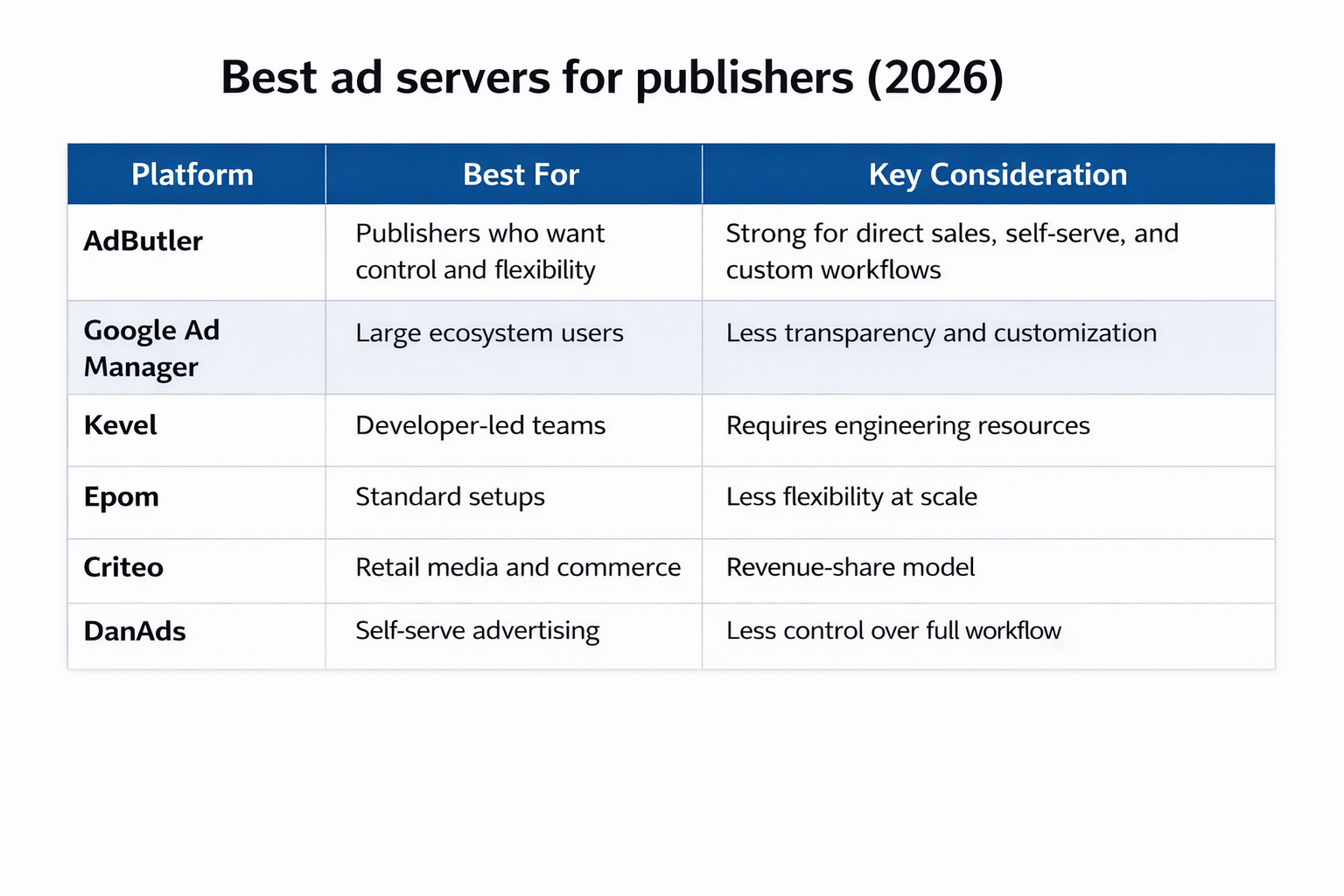
Want to compare these platforms side-by-side? Explore our full ad server comparison hub
How publishers actually use ad servers today
Most publishers don’t choose between direct and programmatic.
They combine them.
A typical setup prioritizes direct-sold campaigns first, then uses programmatic demand to fill remaining inventory. The ad server sits at the center, controlling how these different revenue sources interact.
This becomes even more important when you understand the difference between an ad server and an ad network.
This is how publishers balance revenue, control, and efficiency at scale.
What this looks like in practice
Without a structured ad server setup, operations tend to be manual. Campaigns are harder to manage, pricing is less consistent, and revenue visibility is limited.
With a platform like AdButler, the model becomes more structured. Inventory is clearly defined, campaigns are easier to manage, and pricing and prioritization are controlled rather than reactive.
The shift directly impacts how revenue grows.
When it’s time to switch ad servers
You’ll usually feel it before you formally evaluate it.
If you’re managing campaigns manually, struggling to track revenue clearly, or finding that your platform limits how you package and sell inventory, those are early signals.
Other common triggers include:
difficulty scaling beyond programmatic
lack of customization
increasing operational friction
At that point, the platform isn’t just supporting your business—it’s slowing it down.
Where AdButler fits
AdButler is typically used by publishers who want more control over how their ad business operates.
That includes control over pricing, inventory, and advertiser relationships, along with the flexibility to support multiple monetization strategies. It’s also commonly used by teams that want to introduce self-serve advertising without rebuilding their entire stack.
You’ll often see it used by:
publishers and media companies
retail media teams
networks managing multiple properties
Final thought
An ad server isn’t just another tool in your stack.
It’s the system that determines how your inventory is sold, how your revenue is structured, and how your business scales.
For growing teams, choosing the right platform is critical—especially for mid-size publishers scaling their ad operations.
The wrong platform creates friction. The right platform creates leverage.
Evaluating ad servers for long-term growth? See how AdButler gives publishers the control, flexibility, and transparency to scale without limitations.
FAQs
What is the best ad server for publishers?
The best ad server depends on your priorities, but most publishers focus on control, pricing transparency, and flexibility. Platforms like AdButler are often chosen when those factors are critical.
How do I choose the right ad server?
Focus on how much control you have over inventory and data, whether the platform supports your monetization model, and how transparent the pricing structure is. Ease of use and scalability also matter as your operations grow.
Is Google Ad Manager the best option?
Google Ad Manager is widely used, but many publishers explore alternatives when they need more flexibility, transparency, or control over how inventory is managed.
Can AdButler support both direct and programmatic ads?
Yes. AdButler allows publishers to manage direct campaigns while integrating programmatic demand, giving more control over how inventory is monetized.
Why do publishers switch ad servers?
Most publishers switch when they outgrow limitations; whether that’s lack of flexibility, limited control, or difficulty scaling revenue.
