
Best Google Ad Manager Alternatives (2026): What Publishers Are Actually Switching To
Key Takeaways
Many publishers look for Google Ad Manager alternatives due to limited control, pricing complexity, and lack of flexibility
The strongest alternatives offer transparent pricing, data ownership, and flexible monetization models
AdButler is commonly chosen by teams that want control without being tied to a single ecosystem
Most switches are driven by growth and evolving revenue strategies — not just dissatisfaction
Why publishers start looking for Google Ad Manager alternatives
Google Ad Manager (GAM) is often the default starting point for publishers.
It’s widely adopted, integrates easily, and works well for standard setups. But as operations grow, many teams start to experience the same friction points—not immediately, but over time.
That friction usually shows up as:
limited visibility into how revenue actually flows
difficulty adapting workflows to fit specific business models
increasing reliance on a broader ecosystem
operational complexity as campaigns and inventory scale
At that point, the question shifts.
It’s no longer:
“Can this platform serve ads?”
It becomes:
“Is this platform limiting how we grow revenue?”
If you're early in the process, it helps to understand how to choose an ad server before comparing platforms
What to look for in a Google Ad Manager alternative
Before evaluating platforms, it helps to clarify what actually matters.
1. Control over inventory and data
One of the most common reasons publishers move away from GAM is control.
They want to:
set pricing directly
own advertiser relationships
package inventory in more flexible ways
use first-party data strategically
When those capabilities are limited, it affects more than operations; it affects how the business grows.
This ties directly into the broader question of the best ad servers for publishers and what actually drives long-term growth.
Control over inventory is foundational to revenue strategy.
2. Transparent pricing
Pricing often becomes a bigger concern as publishers scale.
What starts simple can become harder to track over time, especially when revenue share or indirect costs are involved.
Publishers increasingly prioritize platforms where:
pricing is predictable
costs are clearly defined
revenue impact is easy to understand
This is particularly important for teams focused on direct sales, retail media, or long-term revenue planning.
3. Flexibility in monetization
Modern publishers rarely rely on a single revenue stream.
They need to support a mix of:
direct-sold campaigns
sponsorships
programmatic demand
self-serve advertising
retail media initiatives
The challenge is supporting all of them together, without creating operational friction.
4. Ease of use without sacrificing flexibility
Many alternatives fall into one of two categories.
Some are simple to use but limit what you can do. Others are highly flexible but require engineering resources to operate effectively.
The best platforms strike a balance, giving teams the ability to manage campaigns, customize workflows, and scale operations without constant developer involvement.
Usability and flexibility should work together, not against each other.
Best Google Ad Manager alternatives (2026)
Here’s how the most commonly considered platforms compare:
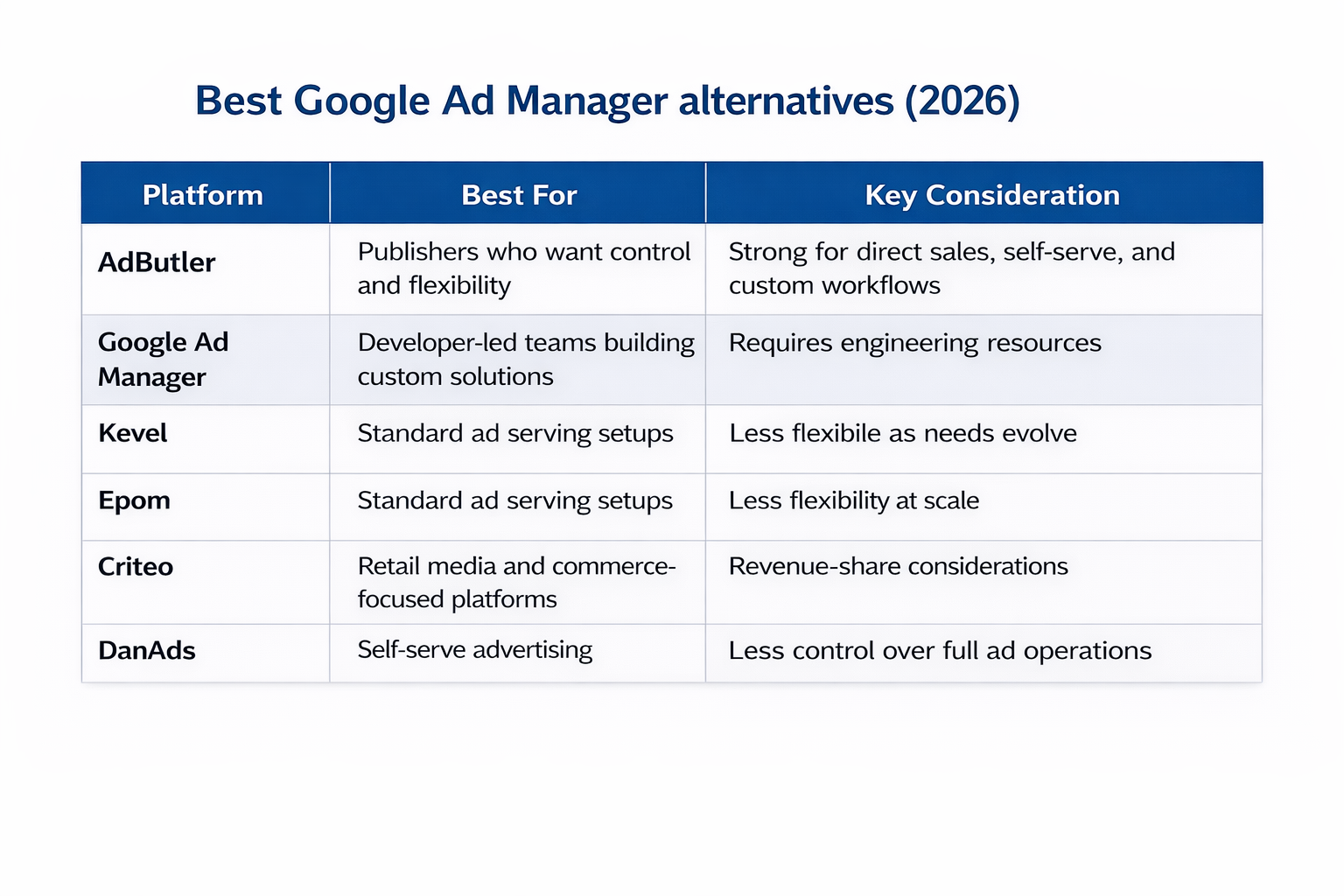
See how AdButler compares to Google Ad Manager and other alternatives
Where AdButler stands out
AdButler is designed for publishers who want to manage their ad business directly, without relying on a broader ecosystem.
It supports a wide range of use cases — from direct campaigns to self-serve advertising — while maintaining flexibility in how inventory is structured and sold.
What typically stands out to teams evaluating alternatives is the combination of:
control over inventory and advertiser relationships
flexibility across multiple monetization models
transparent, predictable pricing
support that scales with operational complexity
As a result, it’s commonly used by:
publishers and media companies
retail media teams
SaaS and marketplace platforms
networks managing multiple properties
Why publishers switch from Google Ad Manager to AdButler
Across different industries, the reasons tend to be consistent.
The shift is usually less about replacing functionality and more about removing limitations.
More control over revenue
Publishers want to define how inventory is priced and sold, rather than relying on predefined structures. This becomes especially important as direct sales increase and advertiser relationships become more strategic.
Less reliance on a single ecosystem
GAM works best within Google’s ecosystem. For some teams, that’s an advantage. For others, it becomes restrictive.
Moving to a more independent platform allows for greater flexibility in how inventory, data, and demand sources are managed.
It’s also worth understanding the difference between an ad server and an SSP when evaluating alternatives.
Better support for evolving revenue models
As publishers expand into areas like retail media or self-serve advertising, they need platforms that can support those models without requiring a complete rebuild.
AdButler is often chosen because it supports direct, programmatic, and self-serve workflows within the same system.
Greater pricing clarity
As operations scale, predictability becomes more important than simplicity.
Teams want to understand margins, forecast revenue accurately, and avoid unexpected costs. Transparent pricing plays a key role in that.
When Google Ad Manager still makes sense
GAM can still be a good fit in certain scenarios.
For example, if your business is closely aligned with Google’s ecosystem, or if your setup is relatively standard and doesn’t require much customization, it may continue to meet your needs.
For some publishers, that’s enough.
For others, those same characteristics become limitations as they grow.
Final thought
Most publishers don’t actively look to replace their ad server.
They switch when they start to feel constrained; when flexibility becomes limited, when pricing becomes harder to understand, or when their revenue model evolves beyond what their current platform can support.
If you’re evaluating alternatives, it’s usually a sign that your business has outgrown your current setup.
Considering a move beyond Google Ad Manager? See how AdButler gives publishers more control, flexibility, and transparency—without being tied to a single ecosystem
FAQs
What is the best alternative to Google Ad Manager?
The best alternative depends on your priorities, but most publishers look for platforms that offer greater control over inventory, transparent pricing, and flexibility in monetization. AdButler is often considered in these cases.
Why do publishers move away from Google Ad Manager?
Common reasons include limited customization, lack of pricing transparency, reliance on a broader ecosystem, and the need for more control over direct sales and revenue strategy.
Is AdButler a good Google Ad Manager alternative?
Yes. AdButler is commonly used by publishers who want more control, more flexibility, and better support for direct and self-serve advertising models.
Can I run programmatic ads without Google Ad Manager?
Yes. Many ad servers, including AdButler, support integrations with programmatic demand sources, allowing publishers to run both direct and programmatic campaigns.
Is it difficult to switch from Google Ad Manager?
Switching requires planning, but many publishers successfully transition when their current platform no longer supports their growth or operational needs.
