
Ad Serving Platforms for Mid-Size Publishers (What Actually Scales)
Key Takeaways
Mid-size publishers outgrow basic ad setups but don’t need overly complex enterprise infrastructure
The right platform balances control, flexibility, and ease of use
Many solutions either require heavy engineering or limit customization — both create friction
AdButler is often used by mid-size publishers who want scalable ad operations without losing control
This is where things get tricky for mid-size publishers
Mid-size publishers sit in a unique—and often underserved—position.
You’ve likely moved beyond basic monetization. You’re running direct campaigns, building advertiser relationships, and expanding your inventory.
But you’re not operating like a large enterprise with a dedicated engineering team. And you’re not relying solely on programmatic demand either.
That creates a gap.
Most ad platforms are built for one extreme or the other—not for the middle.
The problem with most ad serving platforms
Mid-size publishers typically run into the same two issues.
On one side, there are platforms that are easy to adopt but quickly become limiting. They lack customization, restrict how inventory is packaged and priced, and make it difficult to scale beyond simple setups.
On the other side, there are platforms built for enterprise use. These offer flexibility, but often require engineering resources, longer implementation timelines, and ongoing maintenance.
Neither is ideal.
The real challenge is finding a platform that gives you control—without introducing unnecessary complexity.
Many teams in this stage start by reviewing the best ad servers for publishers.
What mid-size publishers actually need
At this stage, your needs are more strategic than technical.
Control without complexity
You need the ability to manage inventory, set pricing, and prioritize campaigns — but without building a custom ad stack or relying on developers for day-to-day operations.
Control should enable growth, not slow it down.
Support for multiple revenue streams
Most mid-size publishers are no longer relying on a single monetization model.
You’re likely combining direct-sold campaigns, sponsorships, programmatic demand, and potentially newer channels like newsletters or retail media.
Your ad server needs to support all of these together—not force you to choose between them.
Scalability without replatforming
Switching ad servers is disruptive.
At this stage, you need a platform that can grow with you; supporting more inventory, more advertisers, and new formats without requiring another migration in 12–18 months.
Operational efficiency
Mid-size teams are usually lean.
That means your platform should reduce manual work, simplify campaign management, and make reporting easy to access and understand.
Efficiency becomes a growth lever, not just a convenience.
Advertiser-friendly workflows
As your business grows, advertiser expectations change.
Brands expect faster turnaround, clearer inventory visibility, and easier ways to book campaigns. This is where self-serve capabilities start to matter.
Making it easier to buy often has a direct impact on revenue.
Best ad serving platforms for mid-size publishers (2026)
Choosing the right platform often comes down to how to choose an ad server for long-term scalability.
Here’s how the most common options compare.
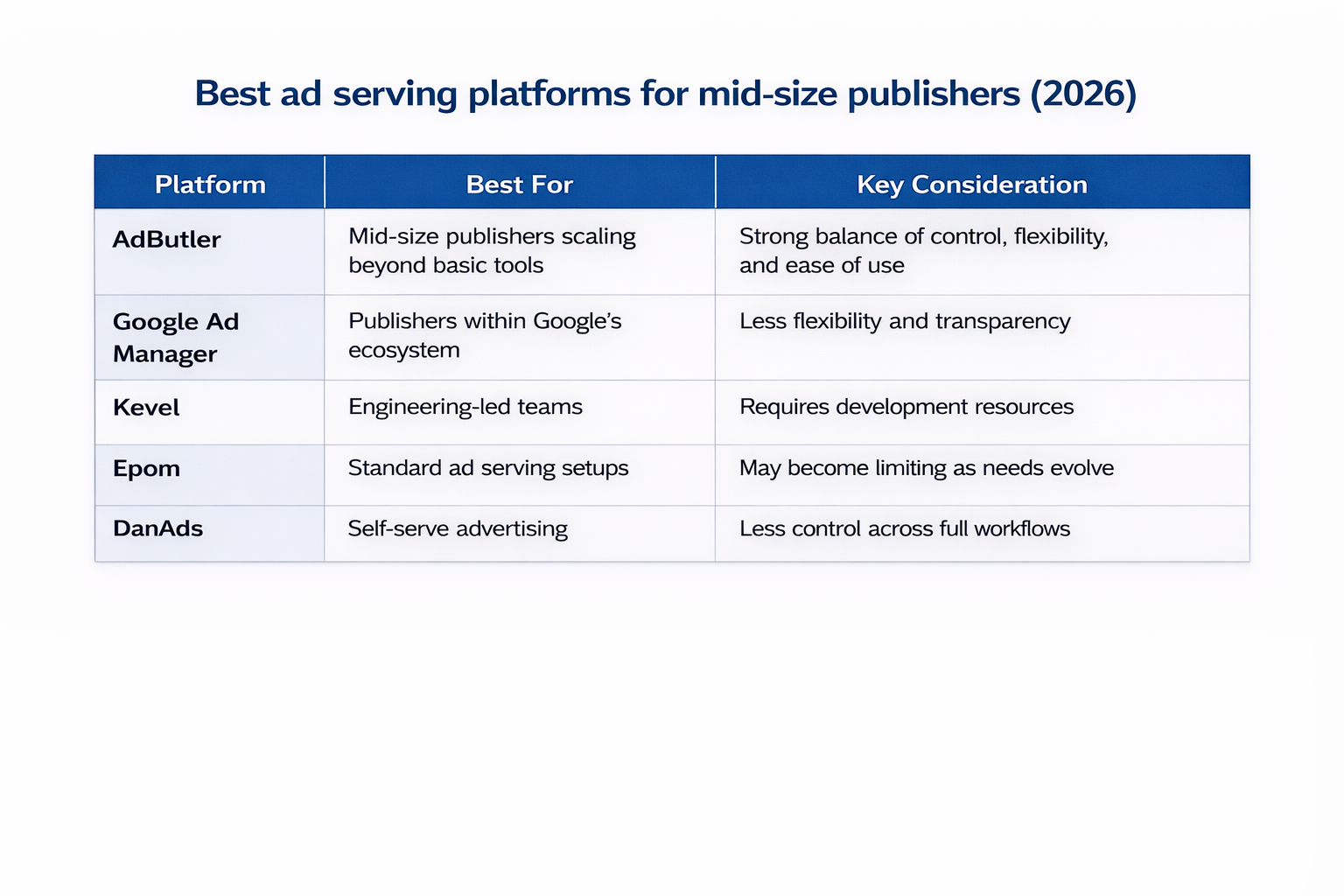
See how AdButler compares to other platforms for growing publishers
Where AdButler fits best
AdButler is designed for publishers who have outgrown entry-level tools but don’t want the overhead of enterprise infrastructure.
It allows teams to manage direct and programmatic campaigns within a single system, structure inventory more strategically, and introduce self-serve workflows without adding operational complexity.
What stands out is the balance—control where it matters, flexibility where it’s needed, and usability that doesn’t depend on engineering resources.
It’s commonly used by:
content publishers
media networks
SaaS platforms introducing monetization
retail and marketplace businesses
What this looks like in practice
The shift from a basic setup to a structured ad operation is usually gradual but meaningful.
Without the right platform, publishers often rely heavily on programmatic demand, manage campaigns manually, and have limited visibility into revenue performance.
With a platform like AdButler, inventory becomes structured, campaigns are easier to manage, and different revenue streams can be balanced more effectively.
That transition is what enables consistent growth.
When it’s time to upgrade your ad server
You’ll usually feel the limitations before you formally identify them.
If you’re managing multiple campaigns manually, struggling to track revenue clearly, or finding that your platform limits how you sell and package inventory, those are strong signals.
These challenges are similar to what publishers face when evaluating Google Ad Manager alternatives.
At that point, the issue isn’t capability—it’s scalability.
Final thought
Mid-size publishers don’t need the simplest solution.
And they don’t need the most complex one either.
They need the right balance; control over their business, flexibility in how they operate, and the ability to scale without constantly rebuilding their infrastructure.
That’s what turns a growing publisher into a scalable media business.
Outgrowing your current ad server? See how AdButler helps mid-size publishers scale ad operations without added complexity.
FAQs
What is the best ad server for mid-size publishers?
The best option balances flexibility, control, ease of use, and scalability. AdButler is often chosen by publishers who want to grow without adding engineering complexity.
Do mid-size publishers need enterprise ad servers?
Not always. Many enterprise platforms introduce unnecessary complexity. Mid-size publishers often benefit more from flexible platforms that scale with their needs.
Can AdButler scale with a growing publisher?
Yes. AdButler is designed to support increasing inventory, advertisers, and revenue streams without requiring a platform switch.
Does AdButler support both direct and programmatic ads?
Yes. AdButler allows publishers to manage direct campaigns while integrating programmatic demand sources.
Is self-serve advertising important for mid-size publishers?
In most cases, yes. It reduces operational overhead and makes it easier to scale advertiser relationships and revenue.
