
Key Features to Look for in an Ad Server
Key Takeaways
The right ad server is about control. The best platforms give you the tools to manage revenue, data, and growth on your terms.
Transparent pricing matters more as you scale:
Revenue share models get expensive over time
SaaS pricing helps you keep 100% of your earnings and forecast costs
Data ownership is now a competitive advantage:
First-party data is critical in a privacy-first world
Publishers need full visibility and control over their analytics
Targeting capabilities directly impact revenue:
Contextual targeting is replacing cookie-based methods
Better relevance can drive 10–30% higher CPMs
Diversified demand = stronger monetization:
Combining direct and programmatic demand maximizes yield
Unified workflows simplify operations
APIs and customization unlock long-term growth:
Essential for retail media, native ads, and custom formats
Future-proofs your monetization strategy
Forecasting tools protect both revenue and relationships:
Prevent overbooking and underdelivery
Improve campaign planning accuracy
Speed is revenue-critical:
Faster ad delivery increases viewability and performance
Poor performance directly reduces earnings
Ease of use and support reduce operational costs:
Clean workflows save time
Strong support accelerates onboarding and optimization
Creative testing drives continuous improvement:
A/B testing and rotation improve performance over time
Supports sustainable revenue growth
Choosing an ad server can feel overwhelming. There are dozens of options, and every platform claims to drive better revenue and performance. But in reality, the right ad server simply gives you the tools to control how you monetize and scale.
This guide breaks down the essential features every publisher should look for when evaluating an ad server today, especially as we move into a privacy-first, multi-channel world.
Transparent Pricing (Not Revenue Share Surprises)
Revenue share models seem convenient — until your traffic grows.
If an ad server skims 10–20% of revenue, costs rise right alongside your success.
Look for:
Flat SaaS pricing or impression-based tiers
No take-rate or hidden fees
Easy cost forecasting as traffic scales
Why it matters: You keep 100% of the revenue you earn.
Full Data Ownership & Privacy Control
Data has become a core business asset. You shouldn’t have to give it away to run ads.
Look for:
Full exportable logs and analytics
Consent management and privacy compliance
Cookieless + first-party audience activation
Why it matters: Control your data → control your future revenue.
Targeting & Relevance Controls (Revenue Booster)
Better targeting = better performance. Full stop.
The ad server you choose should help ensure the right ads reach the right audience at the right moment — without relying on third-party cookies.
Look for:
Geo, device, and placement targeting
Contextual/content matching
Frequency capping & rotation to reduce banner fatigue
First-party data support
Publishers using contextual rules often see 10–30% higher CPMs — because relevance earns more.
Support for Direct + Programmatic Demand
Your revenue shouldn’t depend on a single source.
Look for:
Unified workflows for direct deals + programmatic
Flexible priority rules for different demand paths
Why it matters: You maximize revenue when all channels work together.
API Flexibility & Custom Integrations
APIs unlock custom monetization strategies — retail media, native placements, sponsored listings, OTT, and more.
Look for:
REST APIs + SDK options
White-label UI & reporting
Ability to integrate with your existing stack
Why it matters: Your business evolves → your ad server should too.
Accurate Forecasting & Inventory Insight
Forecasting protects your revenue — and your credibility.
Look for:
Real-time availability forecasting
Delivery pacing controls
Inventory insights by device, geo, format
Why it matters: Avoid overselling inventory and under-delivering on commitments.
Speed + Delivery Performance
Slow ads = lost impressions = lost money.
Look for:
Sub-200ms load times
CDN-backed global delivery
Built-in uptime monitoring
Why it matters: Faster delivery → higher revenue per impression.
Team-Friendly Workflows & Support
You shouldn’t need a PhD in ad ops to run ads.
Look for:
Clean campaign setup
Intuitive reporting dashboards
Human onboarding + ongoing support
Why it matters: Less time managing campaigns → more time selling them.
Creative Tools & Testing
The ability to test + iterate is a growth multiplier.
Look for:
Ad rotation based on performance
Support for display, video, native, & email
A/B testing baked in
Why it matters: Optimization = sustainable, compounding revenue.
Feature Comparison Checklist
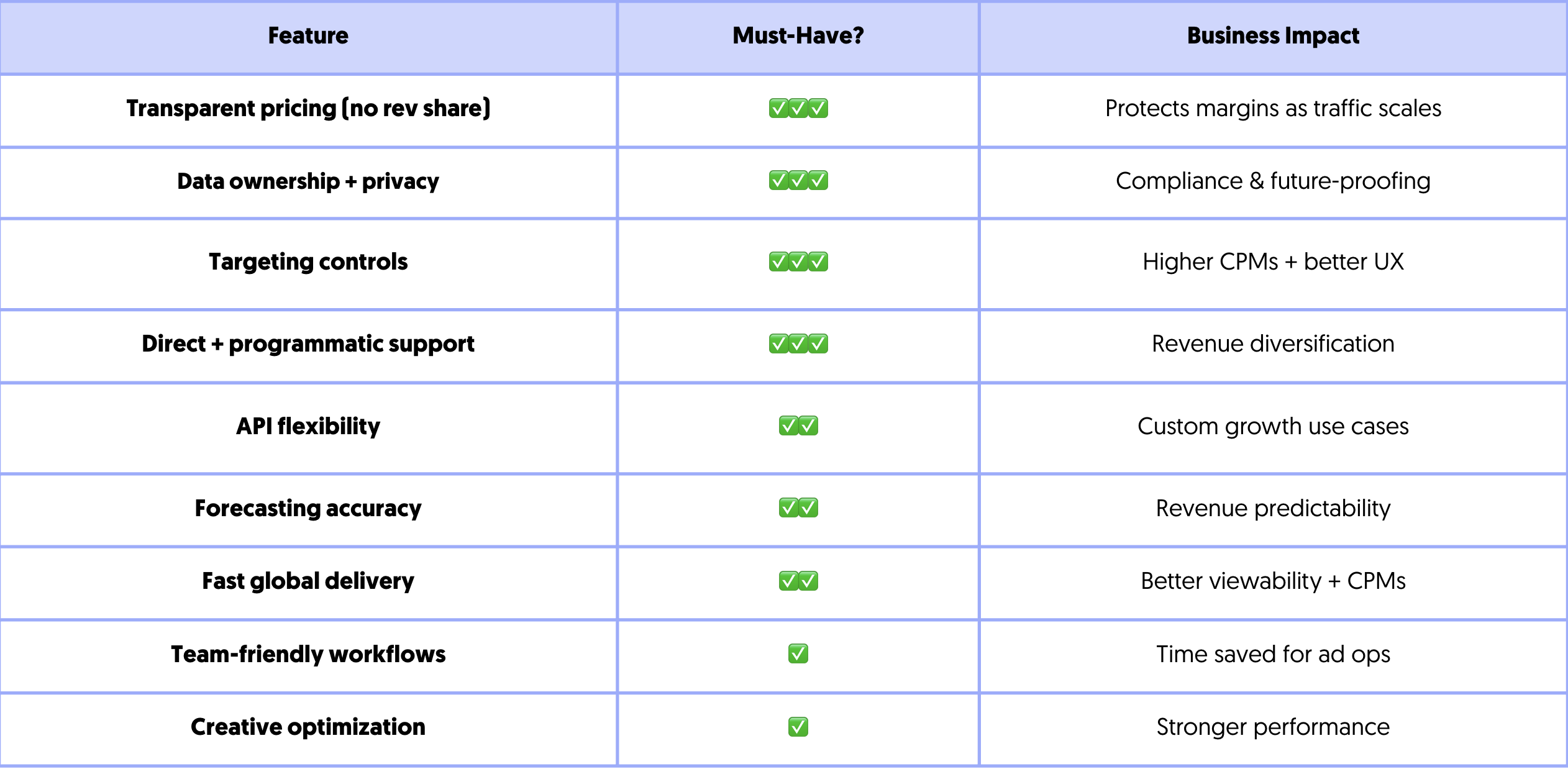
If a platform struggles on the first four, it's likely to cap your growth.
Final Takeaway
Don’t just choose the ad server everyone else uses. Choose the one that:
- Gives you control over your revenue
- Protects and activates your audience data
- Adapts to your business — not the other way around
- Helps you scale without unnecessary complexity
These are the reasons more publishers in 2025 are choosing independent, API-first ad servers built for control and flexibility.
When you control the tech, you control the results.
To learn more about our ad serving solutions, get in touch with our team today.
FAQs
What is the most important feature in an ad server?
Control—over your revenue, data, and workflows. Features like transparent pricing, data ownership, and targeting capabilities are foundational.
Why is transparent pricing important?
Revenue share models scale with your success, reducing profits over time. Transparent SaaS pricing helps you keep more revenue and predict costs.
How does data ownership impact publishers?
Owning your data allows you to optimize campaigns, build first-party audiences, and stay compliant in a privacy-first ecosystem.
What targeting features should I look for?
Geo, device, contextual targeting, frequency capping, and first-party data support—all of which improve relevance and CPMs.
Do I need both direct and programmatic demand?
Yes. A balanced mix maximizes revenue and reduces reliance on a single source.
Why are APIs important in an ad server?
APIs allow you to customize your ad stack, integrate with other tools, and build new monetization models like retail media or sponsored listings.
What does forecasting do in an ad server?
It helps predict inventory availability, avoid overbooking, and ensure campaigns deliver as promised.
How does ad server speed affect revenue?
Faster ad delivery improves user experience, increases viewability, and leads to higher overall revenue.
Are ad servers difficult to use?
Not necessarily. Many modern platforms like AdButler prioritize intuitive interfaces and offer onboarding support to reduce complexity.
How do creative tools improve performance?
Features like A/B testing and ad rotation help optimize creatives over time, leading to better engagement and higher returns.
