
Google's Smart Bidding Update: Why Retail Media and Publisher Networks Are Poised to Win
Key Takeaways
- Google's Smart Bidding update reinforces a much broader trend toward AI-driven advertising automation.
- AI will commoditize campaign optimization but also increase the value of transparency, ownership, and first-party customer relationships.
- Retail media networks (RMNs) and publisher media networks are uniquely positioned because they own audiences, not just advertising inventory.
- As optimization becomes increasingly automated, advertisers will diversify media investments toward channels that provide greater visibility, measurement, and control.
- The future isn't AI versus owned media. It's owned media powered by AI.
Google's Smart Bidding Update Reinforces Where Digital Advertising Is Going
Google recently announced several enhancements to Smart Bidding, including Journey-aware Bidding, Smart Bidding Exploration, and demand-led budget pacing—further expanding how AI automates campaign optimization across Google Ads.
These improvements are meaningful and will help advertisers get more from Google's ecosystem.
Google also reports that Search campaigns using Smart Bidding Exploration reach 27% more unique converting users on average, while eligible campaigns see an 18% increase in unique converting search query categories and a 19% increase in conversions.
But the biggest story isn't the product update itself—it's what it signals.
For more than two decades, digital advertising rewarded companies that built better optimization algorithms. We believe the next decade will reward companies that build better media businesses.
As AI becomes standard across every major advertising platform, campaign optimization is becoming less of a competitive differentiator. What becomes more valuable are the assets AI can't replicate:
- Audiences
- First-party customer relationships
- Advertiser relationships
- Premium inventory
- Commerce data
How AI Is Changing the Source of Competitive Advantage
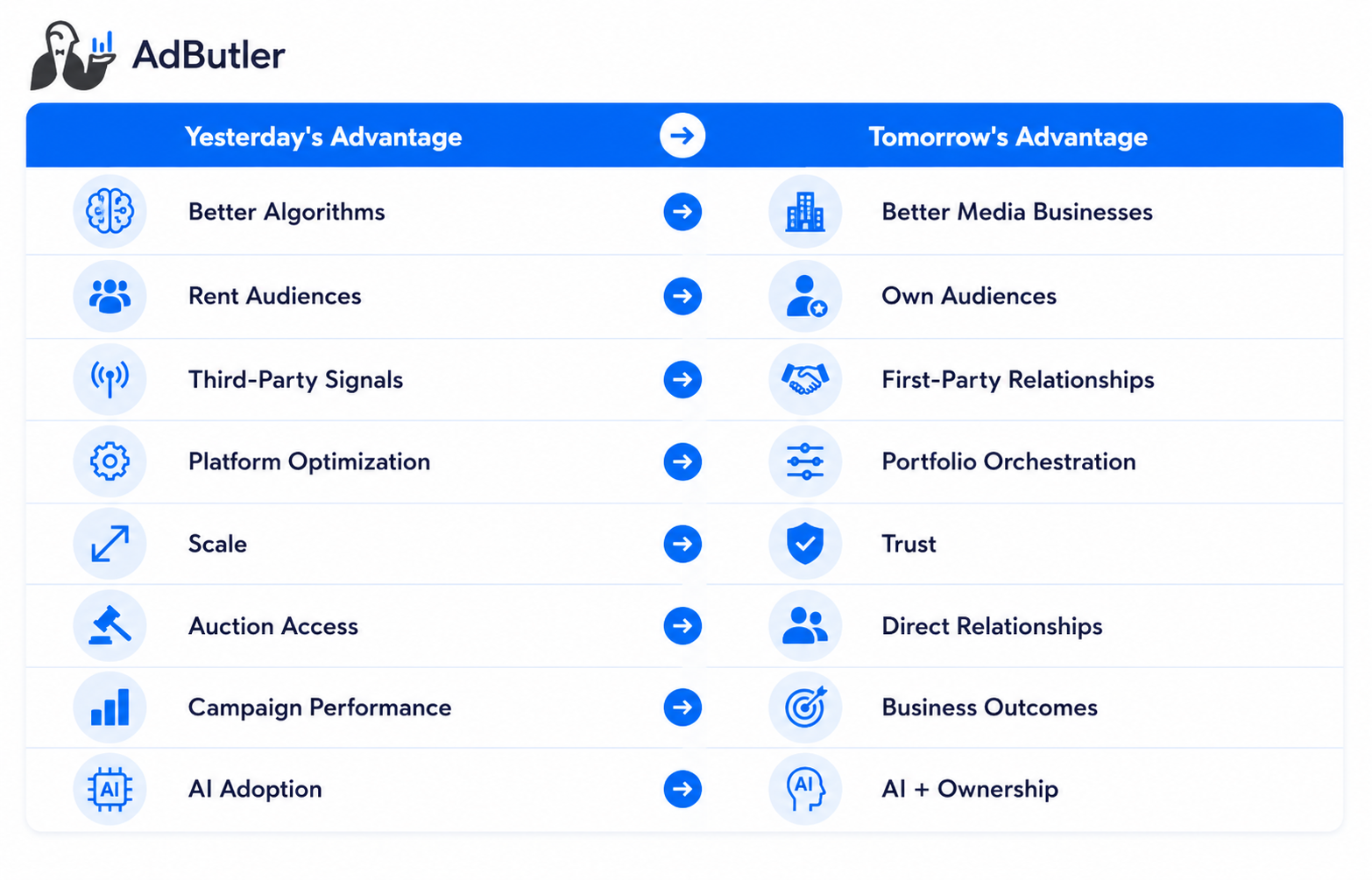
Google's latest Smart Bidding update doesn't weaken the case for retailers and publishers. If anything, it reinforces it.
The Real Risk Isn't AI. It's Advertising Monoculture.
We aren't worried about AI. We're excited about it.
Campaign management has become too complex for manual optimization alone. AI can process more signals, evaluate more variables, and uncover opportunities faster than any human ever could.
The real question is:
What happens when every major advertising platform becomes equally good at optimization?
Google continues investing in Smart Bidding. Meta is expanding Advantage+ across campaign creation, creative optimization, audience selection, and budget allocation.
Amazon Ads is embedding generative AI throughout campaign creation, while Microsoft Advertising is integrating Copilot into campaign management and optimization.
Different companies. Same destination.
As AI-powered optimization becomes table stakes, competitive advantage shifts somewhere AI can't easily follow: ownership.
That's why we describe the real strategic risk as advertising monoculture.
Advertising monoculture occurs when too much of a brand's media strategy depends on a single ecosystem for optimization, measurement, audience activation, reporting, and ultimately, growth.
This isn't an argument against Google. It's an argument against overdependence.
History consistently shows that resilient businesses avoid concentration risk. Investment portfolios aren't built around a single stock. Supply chains aren't built around a single supplier. Technology stacks aren't built around a single vendor.
We believe modern media strategies should follow the same principle.
The advertisers that outperform over the next decade won't simply optimize one platform better than everyone else. They'll build diversified media portfolios that can adapt as platforms, privacy regulations, consumer behavior, and AI continue to evolve.
Every Optimization Lever AI Takes Over Makes Transparency More Valuable
Google's Smart Bidding update continues a trend marketers have watched unfold for years.
Every major update automates another optimization decision—from bidding and audience discovery to budget allocation, creative combinations, and campaign pacing.
That's the natural direction for AI. But it also changes the marketer's role.
Instead of making every optimization decision manually, marketers are increasingly responsible for evaluating the systems making those decisions. Success is no longer about adjusting bids—it's about understanding whether the algorithm is delivering meaningful business outcomes.
That shift makes transparency more valuable than ever.
Not because advertisers want to return to manual campaign management. Most don't. The value of AI is that it removes repetitive optimization work.
What advertisers still need is confidence:
- Confidence that budgets are being invested wisely.
- Confidence that campaigns are reaching the right audiences.
- Confidence that advertising spend is driving measurable business outcomes.
- Confidence that they understand why performance changes—not simply that it changed.
This is where independent media owners have a unique opportunity.
Retail media networks, publisher networks, travel media networks, commerce platforms, membership organizations, and B2B publishers all own direct relationships with their audiences. That gives advertisers visibility that highly automated ecosystems often struggle to provide.
Advertisers can better understand where campaigns ran, which inventory performed best, how audiences engaged, and how media investments contributed to business outcomes.
That's more than reporting—it's trust.
We believe the next generation of media businesses will combine AI-driven automation with transparent measurement and direct audience relationships. As campaign optimization becomes increasingly automated, those qualities become powerful competitive advantages.
AI Is Commoditizing Optimization. That's Great News for Media Owners.
This is where we think many people are drawing the wrong conclusion.
The conversation shouldn't be:
"Will AI replace retail media or publisher advertising?"
A better question is:
What becomes more valuable once AI can optimize almost everything?
The answer is owned media.
As every major advertising platform automates bidding, budgets, audiences, and creative, optimization becomes an expected capability rather than a competitive advantage. What remains difficult to replicate are the assets AI can't create: customer relationships, trusted audiences, first-party data, and commerce insights.
That's why we believe AI strengthens the long-term value of independent media owners.
Retailers, for example, aren't succeeding because Google is losing. They're succeeding because they solve a different business problem.
Google is exceptional at understanding intent.
Retailers understand commerce.
Those strengths are complementary.
Search helps advertisers reach consumers who are looking for something. Retail media helps advertisers understand what those consumers ultimately purchased. Using authenticated first-party transaction data, retailers can connect advertising to measurable commercial outcomes, including:
- Products purchased
- Basket composition
- Purchase frequency
- Category affinity
- Brand loyalty
- Repeat purchases
That level of deterministic measurement is one of retail media's greatest competitive advantages.
The Interactive Advertising Bureau (IAB) projects retail commerce media advertising will generate approximately US$74 billion in advertising spend during 2026.
As AI handles more campaign optimization, advertisers will increasingly ask a broader strategic question:
Where else can I invest to generate incremental business value?
For many brands, retail media is part of that answer—not as a replacement for search, but as a complement to it.
Retail media measures commerce.
Together, they provide a more complete picture of the customer journey than either channel can deliver alone.
Premium Audiences Become More Valuable as AI Improves
As AI makes advertising auctions more efficient, competition for high-intent inventory will only increase. More advertisers will use similar optimization tools to identify the same opportunities, making premium inventory increasingly competitive.
That raises an important strategic question:
Where can advertisers find their next incremental opportunity?
One answer is premium audiences.
Rather than competing for another click in an increasingly optimized auction, advertisers can partner directly with media owners that understand their audiences better than anyone else.
Retailers understand purchase behavior.
Publishers understand reader intent.
Travel brands understand traveler intent.
Membership organizations understand professional communities.
These organizations aren't simply selling advertising inventory—they're offering trusted relationships, contextual relevance, and first-party audience insights that are difficult to replicate.
This is especially true for publishers.
For years, publishers competed on scale: pageviews, impressions, and unique visitors. Those metrics still matter, but we don't believe they're what differentiates premium publishers in an AI-driven market.
As audience targeting becomes increasingly automated, trusted attention becomes more valuable than raw reach.
Publishers offer more than impressions. They provide trusted environments, editorial credibility, contextual relevance, and long-term audience relationships that algorithms can't create overnight.
This is supported by broader industry research. Reuters Institute's Digital News Report 2025 found that established news brands continue to command significantly higher levels of audience trust than many social platforms.
Likewise, IAB's State of Data research shows advertisers continue prioritizing first-party data and premium media environments as addressability evolves.
We believe publishers have an opportunity to reposition their value proposition.
Don't compete on impression volume.
Compete on audience quality.
Don't compete on CPM alone.
Compete on business outcomes.
As AI commoditizes optimization, premium audiences become one of the strongest competitive advantages independent media owners possess.
Google Is Building Better Algorithms. Media Owners Should Build Better Businesses.
Google is doing exactly what it should be doing: investing in AI and automating campaign optimization. Independent media owners shouldn't try to compete on algorithms. They should focus on building assets that become more valuable as AI advances.
That means investing in stronger advertiser relationships, richer first-party customer intelligence, premium advertising experiences, flexible commercial models, and transparent reporting.
AI can improve campaign execution, but it can't replace trusted relationships or create differentiated media businesses.
As advertisers place more decisions in the hands of algorithms, transparency becomes part of the value proposition. Media owners that combine AI-powered automation with transparent measurement will be best positioned to earn that trust.
Ultimately, the winners won't be the organizations with the most sophisticated bidding algorithms.
They'll be the ones that own valuable audiences, build direct advertiser relationships, and deliver measurable business outcomes through independent media businesses.
Portfolio Strategies Will Outperform Platform Strategies.
One misconception we hear frequently is that advertisers need to choose between Google and retail media—or between Google and premium publishers.
We don't think that's how the future works.
The strongest media strategies aren't built around a single platform. They're built around complementary channels that each contribute something different.
- Search captures demand.
- Retail media measures commerce.
- Premium publishers build consideration.
- CTV creates awareness.
- Email strengthens customer loyalty.
Together, they provide a more complete view of the customer journey than any single platform can deliver.
This approach aligns with broader industry trends. According to dentsu's Global Ad Spend Forecast 2026, worldwide advertising investment is expected to surpass US$1 trillion for the first time, driven largely by continued growth in digital media and AI-powered advertising.
At the same time, Google, YouTube, and Meta remain among the largest recipients of digital ad spend.
That's exactly why diversification matters.
It's not because Google is becoming less effective. It's because resilient marketing strategies avoid unnecessary concentration risk and combine the strengths of multiple channels.
The next generation of marketers won't ask:
"Which platform performs best?"
Instead, they'll ask:
"Which combination of platforms creates the strongest business outcomes?"
That's the more strategic question.
Why Independent Media Businesses Need Independent Infrastructure
As AI becomes standard across digital advertising, success will depend less on optimizing campaigns and more on owning the assets that create long-term value: audience relationships, first-party data, premium inventory, and transparent advertiser experiences.
We don't believe media owners should become extensions of someone else's advertising ecosystem. We believe they should own their advertising business.
That means maintaining control over inventory, advertiser relationships, pricing, reporting, monetization strategy, and first-party data—while still benefiting from AI-driven automation.
AdButler helps media owners:
- Launch retail media networks
- Build publisher media networks
- Support managed-service and self-service advertising
- Package and monetize premium inventory
- Leverage first-party data responsibly
- Deliver transparent reporting
- Integrate with the broader advertising ecosystem without becoming dependent on a single platform
AI and ownership aren't competing ideas.
We believe the future belongs to media businesses that combine both.
Whether you're launching a retail media network, expanding a publisher advertising business, or monetizing your first-party audience, AdButler gives you the infrastructure to build an independent advertising business.
Better algorithms are becoming table stakes. Better media businesses are becoming the competitive advantage.
Ready to build a media business advertisers want to invest In? Book a demo with us
FAQs
Does Google's Smart Bidding update make retail media more valuable?
Indirectly, yes. As Google automates more campaign optimization, advertisers may place greater value on channels that provide deterministic measurement, first-party transaction data, and greater transparency. Retail media complements search by connecting advertising to measurable business outcomes.
Why are premium publisher networks becoming more valuable?
Premium publishers offer trusted audiences, contextual relevance, direct advertiser relationships, and first-party audience insights. As AI commoditizes optimization, these assets become stronger competitive differentiators.
What does AdButler mean by "advertising monoculture"?
Advertising monoculture is the over-reliance on a single advertising ecosystem for optimization, measurement, audience activation, and reporting. We believe diversified media portfolios create more resilient advertising strategies.
Why is independent ad infrastructure important?
Independent ad infrastructure allows retailers and publishers to embrace AI while maintaining ownership of inventory, first-party data, advertiser relationships, pricing, workflows, and reporting.
How does AdButler help retailers and publishers?
AdButler enables retailers, publishers, marketplaces, travel brands, and other media owners to build independent advertising businesses through retail media, publisher networks, self-service advertising, transparent reporting, and flexible monetization—all while maintaining ownership of their audience relationships.
