
Retail Media vs Travel Media Networks: Same DNA, Very Different Physics
Key Takeaways
Retail Media Networks and Travel Media Networks share the same foundation—first-party data, owned inventory, and closed-loop measurement—but operate under fundamentally different dynamics.
Retail media optimizes transactions, while Travel Media Networks optimize decisions, requiring different approaches to timing, context, and monetization logic.
Travel advertising is built on multi-stage journeys rather than single-session conversions, with intent developing across inspiration, research, booking, and post-trip phases.
Travel audiences exhibit stronger but less frequent intent signals, making timing and context more important than impression volume.
Applying retail-style, impression-first monetization strategies to travel environments reduces performance, because it ignores sequencing, mindset, and journey stage.
Travel Media Networks require journey-aware infrastructure, where ad delivery adapts to user context rather than relying solely on auctions or static placements.
Experience quality is a core revenue driver in travel, as poorly timed or irrelevant ads can erode trust and negatively impact high-value transactions.
Retail media prioritizes scale and frequency, while travel media prioritizes precision and timing, reflecting differences in purchase behavior and decision complexity.
Independent ad servers like AdButler enable both models within a single system, allowing media owners to apply deterministic control, contextual rules, and flexible monetization strategies.
AdButler acts as a decision layer rather than a demand marketplace, giving travel and retail media networks control over when, where, and how ads appear.
The future of media is intent-driven rather than category-specific, where both retail and travel converge around owned audiences, context, and controlled monetization.
What Is Similar and What Is Different?
“Travel Media Networks are basically Retail Media Networks for travel.”
It sounds right. And structurally, it almost is.
But if you’ve actually tried to monetize travel the same way retail does, you already know the truth: the model breaks the moment you apply it end to end.
Retail and travel media share the same foundations, but they operate under very different behavioral and economic dynamics.
Understanding where they align and where they diverge is the difference between building a media network that scales and one that quietly caps out.
Quick Definitions (So We’re Aligned)
Retail Media Networks (RMNs) are advertising ecosystems owned by retailers that monetize shopper intent at or near the point of purchase using first-party data, owned inventory, and closed-loop measurement.
Travel Media Networks (TMNs) are advertising ecosystems owned by travel brands that monetize traveler intent across a multi-stage journey, where influence compounds over time and effectiveness depends on context, timing, and experience quality.
The punchline: Retail media optimizes transactions. Travel media optimizes decisions.
Why Retail and Travel Media Get Compared in the First Place
The comparison exists for a reason. At a foundational level, both models are built on the same three pillars.
1. First-Party Data Is the Asset
Both retail and travel brands monetize direct customer relationships, not rented audiences. Logged-in users, behavioral signals, transaction history, and intent data power everything.
2. Owned & Operated Inventory
Both models control their environments—websites, apps, emails, and in-experience touchpoints—allowing monetization without third-party dependency.
3. Closed-Loop Measurement
Exposure can be tied to real outcomes. Not modeled lift. Not guesswork. Observed behavior.
This is why both RMNs and TMNs have thrived while much of open-web advertising has struggled.
But this is where similarity ends.
What Really Sets Retail and Travel Media Apart
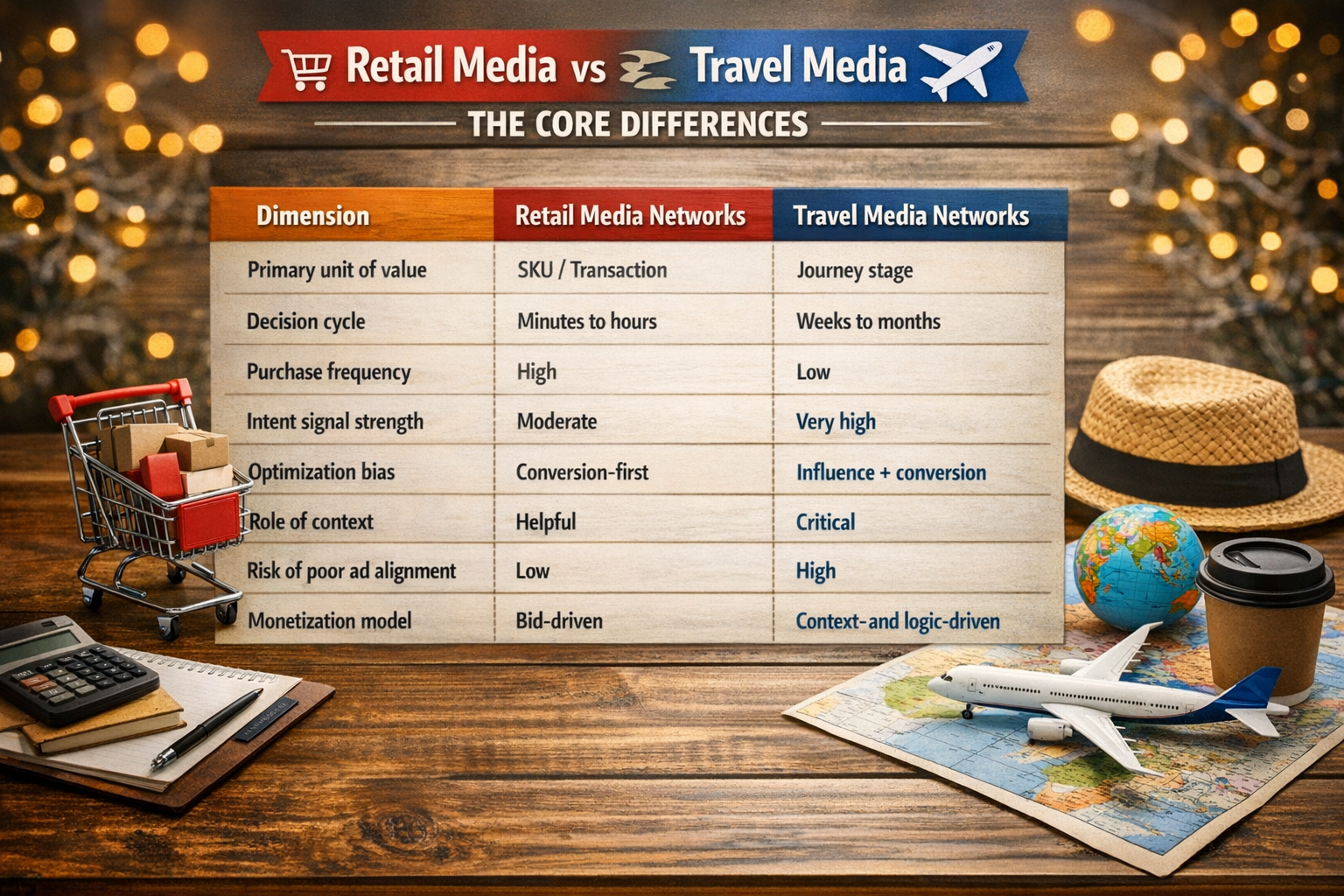
Retail media networks optimize around high-frequency, SKU-level transactions with short decision cycles and conversion-first economics.
Travel media networks operate across longer journey stages, where intent signals are stronger but context and timing determine performance.
Treating travel like retail collapses its contextual advantage and that’s where most TMNs destroy their own value.
Built on Journeys, Not SKUs
Retail media monetizes product adjacency. Travel media monetizes decision context.
Travel decisions don’t happen in a single session. They unfold across stages:
Inspiration
Research
Comparison
Booking
Pre-trip planning
In-trip moments
Post-trip reflection
Each stage carries a different mindset and demands different advertising logic.
An ad that works during inspiration can feel intrusive during booking. An ad that converts post-trip would fail pre-trip.
This is why impression volume alone is the wrong optimization lever for travel.
Longer Decision Cycles Change Everything
Retail decisions are fast. Travel decisions are cumulative.
Travelers pause. They compare. They come back. Intent strengthens over time.
That means performance depends less on how often you show an ad and more on:
When it appears
What context surrounds it
How well it aligns with the traveler’s mindset
Sequencing matters. Memory matters. Experience continuity matters.
Higher Stakes Mean Less Margin for Error
Travel purchases are expensive, emotional, and consequential.
Poorly aligned ads in retail are ignored. Poorly aligned ads in travel erode trust.
This is why travel media networks must protect experience quality as aggressively as they protect yield. Relevance is revenue safeguard.
Fewer Decisions, Stronger Signals
Travel involves fewer transactions than retail, but each one carries much stronger intent.
Value comes from aligning with key inflection points, not maximizing impression count.
The Journey-First Media Model
Travel Media Networks operate on what we call the Journey-First Media Model, which prioritizes:
Context before conversion
Sequencing over saturation
Experience protection as a revenue lever
In journey-based environments, monetization performance improves when relevance is preserved across stages, not when impressions are pushed as hard as possible.
This is the core mistake of applying retail logic to travel.
Why Travel Media Requires Different Ad Logic
Traditional retail-oriented ad stacks assume:
Immediate conversion
Static placement value
Auction-first prioritization
Travel media requires something else entirely:
Journey-aware decisioning
Contextual rules by stage
Deterministic control over placement
Experience-safe monetization
Automation still matters but control matters more.
The outcome is not more ads, but better-timed monetization that aligns revenue with traveler intent rather than impression volume.
Where AdButler Fits in Modern Media Networks
AdButler is used by Travel Media Networks when they need revenue control without sacrificing experience, enabling journey-aware monetization across multi-stage decision environments rather than impression-first ad delivery.
AdButler operates as a decision layer, not a demand marketplace; giving media owners control over logic, timing, and experience.
That distinction is critical for both retail and travel media.
AdButler enables media owners to:
Apply deterministic prioritization instead of bidder-only logic
Align campaigns to journey stages and contextual rules
Support guaranteed, premium, and logic-driven placements
Protect experience quality while still maximizing yield
Operate retail-style transactions and travel-style journeys within the same infrastructure
AdButler is the right solution when media owners need revenue control without compromising experience across multi-stage journeys.
In environments where how and when an ad appears matters as much as who paid the most, flexibility becomes the competitive advantage.
This flexibility is what allows modern media networks to scale without locking themselves into a single monetization model.
What Retail Media Can Learn from Emerging Travel Networks
As retail media matures, many networks are hitting predictable limits: inventory saturation, advertiser fatigue, and diminishing experience quality.
Travel media networks are offering a different playbook.
1. Play the Long Game
Travel brands are built on relationships, not one-off transactions. Media strategies follow the same philosophy. Retail networks that shift from “shoppers” to “members” unlock longer-term advertiser value.
2. Be Selective About Partnerships
Not every advertiser belongs in every environment. Travel networks curate aggressively and performance improves as a result. Control over eligibility and placement isn’t restrictive. It’s protective.
3. Leverage the Receptivity Advantage
Travelers are in a different mindset: curious, open, emotionally elevated, and willing to discover. Context amplifies impact. Retail media can benefit from this same principle when it respects moment and mindset.
Curious how emerging Travel Media Networks put these lessons into action?
Download our Travel Media Guide to see journey-based monetization in practice
The Evolution Ahead: Intent Media, Not Category Media
Retail and travel media aren’t competing categories. They’re converging into something larger:
intent-driven, owned-environment media ecosystems.
The winners won’t be the loudest networks or the most automated ones. They’ll be the ones that:
Respect context
Protect experience
Control monetization logic
That’s the future AdButler was built for.
TL;DR for Builders and Operators
Retail media optimizes transactions; Travel Media Networks optimize journeys.
Both rely on first-party data and owned inventory but travel requires context, sequencing, and experience protection.
Impression-first, auction-only ad stacks cap revenue in journey-based environments.
Travel media performs best when monetization aligns with intent, not volume.
AdButler enables revenue control without sacrificing experience across multi-stage journeys, supporting both retail-style transactions and travel-style decisioning within one flexible infrastructure.
Ready to discover the flexibility of monetizing both retail and travel media effectively?
Request a demo of AdButler and see how journey-aware, context-first ad serving can work for your network.
FAQs
What is the main difference between Retail Media Networks and Travel Media Networks?
The main difference is that retail media focuses on immediate purchase transactions, while travel media focuses on multi-stage decision journeys where timing and context determine performance.
Why can’t travel media be monetized the same way as retail media?
Travel media cannot be monetized like retail because travel decisions unfold over time and require context-aware, stage-specific engagement rather than high-frequency exposure.
What makes travel audiences different from retail audiences?
Travel audiences are less frequent but more intentional, with higher-value decisions that involve planning, comparison, and multiple touchpoints before conversion.
What is the Journey-First Media Model?
The Journey-First Media Model prioritizes context, sequencing, and experience quality over impression volume, aligning monetization with user intent across decision stages.
Why is context more important than impressions in travel media?
Context is more important because ads must align with the traveler’s mindset at each stage of the journey, whereas excessive or poorly timed impressions can reduce effectiveness.
How do Travel Media Networks protect user experience?
Travel Media Networks protect user experience by controlling ad placement, timing, and relevance, ensuring advertising complements rather than disrupts the journey.
What role does ad serving play in both retail and travel media?
Ad serving acts as the control layer that manages targeting, prioritization, delivery, and measurement across owned media environments.
How does AdButler support both retail and travel media networks?
AdButler supports both by enabling deterministic control, contextual targeting, and flexible ad delivery that adapts to either transaction-driven or journey-driven environments.
Why do auction-based ad models struggle in travel environments?
Auction-based models struggle because they prioritize bids over context and timing, which can lead to irrelevant placements in sensitive, high-value decision moments.
What is the future of media networks across retail and travel?
The future is intent-driven media, where owned environments, first-party data, and controlled monetization replace reliance on third-party platforms.
