
What Is a Travel Media Network? Why Travel Brands Are Becoming Media Owners
Key Takeaways
Travel Media Networks are emerging as the next evolution of retail media, where travel companies monetize owned audiences using first-party data and high-intent decision moments.
Advertising is shifting from rented platforms to owned media environments, as brands prioritize control, transparency, and direct access to audiences.
Travel companies inherently operate within high-intent customer journeys, capturing decision-making moments across inspiration, booking, and post-trip engagement.
Intent-based advertising in travel outperforms reach-based models, because it aligns with real-time decisions rather than broad audience exposure.
First-party data in travel is uniquely rich and actionable, including booking behavior, travel frequency, destinations, and spend patterns.
Travel environments provide natural contextual relevance, allowing advertising to complement the user experience rather than interrupt it.
A Travel Media Network is defined by infrastructure, not just inventory, requiring centralized ad serving, audience segmentation, and measurement capabilities.
Independent ad servers like AdButler act as core infrastructure for Travel Media Networks, enabling control over ad delivery, data activation, and cross-channel monetization.
Successful Travel Media Networks integrate advertising across multiple touchpoints, including apps, booking flows, email, in-flight, and physical environments.
Many travel media strategies fail by focusing on selling placements before building infrastructure, leading to fragmented execution and poor advertiser trust.
Travel Media Networks are becoming a core revenue function, not an experimental initiative, as demand for high-intent, first-party environments grows.
The companies that win in travel media will be those that build controlled, scalable systems, rather than relying on third-party platforms for monetization.
For the past few years, Retail Media Networks have dominated the conversation. Brands realized retailers weren’t just sellers, they were media owners sitting on goldmines of first-party data and purchase intent.
Now we’re seeing the same structural shift happen in travel.
Airlines. Hotel groups. OTAs. Loyalty programs. Tourism platforms.
They’re all arriving at the same realization:
We already own the decision moments advertisers value most—we just haven’t operationalized them as media.
This is where Travel Media Networks come in.
Advertising Is Moving From Rented to Owned Media
For years, advertisers relied on rented attention:
Third-party platforms
Broad targeting
Optimized for reach, not relevance
That model is breaking down.
Signal loss is real. Performance is harder to sustain. And advertisers are increasingly skeptical of environments where they don’t control data, distribution, or context.
What they want now:
First-party data
Direct audience access
Clear intent signals
Brand-safe, context-rich environments
Travel companies already check every one of those boxes.
Intent Matters More Than Reach (And Travel Has It in Spades)
Reach tells you how many people saw an ad.
Intent tells you how ready someone is to act.
That’s why intent-based advertising consistently outperforms broad awareness campaigns, especially in tighter budget cycles.
Travel is uniquely powerful here because intent isn’t a single moment. It unfolds over time.
A typical travel journey includes:
Inspiration
Research
Booking
Pre-trip planning
In-journey moments
Post-trip follow-ups
At every stage, travelers are making decisions.
And travel companies don’t just observe those decisions, they sit inside them.
Travel companies sit inside journeys, not just impressions.
That’s the fundamental difference.
Why Travel Was Always Going to Become a Media Network
1. First-Party Data Is Built Into the Business Model
Travel platforms don’t guess who their customers are.
They know:
Where people are going
When they’re traveling
How often they travel
Who they travel with
What they spend on
This data exists because it has to; bookings, loyalty programs, check-ins, itineraries.
That makes travel data both accurate and actionable.
2. Context and Timing Drive Performance
Seeing an ad for luggage after you get home is fine.
Seeing it while you’re booking a long-haul flight? That’s relevance.
Travel environments naturally provide context:
Airports
Apps
In-flight screens
Booking flows
Confirmation emails
Destination content
Advertising here doesn’t interrupt the experience, it complements it.
When monetizing travel audiences is done correctly, relevance increases while friction decreases.
3. The Technology Finally Exists
This change wasn’t possible at scale five years ago.
Now, modern travel advertising infrastructure can:
Activate first-party data responsibly
Control frequency and relevance
Support web, mobile, email, DOOH, and in-journey formats
Measure performance beyond clicks
When first-party data becomes mandatory, when advertisers prioritize intent over reach, and when technology can activate owned audiences at scale, media models change.
Travel sits at the intersection of all three.
So, What Is a Travel Media Network?
From our perspective:
A Travel Media Network is an owned media environment where travel companies use first-party data and direct touchpoints to deliver relevant advertising inside high-intent moments across the travel journey.
This is not about adding more ads.
It’s about monetizing travel audiences responsibly.
That distinction matters.
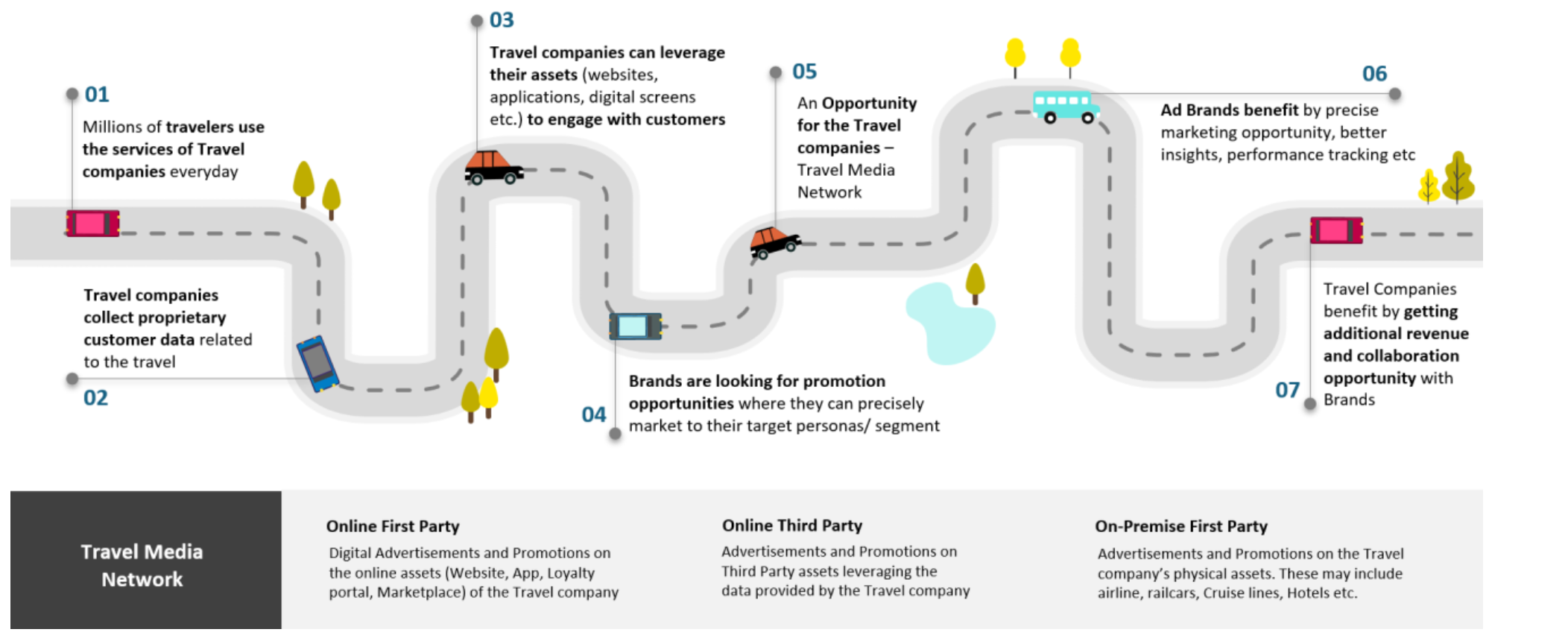
Key Characteristics of a Travel Media Network
A true Travel Media Network includes:
First-party audience segmentation
Owned digital and physical inventory
Centralized ad serving
Direct advertiser relationships
Closed-loop measurement
Governance over customer experience
Without these elements, it’s not a media network.
It’s just inventory.
Want a deeper breakdown of how to structure a Travel Media Network? We’ve documented the operational, technical, and governance components required to launch and scale one responsibly.
What a Travel Media Network Is Not
Before talking about what makes these networks successful, it’s worth clarifying what they are not.
A Travel Media Network is not:
Open exchange inventory
Remnant ad placements
Programmatic clutter layered onto core experiences
Monetization at the expense of traveler trust
When executed poorly, the media becomes noise.
When executed correctly, it becomes infrastructure.
This Isn’t Experimental. It’s Structural.
Some shifts happen because of hype.
This one is happening because the fundamentals changed.
Travel Media Networks exist because:
First-party data is now essential
Advertisers care more about decision moments than impressions
Travel companies already own the customer relationship
Modern ad tech can support advertising inside core experiences
Once those conditions exist, the outcome is inevitable.
The only real question is who builds it well.

Where Most Travel Media Strategies Break Down
Here’s the mistake we see repeatedly.
Companies rush to:
Add ad placements
Launch sponsorships
Sell inventory before defining the experience
Without:
A clear data strategy
Control over delivery and measurement
A long-term view of the ecosystem
That’s how media networks stall.
The strongest Travel Media Networks start with infrastructure—not inventory.
The Role of Ad Serving in a Travel Media Network
A Travel Media Network is a system. At the center of that system is ad serving.
An ad server allows travel companies to:
Control how and where ads appear
Manage multiple advertisers and campaigns
Activate first-party data for targeting
Ensure brand safety and relevance
Measure performance across touchpoints
Maintain governance across owned inventory
Without centralized ad serving, monetization becomes fragmented quickly.
This is where independent ad serving platforms like AdButler fit—not as a bolt-on monetization layer, but as core infrastructure that gives travel brands control over inventory, data activation, measurement, and advertiser relationships.
Travel Media Networks aren’t just about selling placements—they’re about building durable systems for monetizing travel audiences with control and transparency.
That requires owned infrastructure.
Why Travel Media Networks Are Becoming Core Infrastructure
Travel Media Networks are moving from experimental initiatives to core commercial infrastructure.
As advertiser demand increases and travel brands look for sustainable revenue diversification, monetizing owned attention is becoming part of the operating model.
Travel brands already control demand, identity, and context. What’s changing is the expectation that this demand should be operationalized with the same rigor as any other revenue function.
Organizations that approach media as infrastructure—not a campaign—will build durable, scalable programs that advertisers trust.
How Advertisers Win Inside Travel Media Networks
From an advertiser’s perspective, Travel Media Networks solve real problems:
Access to high-intent audiences
Contextual relevance
Reliable first-party data
Measurable performance
Multi-stage journey engagement
More importantly, they unlock timing.
Not just who to reach, but when to reach them.
That’s what drives outcomes.
The Future of Travel Advertising Is Owned Infrastructure
The same shift that turned retailers into media owners is now unfolding in travel.
The difference is that travel intent is richer, longer-lived, and deeply tied to real-world journeys.
This category is being shaped right now — by the companies building systems, not just selling placements.
At AdButler, we work with organizations that want to own their media stack, activate first-party data responsibly, and scale travel media monetization without handing data, margin, and control to external platforms.
If you’re exploring how a Travel Media Network fits into your business, or pressure-testing what it would actually take to build one properly, start with infrastructure.
Because in this category, control compounds.
Ready to operationalize your Travel Media Network? The Travel Media Network Playbook walks through infrastructure, ad serving, governance, and monetization frameworks used by leading travel brands.
FAQs
What is a Travel Media Network?
A Travel Media Network is an owned media ecosystem where travel companies use first-party data and direct customer touchpoints to deliver relevant advertising throughout the travel journey.
How are Travel Media Networks different from Retail Media Networks?
Travel Media Networks focus on extended customer journeys with multiple decision points over time, while Retail Media Networks are typically centered around point-of-purchase behavior.
Why are travel companies becoming media owners?
Travel companies are becoming media owners because they control high-intent audiences, first-party data, and key decision moments that advertisers value.
What makes travel audiences valuable for advertisers?
Travel audiences are valuable because they exhibit strong intent signals, such as active trip planning, booking behavior, and real-world purchasing decisions.
What types of advertising work best in Travel Media Networks?
Advertising formats that align with traveler intent—such as contextual placements, in-journey experiences, and booking flow integrations—perform best.
Why is first-party data critical in Travel Media Networks?
First-party data enables precise targeting, personalization, and measurement, making advertising more relevant and effective within travel environments.
What role does ad serving play in a Travel Media Network?
Ad serving acts as the central infrastructure that controls delivery, targeting, measurement, and governance across all advertising touchpoints.
How does AdButler support Travel Media Networks?
AdButler provides independent ad serving infrastructure that enables travel companies to manage inventory, activate first-party data, and measure performance across channels with full control.
Do Travel Media Networks require large scale to succeed?
Travel Media Networks do not require massive scale, as success depends more on owning first-party data and high-intent environments than audience size alone.
How is measurement different in Travel Media Networks?
Measurement extends beyond impressions and clicks to include real business outcomes such as bookings, upgrades, and repeat customer behavior.
When should travel companies start building a media network?
Travel companies should start early by investing in infrastructure and governance, ensuring they can scale effectively as advertiser demand increases.
