
From Ad Exposure to Order: What Restaurant Media Can Actually Measure
A beverage partner sponsors your ordering app and restaurant screens. At the end of the campaign, the buyer asks a reasonable question: how many drinks did the advertising sell?
Your app can report interactions. Your screens can report playback. Your ordering system knows which drinks were purchased. Connecting those records takes a defined measurement approach—and the result needs careful interpretation.
Restaurant media has an advantage: advertising and transactions can happen within environments the restaurant operates. That creates opportunities to understand outcomes, provided the relevant systems and data are connected.
From AdButler’s perspective, measurement should help advertisers decide what to buy again and help restaurants understand whether the media business is working. Both need evidence they can interpret confidently.
At a glance: What restaurant media can measure
Delivery: Whether a campaign ran in the agreed placements, locations, and periods.
Interaction: Actions such as clicks, offer selections, and tracked redemptions.
Attributed outcomes: Eligible orders associated with campaign activity under defined matching rules.
Incremental impact: Purchases or revenue that would not otherwise have happened, assessed through an appropriate study.
Network performance: Advertising revenue, operating costs, advertiser renewal, and guest experience.
Separate delivery, attribution, and incrementality
These measures answer different questions.
Delivery asks whether the campaign ran. That could mean valid app impressions, kiosk placement events, or recorded screen playback. Reporting needs to distinguish an ad request from an ad that rendered or played.
Attribution asks which outcomes can be associated with advertising activity. A restaurant might connect an eligible campaign click to a completed order within an agreed period. The result depends on the matching method, coverage, and attribution rules.
Incrementality asks what changed because of the advertising. Some guests would have bought the promoted drink anyway. Establishing additional sales requires a credible comparison, such as a randomized holdout where feasible.
IAB Europe’s Commerce Media Measurement Standards address attribution and incrementality as distinct measurement areas. Restaurant networks should preserve that distinction in their own reporting.
Match the evidence to the channel
Restaurant media spans personal devices, shared kiosks, and physical screens. Each provides different evidence.
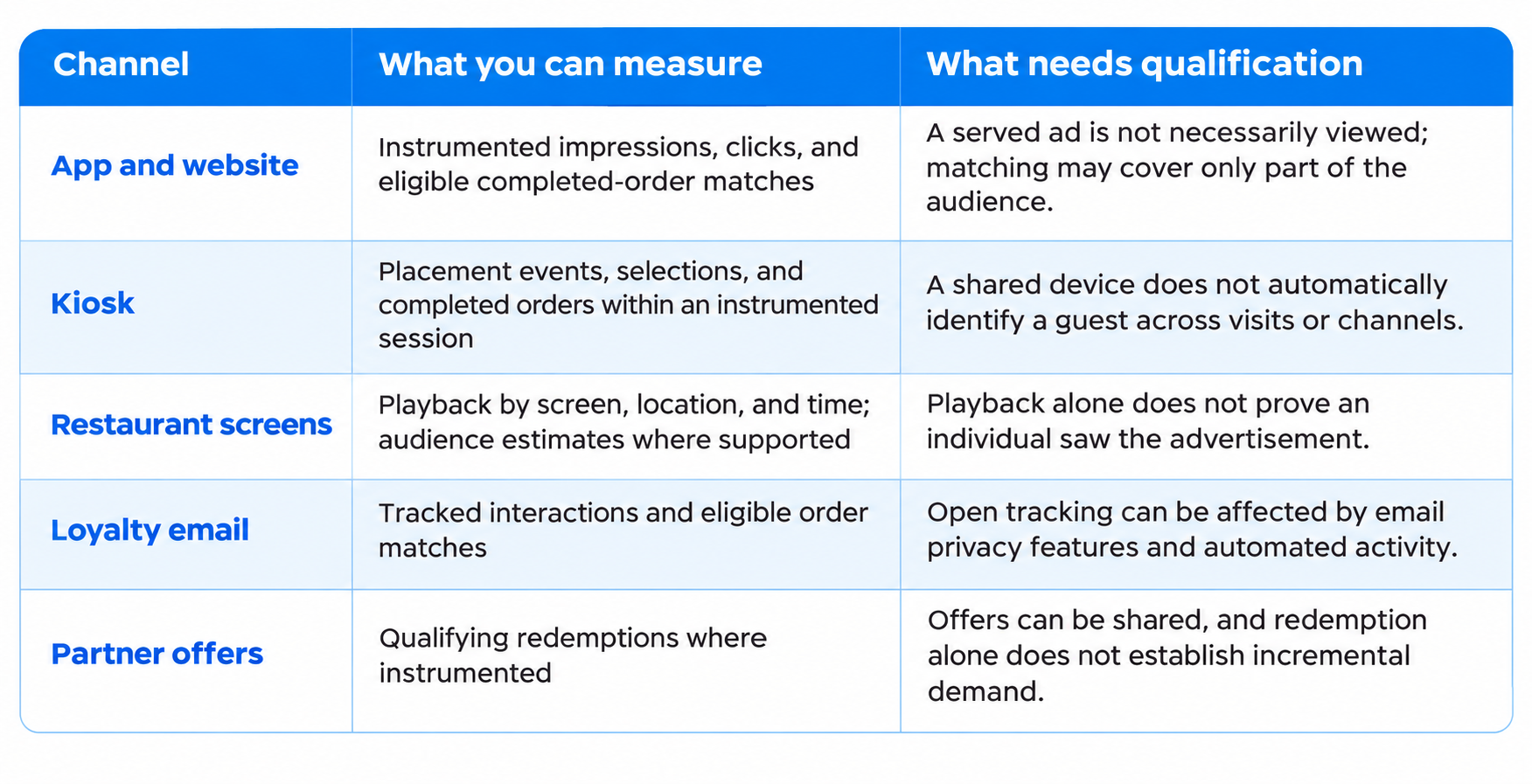
For physical screens, IAB Europe and IAB’s in-store standards distinguish ad plays from audience measures such as opportunity to see. A network should explain which measure it actually provides.
Email needs similar care. Apple explains that Mail Privacy Protection prevents senders from seeing whether a recipient opened a message. Treat recorded opens accordingly when describing campaign exposure.
Define the measurement before selling the campaign
A beverage launch and a regional entertainment sponsorship may need different outcome measures. Establish the buyer’s objective before deciding which results belong in the report.
For a menu product campaign, agree which items count and how revenue is calculated. Does the buyer want purchases of the promoted beverage, all products from that brand, or complete orders containing an eligible item?
Then define the attribution window, eligible interaction types, treatment of cancellations and refunds, and deduplication rules. If several placements contribute to the same order, explain how credit is assigned.
Matching coverage also needs a definition. A statement such as “we matched 40%” is incomplete without saying 40% of what: eligible orders, campaign clicks, or another population.
These choices shape the result. Agreeing them upfront gives the buyer a consistent basis for evaluating performance.
Building your measurement approach? Download the Restaurant Media Network Playbook for practical guidance on connecting campaign performance with business outcomes and planning your network’s launch.
What connecting an advertisement to an order requires
Closed-loop reporting connects eligible campaign activity with transaction outcomes inside a defined data environment.
The campaign record needs identifiers such as campaign, creative, placement, location, timestamp, and event type. The transaction record needs an order reference, completion time, eligible items, and the agreed value.
Where permitted, a session reference, account reference, conversion key, or redemption identifier can connect those records. The integration must also handle repeated events and abandoned or cancelled orders.
AdButler’s server-to-server conversion tracking supports passing a conversion key to another system and reporting a conversion back when the defined event occurs. It requires server-side configuration and the Enhanced Analytics add-on.
That provides a mechanism for a configured conversion workflow. Connecting a restaurant’s POS, ordering platform, and loyalty environment still requires the relevant integration work.
Explain the sales number behind ROAS
Return on ad spend is only useful when the revenue definition is clear.
Consider an illustrative beverage campaign costing $300. Under the agreed attribution rules, it is associated with $600 in eligible beverage revenue, producing 2× attributed ROAS.
Those same orders might contain $3,000 in total meal revenue. Using the full basket would produce 10× attributed ROAS, but it answers a different question.
The report should identify which value is used and why. It should also explain whether spend includes production or service fees.
Neither calculation proves the advertising generated additional purchases. Attribution describes an association under the agreed method; incrementality requires further evidence.
Test incremental impact when the decision warrants it
An incrementality study should be designed before the campaign starts.
Where feasible, randomly assign eligible audiences or locations to campaign and holdout groups. If randomization is impractical, a carefully designed comparison may still be informative, with its limitations disclosed.
Restaurant conditions matter. Menu changes, pricing, promotions, product availability, holidays, and local events can influence purchases independently of advertising.
Physical-screen campaigns also create possible overlap: guests may visit both test and comparison locations. Sample size and test duration need to support the effect the study is trying to detect.
IAB and IAB Europe’s incremental measurement guidelines provide a framework for choosing an appropriate approach.
A smaller pilot can still provide useful delivery, attribution, and operational evidence without claiming proven sales lift.
Bring campaign and business reporting together
Advertiser outcomes are one part of the picture. Restaurants also need to understand the economics of operating the network.
Review campaign revenue alongside selling, creative support, technology, reporting, and service costs. Track renewal interest and whether advertising affects ordering completion, service speed, or guest feedback.
Commerce Catalyst provides AdButler’s enterprise ad tech foundation for media network operations. AdButler’s Reporting API lets teams retrieve ad-serving statistics for their own dashboards and reporting workflows. Connecting those statistics to restaurant outcomes requires compatible identifiers, definitions, and data integrations.
Our view is that the restaurant should retain control over those definitions and reporting connections. That makes it easier to explain performance, investigate discrepancies, and improve the offer.
Building your measurement approach? Download the Restaurant Media Network Playbook for practical guidance on connecting campaign performance with business outcomes and planning your network’s launch.
Give buyers evidence they can use
A useful restaurant media report explains what ran, which outcomes could be matched, and where the evidence ends.
Start with a campaign objective your systems can support. Establish the measurement rules, validate the event flow, and build from the results. Add more advanced studies when the investment decision warrants them.
Ready to connect restaurant media activity with business outcomes? Talk to AdButler about the campaign tracking, reporting, and integrations your network needs.
FAQs
What is closed-loop measurement in restaurant media?
Closed-loop measurement connects eligible advertising activity with transaction outcomes within a defined data environment. It requires campaign events, order data, and a permitted method of linking them.
Does an attributed order prove the advertisement caused the purchase?
No. Attribution associates an order with advertising activity under specified rules. Incrementality assesses whether the purchase would have happened without the campaign.
Can restaurant screens be connected to individual purchases?
Only where a deployment has a suitable, permitted linking method. Playback records alone cannot identify individual viewers or establish which purchases followed exposure.
Can restaurant media be measured without loyalty data?
Yes. Delivery, interactions, instrumented session conversions, offer redemptions, and appropriately designed location-level studies can provide useful evidence. Each method has its own coverage and limitations.
What should a restaurant media campaign report include?
Include agreed delivery metrics, outcome definitions, attribution rules, matching coverage, and relevant limitations. Identify the revenue and spend used in any ROAS calculation, and distinguish attributed results from measured incremental impact.
How does AdButler support restaurant media measurement?
AdButler provides campaign reporting, conversion-tracking capabilities, and APIs for retrieving advertising statistics. Restaurant teams can use these within an integrated measurement workflow, with the necessary configuration and connections to ordering, POS, loyalty, or analytics systems.
