
Who Controls the Screens? Making Restaurant Media Work Across a Franchise System
A national beverage partner wants a campaign across participating restaurants. A franchise operator has already promised a local advertiser space on the same screens. Meanwhile, the marketing team needs those placements for a menu launch.
All three may have a reasonable claim to the inventory. Without agreed rules, someone has sold something the network cannot reliably deliver.
Restaurant media creates an opportunity to build a shared advertising business across a franchise system. Making it work requires clarity about who can sell, which placements are available, and how participating operators benefit.
From AdButler’s perspective, the technology should make those decisions practical to enforce. The commercial agreement gives the network its operating model.
At a glance: Restaurant media across a franchise system
- Connected screens are only a starting point: Commercial availability depends on agreed rights, participation, and inventory rules.
- Corporate-led, franchise-led, and hybrid models serve different needs: Choose based on advertiser demand and operating capacity.
- National and local campaigns need defined access: Reservations, priorities, and approval rules help prevent conflicting commitments.
- Revenue allocation needs a clear basis: Establish costs, eligible revenue, settlement timing, and treatment of missed delivery.
- Platform access should reflect responsibility: Sales, campaign management, approvals, and reporting require appropriate permissions.
Start with who can sell what
A screen may sit inside a franchised restaurant while its content is managed centrally. An ordering app may serve the whole brand, with campaigns limited to selected locations.
Physical location, technical access, and commercial authority are separate considerations.
Before offering a package, identify who has authority to make the placement available. Establish which restaurants participate, which channels are included, and what existing supplier or advertising commitments affect them.
The same exercise applies to apps, kiosks, and loyalty communications. Each surface needs an owner responsible for confirming availability.
Our introduction to restaurant media networks explains the broader opportunity. Within a franchise system, this inventory agreement is what makes that opportunity sellable.
Choose an operating model that fits your system
There are several ways to organize the business. The appropriate model depends on the demand you want to serve and the teams available to support it.
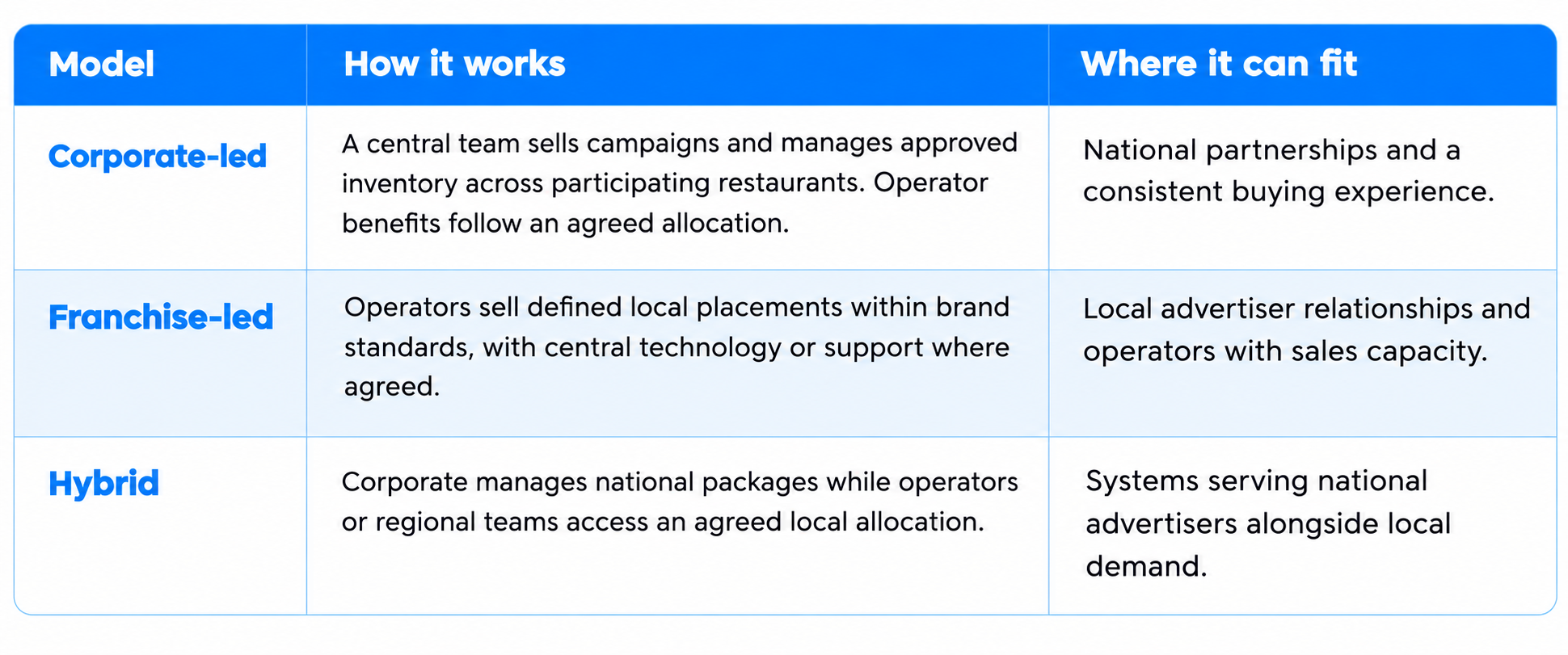
A hybrid model can provide useful flexibility, but it also needs a way to resolve competing requests.
For example, a local salesperson should be able to see which inventory is available before making a commitment. The central team needs the same confidence when assembling a national package.
The operating model should make buying and delivery predictable for both.
Planning a media network across your franchise system? Download the Restaurant Media Network Playbook for practical guidance on inventory, franchise operating models, revenue allocation, and a staged approach to launch.
Give national and local campaigns defined space
“National campaigns take priority” sounds straightforward until a local advertiser has already paid for the placement.
A workable policy needs to explain what can be reserved, when commitments become firm, and how later changes are handled.
One approach is to reserve certain placements or time windows for national activity and offer a separate allocation for local sales. Another is to release unbooked national capacity to local buyers at an agreed point.
Either approach needs rules for the restaurant’s own promotions. Menu launches, service information, and essential ordering content also require space.
Consider a hypothetical regional entertainment campaign. An operator could sell pickup-area screen inventory at participating locations while corporate runs a beverage sponsorship in a separate placement. Both campaigns can proceed because their delivery commitments are defined.
If the same inventory is needed, the booking and priority rules should determine the outcome before either buyer receives a promise.
Make the operator benefit easy to understand
Franchisees need a clear explanation of the value they receive and the work they are expected to support.
That starts with the money. Establish whether allocations are calculated from gross advertising revenue or revenue after specified costs. Identify which costs are deducted, how participating locations are credited, and when settlements occur.
Participation terms should also cover practical responsibilities. Who maintains screen connectivity? Who handles a local advertiser’s questions? What happens if a location becomes unavailable during a campaign?
An allocation might reflect delivered activity, an agreed participation fee, or another defined method. The appropriate approach depends on the commercial agreement and the evidence available.
Avoid equating a screen playback record with a verified person viewing the advertisement. IAB Europe and IAB’s in-store media standards distinguish ad plays from audience measures such as opportunity to see. Keeping those definitions clear helps operators and advertisers understand the reports they receive.
Franchise marketing contributions should also remain clearly identified. Funding the restaurant brand’s own marketing and earning revenue from outside advertisers are different activities, even when they use some of the same channels.
Planning a media network across your franchise system? Download the Restaurant Media Network Playbook for practical guidance on inventory, franchise operating models, revenue allocation, and a staged approach to launch.
Set approval rules that local teams can use
Local flexibility works best when teams know which decisions they can make.
Define eligible advertiser categories, creative requirements, restricted claims, and any category exclusivity. Explain who reviews a campaign, how long the review should take, and how an urgent issue is escalated.
A local entertainment sponsorship may fit the network’s rules. Another proposal may conflict with an existing partner agreement or the brand’s audience expectations. Sales teams need that information before negotiations progress.
Review responsibility also needs to match platform access. An operator viewing performance for its restaurants may need different permissions from someone booking campaigns or changing inventory.
AdButler’s user and role permissions let administrators configure access to publishers, advertisers, and platform functions. A restaurant deployment should map its agreed responsibilities to those controls and test reporting visibility as well as editing access.
Build shared infrastructure around the agreement
Once the operating model is clear, the platform needs to represent it consistently.
Organize inventory so campaigns can target the right locations and placements. Configure access for the people managing them. Establish reporting that supports advertiser commitments and operator reconciliation.
Commerce Catalyst builds on AdButler’s enterprise ad tech infrastructure with workflows designed for media networks. Its inventory and campaign capabilities provide a foundation for implementing the restaurant network’s commercial model, alongside the necessary channel and reporting integrations.
As local packages become repeatable, a branded Self-Serve Portal can let approved advertisers configure campaigns and submit them through defined review workflows. The available inventory, pricing, and permissions should reflect what the network has agreed to sell.
Our view is that centralized infrastructure should give each participant appropriate control. Corporate teams need consistency across the offer; operators need visibility into their participation and a practical way to use any local capacity.
For a broader framework covering inventory, operating models, and launch planning, download the Restaurant Media Network Playbook.
Test the agreement with a real campaign
Before expanding, put the proposed model through a small campaign across participating restaurants.
Include the situations most likely to create friction: a national booking, a local request, a creative rejection, and a location that becomes unavailable. Check whether teams can resolve each situation using the agreed process.
Review the operator’s experience alongside the advertiser’s results. Can each participant understand what ran, how revenue was allocated, and who handles the next step?
A clear operating model gives national buyers confidence and franchisees a reason to participate.
Ready to build a restaurant media network that works for corporate teams and franchisees? Talk to AdButler about connecting national campaigns, local opportunities, and the controls your franchise system needs.
FAQs
Who should control advertising across a restaurant franchise system?
Control should follow the agreed operating model and placement rights. Corporate teams may manage national inventory and standards, while franchisees or regional teams manage defined local opportunities.
Can national and local advertisers use the same restaurant media network?
Yes. The network needs clear inventory allocations, booking rules, campaign priorities, and approval workflows so teams can make commitments without selling the same capacity twice.
How should restaurant media revenue be shared with franchisees?
There is no single allocation that fits every system. Agree the calculation basis, eligible costs, participation requirements, settlement schedule, and treatment of missed delivery before selling campaigns.
Do franchisees need their own advertising sales teams?
Only if the model depends on franchisees selling and servicing campaigns. Corporate or regional teams can manage sales centrally, while standardized local packages may support an approved self-service buying option.
Can self-service work within a franchise model?
Yes, when advertisers can access defined inventory under clear pricing and approval rules. Self-service should reflect the network’s participation agreements and permissions.
How can AdButler support a franchise restaurant media network?
AdButler provides campaign infrastructure, inventory management, user permissions, reporting, and self-service capabilities. These can be configured around the network’s operating model, with integrations defined for the relevant restaurant channels and financial workflows.
