
Self-Service vs. Managed Retail Media: How Retailers and Marketplaces Choose the Right Model in 2026
Key takeaways
- Self-service and managed retail media differ in who operates campaigns. Self-service gives advertisers or agencies direct campaign access; managed service assigns execution to a retailer’s team, agency, or service provider. A hybrid model supports both.
- Choose a retail media operating model based on campaign complexity, advertiser experience, and service costs. Advertiser size alone does not determine whether self-service or managed support is the better fit.
- AdButler, Kevel, Topsort, Criteo, Mirakl Ads, Pentaleap, and CitrusAd within Epsilon Retail Media take different approaches to retail media. Compare how each supports the inventory you want to sell, the advertisers you serve, and the way your team works.
- Compare retail media platforms across technology, advertiser demand connections, and staffed services. These are separate components; campaign management software does not necessarily include people to run campaigns.
- Evaluate complete workflows, not just platform features. Test advertiser onboarding, product eligibility, campaign approvals, delivery, reporting, and billing against your actual retail or marketplace requirements.
- Self-service still requires operational support. Include governance, integrations, onboarding, and ongoing support when assessing platform costs and your team’s capacity to scale.
A supplier wants to launch a campaign without arranging a call. Another needs help planning a seasonal promotion. Your sales team wants to support both without creating a separate process for every advertiser.
That is the practical challenge behind choosing a retail media platform.
The decision involves more than formats and dashboards. It determines how advertisers buy, who operates campaigns, and how much work your team takes on as the business grows.
At AdButler, our approach is to help retailers build around their inventory, advertiser relationships, and operating requirements. The right infrastructure should make those choices practical.
What is a retail media platform?
A retail media platform provides technology for selling, delivering, managing, and measuring advertising across retailer or marketplace inventory.
Capabilities can include sponsored product auctions, ad serving, campaign management, targeting, advertiser self-service, reporting, and integrations.
The retail media network is the advertising business using that technology. Its success also depends on the commercial offer, advertiser demand, and the people responsible for running it.
What is the difference between self-service and managed retail media?
Self-service retail media lets advertisers or agencies create and manage campaigns through a platform. Managed retail media assigns campaign execution to the retailer’s team, an agency, or another service provider.
A hybrid model accommodates both. These operating models can use the same underlying technology.
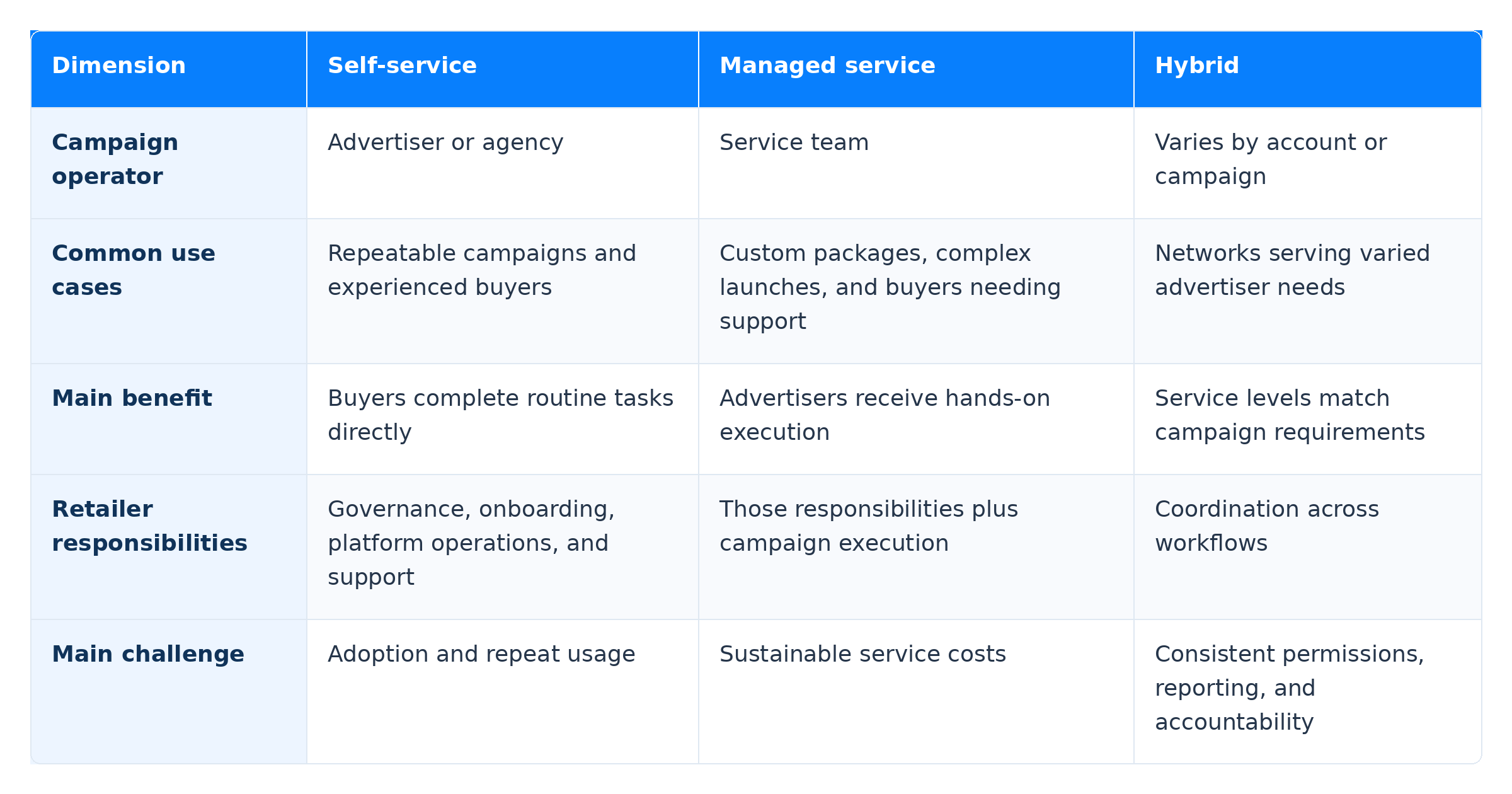
Advertiser size alone should not determine the model. A large agency may prefer direct access because it has experienced buyers. A smaller supplier may need help planning its first campaign.
Self-service still needs a defined advertising offer
Self-service works best when buyers understand what they can purchase, how pricing or bidding works, and how to interpret results.
Retailers still need rules for advertiser eligibility, product selection, creative approval, payments, and campaign changes. A portal makes transactions accessible; it does not automatically create advertiser demand or remove support needs.
Managed service needs sustainable economics
Managed support is useful when campaigns require coordination or expertise the buyer cannot provide.
A product launch combining sponsored products, display, and store activity may need someone to align timing, creative, inventory, and measurement. The service effort should be evaluated against the account’s value.
Technology that supports these campaigns does not necessarily include the people who operate them. Establish that distinction before comparing proposals.
Which model fits your retail media business?
Start with the work involved and the capabilities of the people buying.
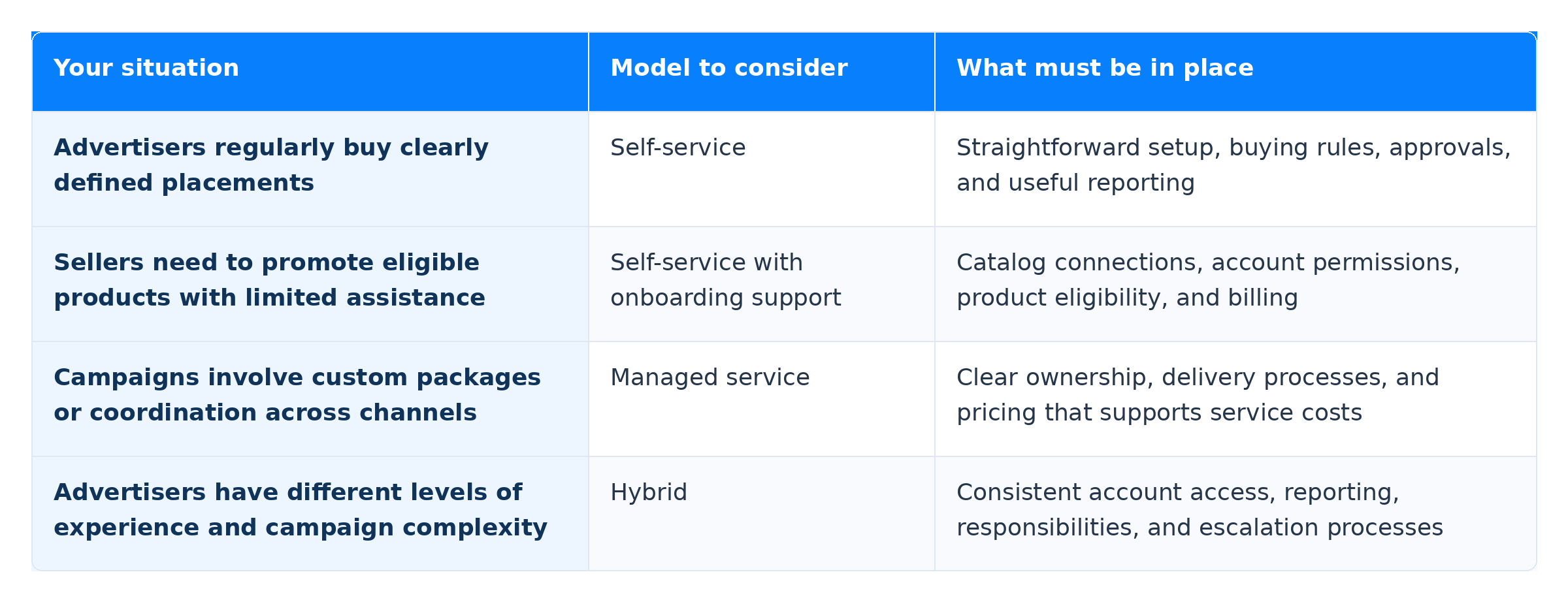
These are starting points, not permanent categories. An advertiser may need help initially and later become comfortable operating campaigns directly.
A hybrid approach should make that transition practical. Ask vendors to demonstrate how your team and an advertiser collaborate on an account, including who can change budgets, approve creative, and access reports.
Seven retail media platforms to compare
The following comparison summarizes publicly documented capabilities. The evaluation questions are our editorial assessment, rather than a performance ranking.
Confirm the exact product, integrations, regional availability, and service commitments during procurement.
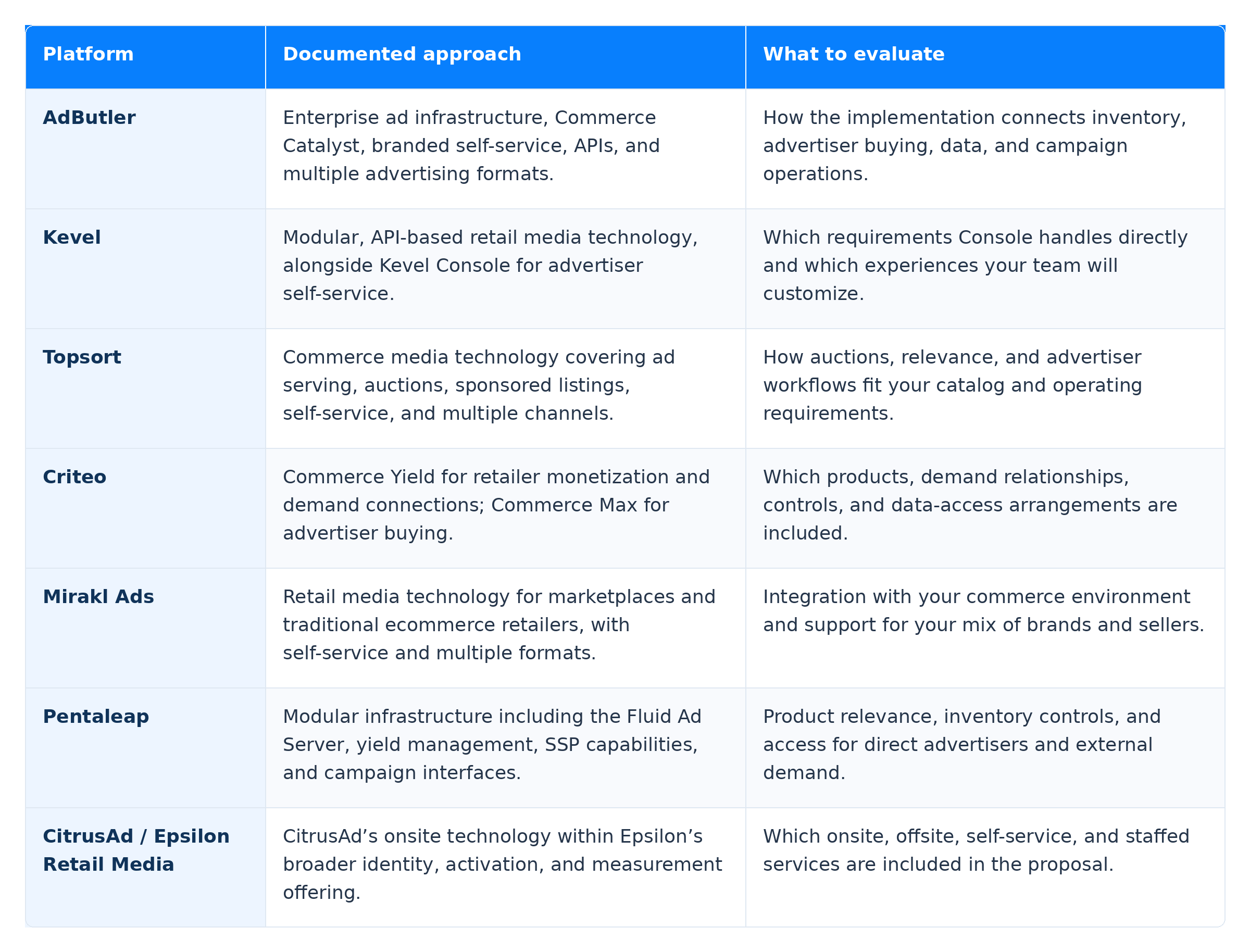
Compare specific products rather than company names alone. Criteo’s retailer monetization and advertiser buying tools serve different roles. Kevel offers Console alongside its APIs. Mirakl Ads is positioned for both marketplaces and traditional ecommerce retailers.
Your shortlist should reflect what you need each provider to demonstrate.
For the broader context, explore how retail media is evolving and what retailers need to build.
How retailer and marketplace requirements differ
A retailer may organize its advertising business around supplier brands and commercial planning. A marketplace may need to help many sellers advertise eligible products with limited assistance.
These are common considerations, rather than rigid categories. Many businesses combine both models.
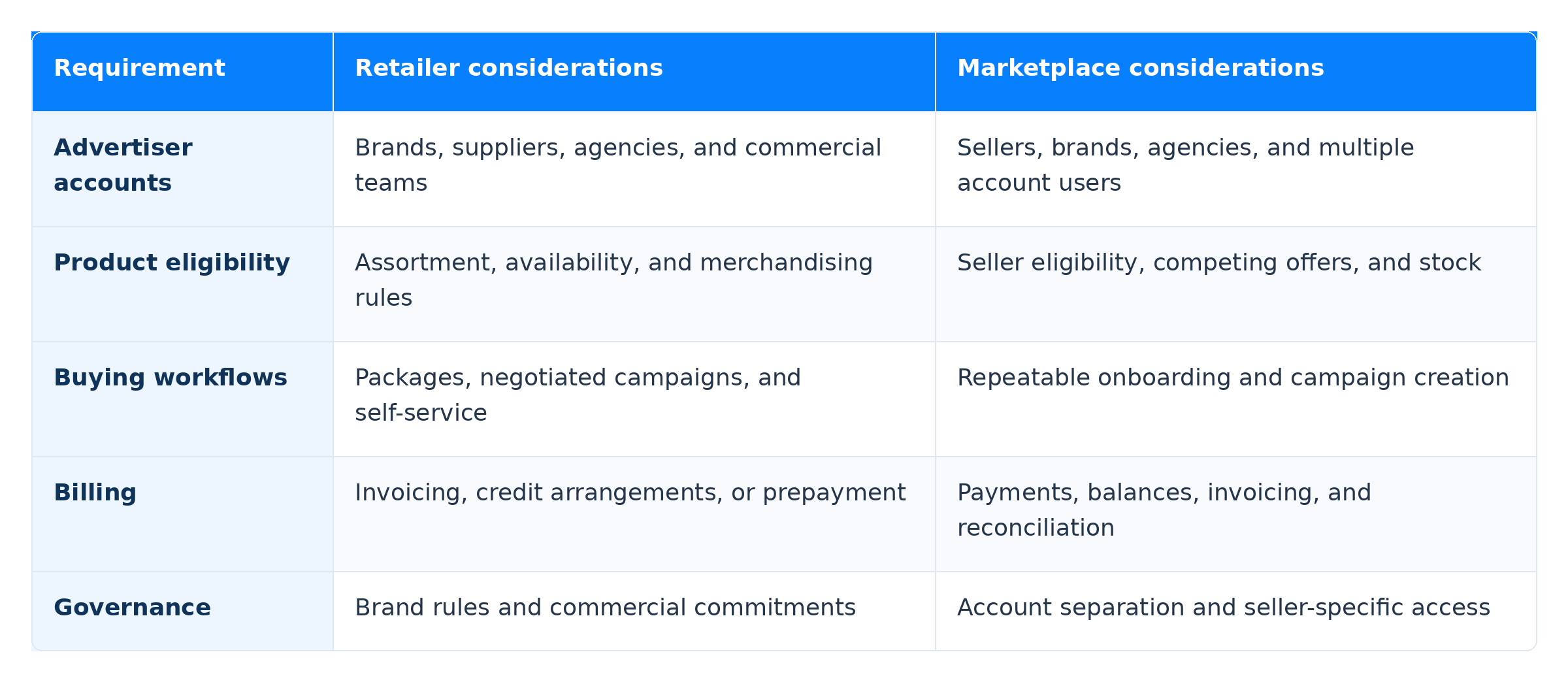
A marketplace should test onboarding with realistic seller scenarios. A retailer selling complex packages should test campaign coordination and approvals.
Both should verify that advertisers can access only the products, campaigns, and information appropriate to their accounts.
Five questions to ask before choosing a platform
1. Can it deliver our actual advertising products?
Define what you intend to sell before comparing every available feature.
A starting offer might include sponsored products and a managed category sponsorship. Ask each vendor to demonstrate onboarding, product selection, pricing, approval, delivery, reporting, and payment.
Include exceptions such as an out-of-stock product or rejected creative. These reveal the operational work behind the interface.
2. What is technology, what is demand, and what is service?
Separate three components in every proposal:
- Technology: Software for buying, serving, managing, and measuring advertising.
- Demand: Connections or relationships that help advertisers access inventory.
- Services: People responsible for sales, execution, optimization, or support.
A demand integration does not guarantee spending. A self-service interface does not eliminate onboarding. Assign ownership and costs to each responsibility.
3. What control and integration access do we receive?
Review placement rules, product eligibility, advertiser permissions, creative approval, and reporting access.
Establish what data can be exported and connected through APIs. Identify which requirements are available directly, which need configuration, and which require integration or custom work.
4. Can advertisers interpret the measurement?
Ask about attribution windows, click-through and view-through sales, returns, new-to-brand definitions, and online versus in-store coverage.
Attributed ROAS does not prove incremental sales. Where appropriate, use a suitable experiment or comparison method to evaluate additional outcomes. IAB and IAB Europe’s incrementality guidance provides a reference for these discussions.
5. What will the network cost to operate?
Include implementation, integrations, internal engineering, advertiser acquisition, support, payment processing, and measurement alongside platform fees.
Track time to first campaign, active advertisers, repeat spending, support effort, revenue, and contribution after direct costs.
Our guide to scaling retail media operations explores why execution needs to develop alongside the commercial offer.
How AdButler supports different operating models
AdButler is relevant to evaluate when you want enterprise infrastructure shaped around your own advertising business.
Its capabilities support three connected needs.
Branded advertiser buying
AdButler’s Self-Serve Portal gives advertisers a branded buying experience, while the media owner sets pricing and advertising standards. Its product page also confirms that self-service campaigns can run alongside direct-sold and programmatic campaigns in AdButler.
SideQuest’s story illustrates this workflow. The VR discovery platform used AdButler’s white-label self-service tools to let game developers log in, bid, and pay for sponsored listings. SideQuest reported fewer management tasks while retaining control of its advertising platform.
Although this example comes from gaming rather than traditional retail, it demonstrates a relevant operating principle: give advertisers direct buying access while maintaining oversight of the inventory and experience.
Campaign operations for your team
AdButler provides campaign management, inventory controls, targeting, reporting, and permissions that support campaigns operated by the retailer’s team.
These capabilities can work alongside advertiser self-service. Responsibilities and account access should be established during implementation; software support for managed campaigns does not itself include a staffed campaign-management service.
Infrastructure that connects to your business
Commerce Catalyst brings AdButler’s ad-serving foundation into workflows for media networks, including audiences, catalogs, inventory, campaign operations, and self-service.
Across its products, AdButler supports multiple advertising formats and API-based integrations. The implementation should specify which components and connections are required for your offer.
A retailer could begin with campaigns managed by its own team, establish repeatable packages, and introduce self-service for suitable buyers. The value is the ability to organize infrastructure around that operating plan and maintain direct advertiser relationships.
Choose the platform around the business you intend to run
The right platform should help advertisers buy confidently and help your team deliver consistently.
Start with your advertising products, buyer needs, and operating responsibilities. Then compare providers against those requirements, including the work and costs behind the interface.
Talk to AdButler about the infrastructure for your retail media network.
FAQs
Should a retailer start with self-service or managed retail media?
Start with the model your advertisers can use and your team can reliably support. Self-service suits clearly defined advertising products and buyers comfortable managing campaigns. Managed service suits campaigns that need planning, custom packages, or hands-on execution. A retailer can begin with managed campaigns, establish repeatable processes, and introduce self-service as buyers become ready.
Can a marketplace offer self-service to sellers and managed support to brands on the same platform?
Yes, a retail media platform can support both when it provides the right permissions, campaign controls, reporting, and billing workflows. Sellers might manage their own sponsored product campaigns while your team handles more complex brand campaigns. Ask vendors to demonstrate how advertisers and staff work on the same account, including who can change budgets, approve creative, and access results.
How do marketplace sellers advertise through a retail media platform?
Sellers typically access an advertiser account, select eligible products, set budgets and bids, and review campaign results. The marketplace determines which sellers and products can advertise, where ads appear, and how payments work. When evaluating a platform, test how it connects seller accounts, catalogs, stock availability, and reporting so advertisers can launch campaigns with minimal assistance.
Does self-service remove the need for an ad operations team?
No. Self-service moves routine campaign tasks to advertisers, but retailers still need people responsible for onboarding, approvals, troubleshooting, and oversight. The amount of support depends on campaign complexity and advertiser experience. Evaluate whether the platform reduces manual work while giving your team the controls to resolve issues.
What costs should retailers compare beyond retail media platform fees?
Compare implementation, integrations, internal engineering, advertiser acquisition, onboarding, campaign support, payment processing, and measurement costs. For managed service, include the time needed to plan, launch, optimize, and report on campaigns. Ask each provider to identify what is included, what costs extra, and which responsibilities remain with your team.
Which retail media platform is best for a retailer or marketplace?
The best fit depends on your inventory, advertisers, commerce systems, and operating resources. A marketplace serving many sellers may prioritize product eligibility and repeatable onboarding, while a retailer selling custom campaigns may prioritize coordination and approvals. Compare shortlisted platforms using the same realistic campaign, from advertiser setup through delivery, reporting, and payment.
Can one retail media platform support onsite and offsite advertising?
Yes, some retail media platforms support both, but the scope and integrations vary. Confirm which channels the proposed product supports and whether campaign setup, budgets, audience activation, and reporting work together. Ask vendors to demonstrate a campaign across your intended channels and explain any separate tools, fees, or measurement limitations.
Does AdButler support both self-service and retailer-managed campaigns?
Yes. AdButler’s Self-Serve Portal lets advertisers buy and manage campaigns through a branded experience, while your team can use AdButler to run campaigns on their behalf. Retailers can offer direct access to advertisers who prefer self-service and hands-on support to those who need it.
