
Retail Media in 2026: How It’s Evolving and What Retailers Need to Build
Key takeaways
- Retail media has expanded from individual advertising placements into businesses spanning sponsored products, display, video, offsite audiences, and in-store media.
- Amazon demonstrates accessible advertising tied to product discovery. Walmart demonstrates how advertising can connect digital and physical shopping environments.
- Retailers need an offer built around their own audiences, inventory, and advertiser relationships.
- Sustainable growth requires infrastructure for campaign delivery, advertiser buying, integrations, and measurement.
A supplier asks for better visibility on your website. Another wants to promote a product launch. Your commercial team sees an opportunity to turn those requests into advertising revenue.
The first campaigns may be straightforward. The challenge comes when more advertisers want different formats, easier buying, and clearer evidence of results.
That is where retail media becomes a business to operate.
At AdButler, we believe sustainable growth starts with control over your inventory, advertiser relationships, and campaign workflows. Understanding retail media’s evolution helps you decide what to offer and what you need behind it.
What is retail media?
Retail media is advertising that uses a retailer’s inventory, audiences, or shopping data to reach consumers. It can appear on retailer websites and apps, in physical stores, or on external media through retailer audience activation.
Three related terms help explain the ecosystem:
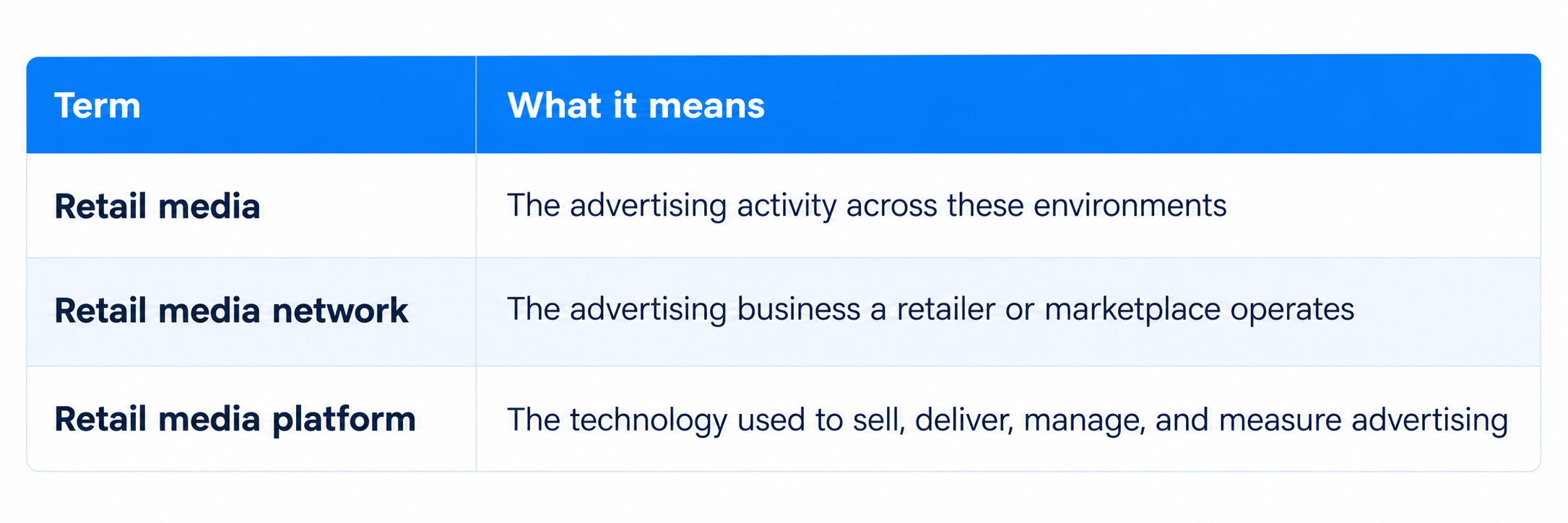
Commerce media is the broader category, extending similar models to businesses such as travel platforms, delivery services, and financial institutions.
For retailers, the opportunity begins with assets they already have: shopping intent, customer touchpoints, product information, and commercial relationships. Turning those assets into a dependable advertising offer takes planning.
How retail media has evolved
Retail media’s evolution can be understood as a progression in capabilities. Retailers develop these at different speeds; there is no single sequence every business must follow.
From individual placements to sponsored products
A homepage banner can be sold through a conversation. A sponsored product program needs a more structured system: eligible products, placement rules, pricing or bidding, budgets, and reporting.
Advertising becomes something multiple suppliers can buy repeatedly. It also becomes more closely connected to merchandising, because paid visibility must work alongside organic product discovery and availability.
From onsite campaigns to broader shopper reach
Retailers can extend their advertising offer across digital properties, external media, and physical stores.
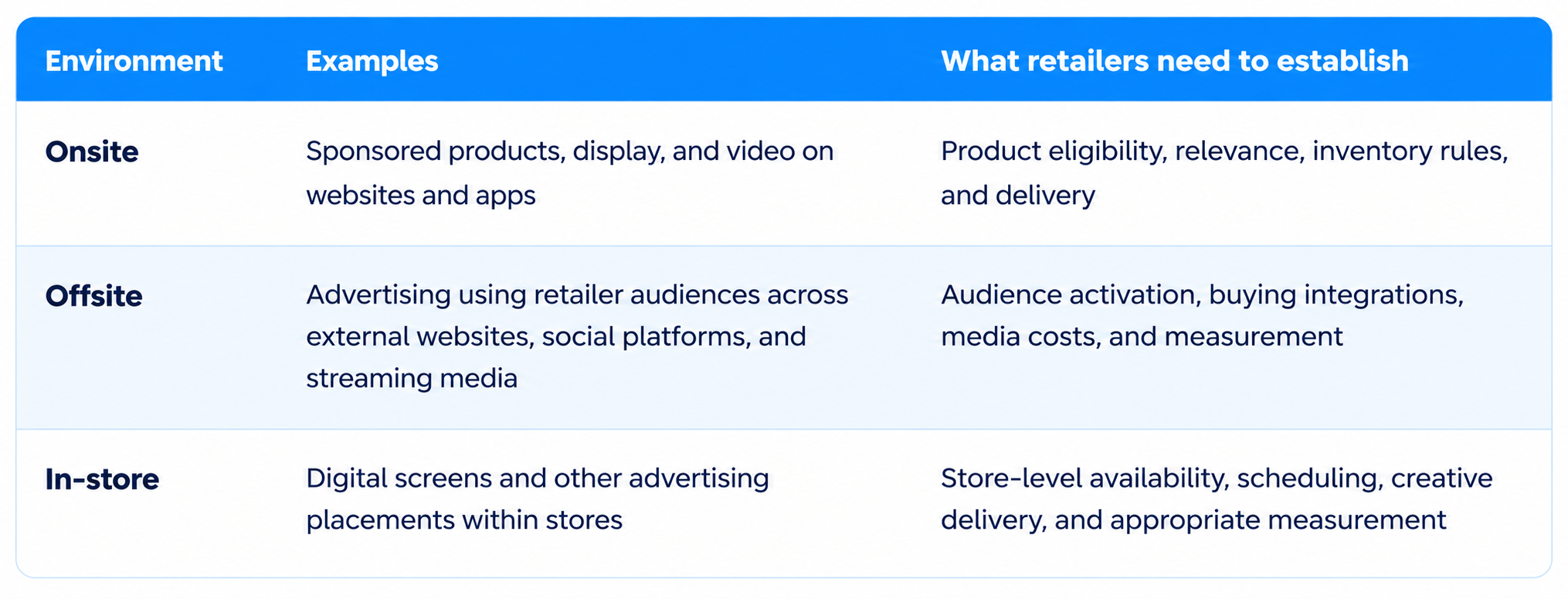
Each environment creates different operational requirements. A retailer should establish how a channel will work before adding it to an advertiser package.
From manual execution to scalable buying
As advertiser numbers grow, teams need repeatable processes for onboarding, approvals, delivery, reporting, and billing.
Self-service can let advertisers complete routine tasks directly. Managed support remains useful for complex campaigns or buyers who need assistance. The right combination depends on the advertising products and the people buying them.
This is where infrastructure becomes central: can your team support more business without every campaign creating proportionately more work?
From reported sales to clearer evidence of value
Attributed sales help advertisers understand reported campaign performance. Incrementality asks whether advertising generated outcomes that would not otherwise have happened.
IAB Europe’s updated commerce media measurement standards address incrementality, new-to-brand metrics, and sales reporting. These distinctions help retailers and advertisers evaluate results more consistently.
How large is the retail media opportunity in 2026?
EMARKETER’s forecast projected a $71.09 billion in US retail media advertising spend for 2026.
This provides a dated indication of market scale, rather than a final annual result. Its subsequent H1 2026 analysis describes growth becoming increasingly concentrated among larger networks, reinforcing the need for smaller retailers to give advertisers a distinct reason to invest.
For an individual retailer, the useful question is: Why would an advertiser choose our network and continue investing?
The answer might be category expertise, regional reach, valuable shopping intent, or access to particular store environments. Those strengths should shape the offer.
What Amazon and Walmart reveal about retail media
Amazon and Walmart demonstrate different aspects of a mature advertising business. Their approaches provide useful lessons, even when another retailer’s scale and resources are very different.
Amazon: Make advertising accessible during product discovery
Amazon’s Sponsored Products promote individual products in placements including search results and product pages. Its sponsored ads offering includes self-service tools for advertisers to manage campaigns.
Our takeaway is that an advertising product should be easy to understand, buy, and repeat.
For other retailers, that means clear eligibility, relevant placements, manageable campaign controls, and useful reporting. A portal supports that experience, but advertisers still need onboarding and guidance.
Amazon also supplies technology beyond its own storefront. Amazon Retail Ad Service, currently described as a beta offering, helps participating retailers offer ads on their properties, with sponsored product buying available across participating retailers.
Walmart: Connect digital and physical shopping
Walmart Connect combines onsite, offsite, and in-store advertising. Its offsite offering activates Walmart audiences across environments including connected TV, social media, and the open web.
Our takeaway is that a retailer’s advertising proposition can extend across the places its customers discover and purchase products.
For retailers with stores, that creates opportunities beyond the website. Making them sellable requires clear availability, creative requirements, delivery processes, and measurement suited to each environment.
The practical starting point is a campaign your team can reliably deliver. Expansion should follow advertiser needs and operational readiness.
What infrastructure does a retail media network need?
The requirements depend on the advertising offer, but five capabilities deserve attention.
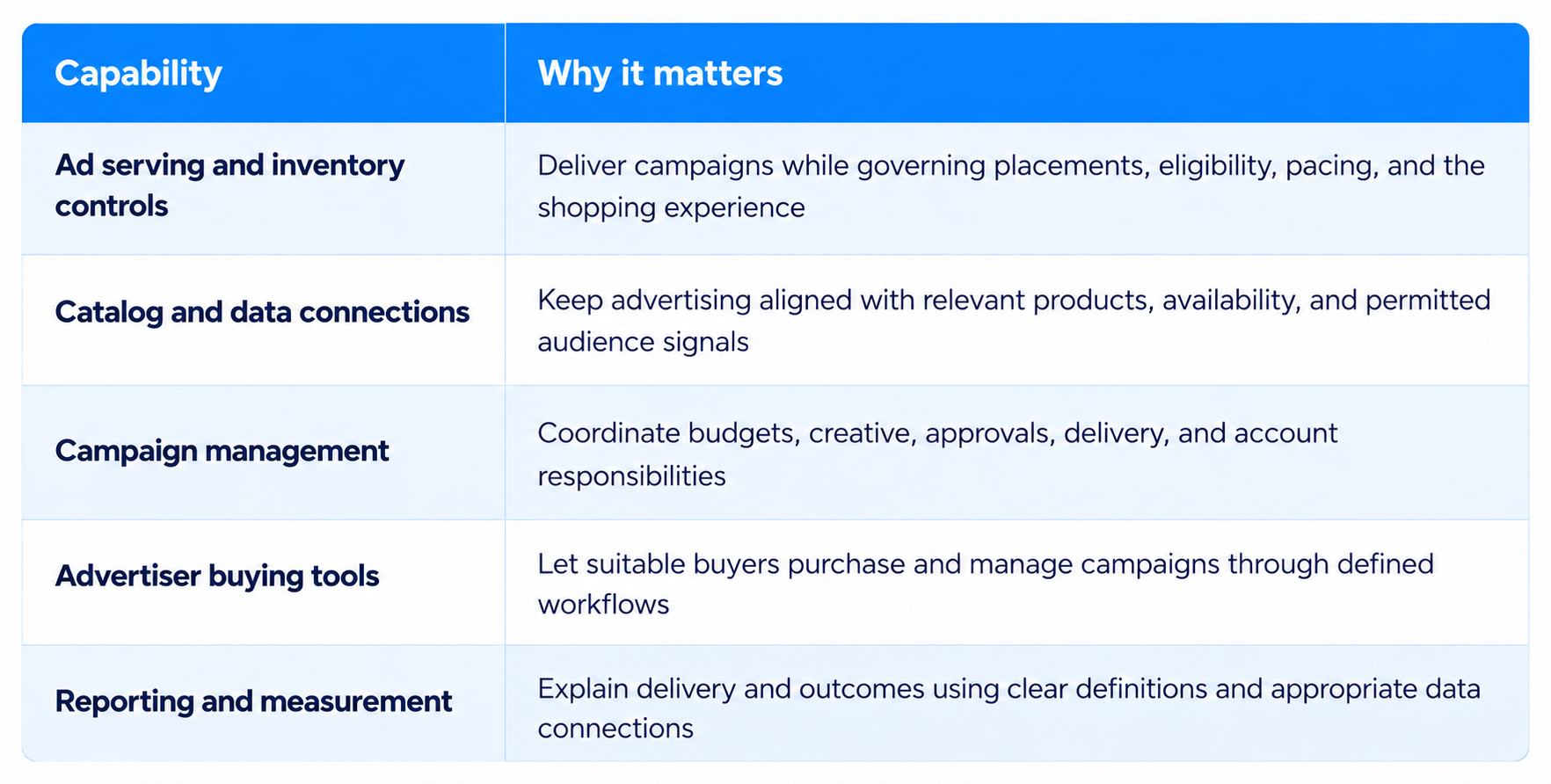
These capabilities need to work together. A campaign interface is less useful if product availability is unreliable or reporting requires extensive manual reconciliation.
Ask vendors to demonstrate your actual workflow, including exceptions such as an out-of-stock product, rejected creative, or a campaign that is behind schedule.
How to start building your own network
Define a specific first offer
Choose an opportunity that fits an existing advertiser relationship: sponsored products for suppliers, category sponsorships, or a seasonal promotion.
Specify the buyer, objective, placements, pricing, and reporting. A clear offer makes selling and delivery easier.
Decide how advertisers will buy
Identify which campaigns need hands-on support and which could become self-service.
Advertisers should understand how to launch, what they can change, and how to review results. Your team should know who handles approvals, delivery issues, and support.
Test the economics alongside performance
Review campaign outcomes together with time to launch, support effort, repeat spending, and contribution after direct costs.
A campaign can generate revenue while consuming too much staff time to scale. Our guide to scaling retail media operations explores that execution challenge.
Where AdButler fits
AdButler provides enterprise infrastructure for retailers and marketplaces building their own advertising businesses.
Commerce Catalyst brings its ad-serving foundation into workflows designed around audiences, catalogs, inventory, and self-service. It supports onsite and offsite campaign management, semantic catalog matching, and integrations with demand platforms. The implementation should specify the connections and workflows required for your offer.
AdButler’s customer work provides a practical example of building around a marketplace’s requirements. Music marketplace BeatStars built a custom promotional platform using AdButler’s API. BeatStars launched its upgraded advertising system in three months. This is an example of a customized marketplace implementation, rather than a standard rollout timeline or a Commerce Catalyst-specific result.
For retailers, the starting point could be supplier-funded onsite campaigns, followed by branded self-service as buying processes become repeatable. Expansion should follow advertiser demand and operational readiness.
Build a network advertisers can keep buying from
Retail media’s evolution creates more ways to monetize shopping intent. Sustainable growth depends on a clear advertiser proposition, reliable operations, and results buyers can understand.
Start with the strengths your shoppers and commercial partners already give you. Build an offer your team can deliver, then expand with evidence.
FAQs
How is retail media different from commerce media?
Retail media focuses on advertising associated with retailers and marketplaces. Commerce media is broader, extending similar models to businesses such as travel platforms, delivery services, and financial institutions.
Do retailers need Amazon’s scale to build a media network?
No, but they need sufficient advertiser demand and viable economics. A focused category or regional audience can support an offer; the business case should come from the retailer’s own inventory, buyers, and operating costs.
Should retailers launch onsite, offsite, and in-store together?
Only if advertiser demand and operational readiness support it. Starting with a clearly defined offer can make it easier to validate buying interest and delivery before adding channels.
Does a retail media platform automatically bring advertisers?
No. Technology supports advertising operations, while demand integrations may provide access to buyers. Retailers still need a compelling offer, onboarding, support, and reasons for advertisers to return.
Does attributed revenue prove advertising generated additional sales?
No. Attribution assigns sales to advertising under defined rules. Incrementality evaluates additional outcomes caused by advertising, typically using a suitable experiment or comparison method.
