
Unfair Truth: Owning First-Party Data Isn't the Competitive Advantage Anymore. Activating It Is.
Key Takeaways
- First-party data alone isn't a retail media strategy. The competitive advantage comes from activating it.
- Retailers need to turn customer signals into targetable audiences, measurable campaigns, and advertising products brands can actually buy.
- More data doesn't automatically mean better advertising. The quality, permissioning, relevance, and usability of that data matter.
- Retail media infrastructure should connect data, inventory, targeting, campaign execution, and measurement—not leave them operating as separate systems.
Retailers love talking about first-party data.
Purchase history. Search behavior. Product views. Loyalty activity. Cart activity. Store visits. Customer preferences.
And they're right to value it.
Retailers have direct relationships with consumers that many other media owners simply don't have. Those relationships can generate incredibly useful signals about what people browse, consider, purchase, and purchase again.
Retailers aren't wrong to believe their data is valuable. IAB Europe found that nearly 90% of buyers were motivated by access to retailer first-party data when investing in retail media.
But here's the unfair truth:
Advertisers can't buy data sitting in a warehouse.
They can buy what you build with it.
Having the data doesn't mean you're activating it.
A retailer can have millions of loyalty members, years of transaction history, and enormous volumes of behavioral data and still offer advertisers little more than basic audience targeting and sponsored listings.
As we've argued before, sponsored products alone don't make a retail media strategy and possessing first-party data doesn't change that.
The Industry Has Spent Too Long Talking About Ownership
For years, the advertising industry has repeated the same message:
First-party data is the future.
That made sense.
Privacy changes, signal loss, and growing scrutiny around third-party identifiers made direct customer relationships increasingly important.
That value is already influencing where advertisers spend. More than a third of retail media buyers cite access to first-party data as a key driver of retail media adoption, according to IAB Europe's updated 101 Guide to Retail Media.
But retail media has matured.
The interesting question isn't whether retailers have first-party data anymore.
Of course they do.
The question is:
- What can advertisers actually do with it?
- Can they reach meaningful audience segments?
- Can campaigns respond to shopping intent?
- Can targeting extend beyond basic demographics?
- Can results be connected to commerce outcomes?
- Can the retailer package those capabilities into products advertisers understand and buy?
That's where the competitive advantage moves from ownership to activation.
A Million Data Points Aren't an Advertising Product
This distinction matters.
Your data team might understand that a customer:
- buys premium skincare every six weeks;
- browsed sunscreen twice this month;
- belongs to your loyalty program;
- purchases predominantly through your app; and
- recently searched for travel-size products.
Useful? Absolutely.
But an advertiser doesn't need a database record. They need an opportunity.
For a beauty brand, that might become:
Reach high-value skincare customers showing recent summer-product intent.
Now the data has become something commercially useful.
That's the leap many media businesses still need to make.
Raw data → Audience intelligence → Targetable segment → Advertising product → Measurable outcome
That's increasingly how the industry itself defines the opportunity. IAB describes commerce media as turning owned assets;including websites, apps, and first-party data, into revenue-generating advertising channels, with first-party data supporting both targeting and measurement.
The competitive advantage isn't sitting on the left side of that chain.
It's being able to move through the entire thing.
The First-Party Data Activation Gap
Here's a simple way to think about it:
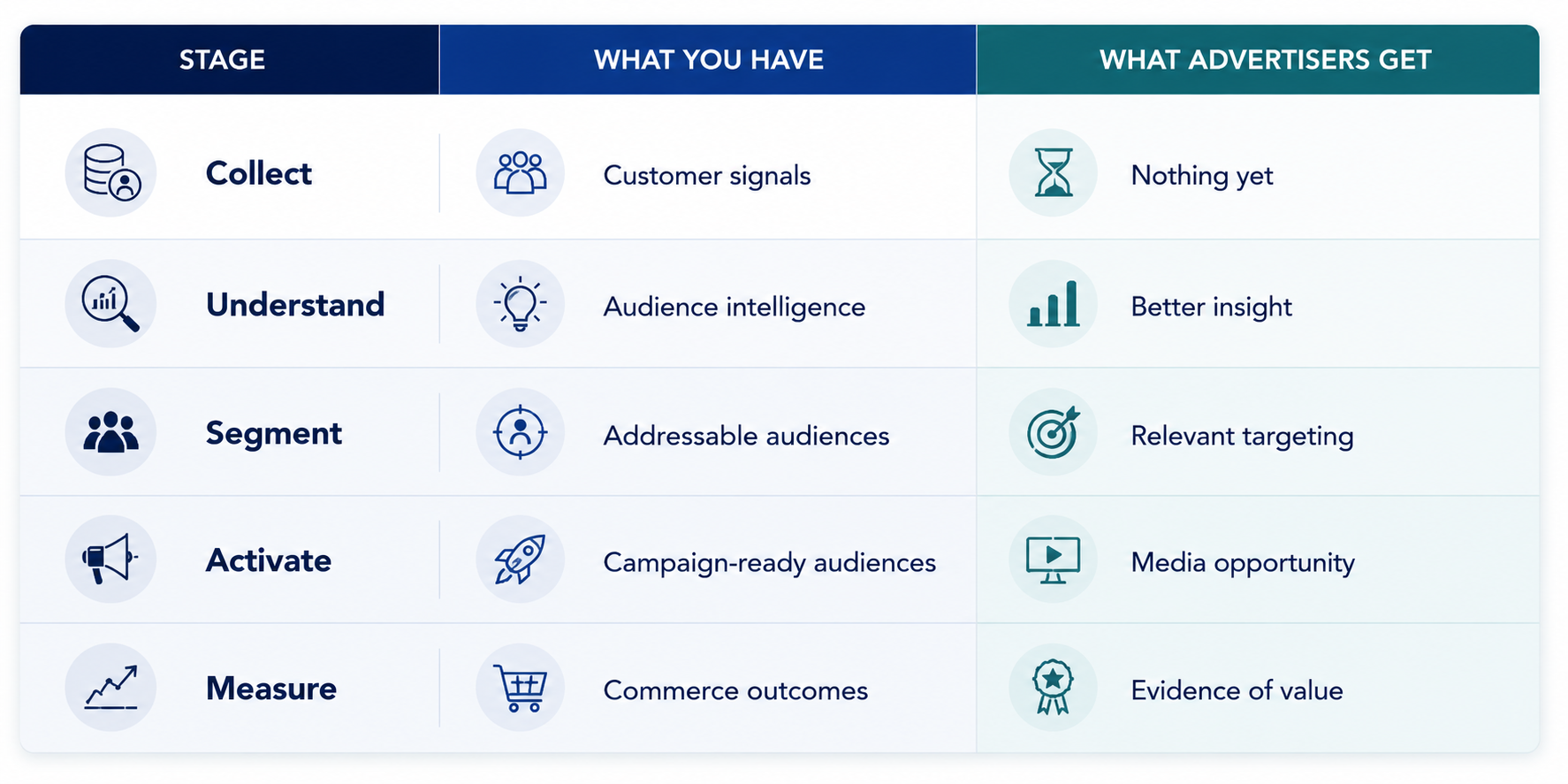
Most retailers are already collecting.
Many are increasingly good at understanding.
The competitive battleground is activation and measurement.
Measurement is increasingly part of that competitive equation. IAB Europe's 2026 Commerce Media Measurement Standards introduce a more clearly defined measurement funnel, standardized sales definitions, incrementality methodologies, and guidance for measurement and insights platforms.
That's where data stops being an internal asset and starts becoming part of the media business.
Better Activation Doesn't Mean More Targeting
There's another mistake worth addressing.
Activation isn't about using every piece of information you have to create increasingly narrow audiences. More targeting isn't automatically better targeting.
A segment with seventeen different criteria may sound sophisticated but be commercially useless if it produces almost no scale.
And just because a retailer possesses a signal doesn't necessarily mean that signal should be activated for advertising.
Privacy. Consent. Governance. Purpose. Audience size. Relevance.
All of those matter.
IAB similarly emphasizes that first-party data activation needs appropriate controls around privacy obligations, governance, consumer trust, and responsible data collaboration.
The goal isn't to expose more customer data.
It's to translate appropriate first-party signals into useful advertising decisions while protecting the customer relationship that created the data in the first place.
That distinction becomes increasingly important as retail media networks mature.
Your Data and Your Media Can't Live Separate Lives
Here's where the infrastructure problem appears.
A retailer might have:
- Customer data in a CDP.
- Transactions in a commerce platform.
- Loyalty data somewhere else.
- Campaigns in an ad platform.
- Sponsored products in another system.
- Reporting in dashboards and spreadsheets.
Technically, the retailer has everything it needs. Operationally, those assets may barely communicate.
That's a problem because retail media requires data to move from insight to decision to delivery to measurement.
If the audience exists in one system but can't influence campaign delivery in another, its advertising value is limited.
If a campaign can target an audience but results can't be connected back to meaningful outcomes, its measurement value is limited.
And if every new advertiser audience requires weeks of manual work, its commercial value becomes difficult to scale.
Data activation is ultimately an infrastructure problem.
It's the same retail media execution problem that appears when campaign management, approvals, inventory, and reporting can't keep pace with advertiser demand.
The Best Retail Media Data Products Will Be Easy to Buy
This is the part that doesn't get discussed enough.
Advertisers shouldn't need to understand your internal data architecture.
They shouldn't need to know which CDP contains which signal or how five internal systems communicate.
They need understandable products.
- Recent category purchasers.
- High-intent shoppers.
- Lapsed customers.
- Loyalty members.
- Category browsers.
- Relevant contextual audiences.
And they need to understand what those audiences enable:
- Who can I reach?
- Where can I reach them?
- How large is the opportunity?
- What inventory can I activate?
- What can I measure?
That's how first-party data becomes a media product. Not by giving advertisers more data. By making the data more usable.
We've explored the implementation side in more depth in our guide to monetizing first-party data with an ad tech platform.
Where AdButler Fits
This is why we increasingly think about AdButler as an enterprise ad tech stack, rather than simply an ad-serving endpoint.
Retailers don't need another place for valuable data to sit.
They need infrastructure that helps turn their advertising strategy into execution.
AdButler provides the campaign management, inventory management, targeting, decisioning, reporting, permissions, APIs, automation, and self-service capabilities needed to connect media execution across a retailer's owned environments.
First-party audience intelligence can then inform which campaign runs, for which audience, across which inventory, under which rules, and how performance is measured.
The retailer remains in control.
The advertiser gets a more sophisticated media product.
And the customer gets advertising that's more relevant to the context they're already in.
That's the difference between having data and building an advertising business around it.
The Real Unfair Truth
First-party data isn't scarce anymore.
Useful first-party data activation is.
The next generation of retail media leaders won't win simply because they have the biggest loyalty program or the largest transaction database.
They'll win because they can turn those assets into advertising products brands can understand, activate, measure, and buy repeatedly.
Collecting the signal is step one.
Understanding it is step two.
But the commercial value appears when you can activate it responsibly at scale.
Because data sitting in a warehouse doesn't generate media revenue.
Talk to AdButler about turning first-party audience intelligence into scalable advertising products.
FAQs
What is first-party data?
First-party data is information an organization collects directly through its relationships and interactions with customers or audiences. For retailers, this can include transactions, loyalty activity, searches, product interactions, and other consented customer signals.
What is first-party data activation?
First-party data activation is the process of making appropriate customer or audience signals usable across marketing and advertising activities, such as audience segmentation, targeting, personalization, campaign delivery, and measurement.
Why is first-party data important for retail media?
First-party data can help retailers understand shopping behavior and create advertising opportunities around relevant customer intent, audiences, and commerce interactions. This can differentiate retailer-owned media from advertising environments without the same direct commerce relationships.
Is collecting first-party data enough?
No. Data needs to be organized, governed, segmented, and connected to systems that can actually use it. Without activation, large amounts of first-party data may provide insight without creating meaningful advertising capabilities.
How can retailers monetize first-party data responsibly?
Retailers can use appropriate first-party signals to create privacy-conscious audience segments and advertising products without directly exposing underlying customer information to advertisers. Consent, governance, permissions, data minimization, and applicable privacy requirements should remain foundational.
How does an enterprise ad tech stack support first-party data activation?
An enterprise ad tech stack connects audience intelligence with the systems responsible for campaign management, targeting, decisioning, inventory, delivery, reporting, and advertiser workflows. This helps turn audience data into operational advertising capabilities rather than leaving it isolated in data systems.
