
Unfair Truth: A 100% Programmatic Strategy Is Just Outsourced Monetization
Key Takeaways
- Programmatic is an incredibly efficient distribution channel. It shouldn't automatically become your entire monetization strategy.
- A programmatic-only model can put more distance between publishers and the advertisers buying their audiences.
- Direct-sold advertising remains a major publisher revenue source. Digiday's 2026 publisher research ranked direct-sold ads ahead of programmatic ads among the publishers it surveyed.
- Publishers differentiate through assets they actually own: audience relationships, first-party data, premium inventory, context, and advertiser relationships.
Programmatic made monetization easier.
That's precisely why it's so powerful.
Connect inventory to demand. Let auctions determine pricing. Automate transactions. Fill impressions at a scale no direct sales team could realistically replicate.
But convenience comes with a risk.
When programmatic becomes your entire monetization strategy, you're no longer just automating media sales. You're outsourcing a meaningful part of your media business.
Pricing.
Buyer relationships.
- Inventory packaging.
- Campaign experience.
Convenient? Absolutely.
Strategic? Not always.
That's the unfair truth.
Automation Is a Channel. It Isn't a Business Strategy.
There's nothing wrong with programmatic. In fact, publishers need it.
Programmatic gives media owners access to enormous pools of demand without negotiating every impression individually. It creates efficiency, improves fill, and lets publishers monetize inventory that would otherwise be difficult to sell.
The problem starts when "we monetize through programmatic" becomes the answer to every revenue question.
Because your monetization strategy should answer much bigger questions.
- What is our audience worth?
- Which inventory deserves a premium?
- Which advertisers should have deeper access to our audience?
- What products can we build that competitors can't?
- Which buyer relationships should we own?
An auction can't answer those questions for you. It can only price the inventory you give it.
The More You Outsource, the Less You Differentiate
Open programmatic markets are extraordinarily good at making inventory easy to transact.
They're less effective at explaining why your inventory deserves to be different.
Think about what happens when publishers plug similar inventory into similar exchanges that buyers access through similar platforms.
The buying process becomes standardized.
And when the transaction becomes standardized, publishers risk being compared on increasingly standardized signals:
- Price.
- Audience.
- Viewability.
- Performance.
That's useful for buyers. But publishers need another layer.
Because your media business isn't interchangeable. Your audience isn't interchangeable. Your editorial environment isn't interchangeable.
And your most valuable inventory probably shouldn't be either.
That's part of why the programmatic market is becoming more nuanced.
IAB Europe's 2026 Guide to Curation in Digital Advertising examines how inventory, data, and signals can be deliberately selected, organized, and packaged to make programmatic supply easier for buyers to understand, evaluate, and activate.
The better question isn't:
How much can we automate?
It's:
What should we automate?
Direct Advertising Never Actually Went Away
There's a popular narrative that direct advertising belongs to an earlier era of digital publishing.
The numbers tell a different story.
Digiday's 2026 research, based on a survey of 56 publisher professionals and interviews with publishing executives, ranked direct-sold ads as the top publisher revenue stream by weighted average, ahead of branded content and programmatic ads.
Direct-sold advertising was also the area respondents were most focused on building over the following six months.
That isn't a rejection of programmatic.
It's evidence that publishers see value in having multiple paths to revenue.
Premium sponsorships. Newsletter packages. Homepage takeovers. Custom formats. Branded experiences. High-value audience segments.
These aren't simply impressions. They're products.
And products give publishers something commodity inventory doesn't:
Differentiation.
The Publisher Ownership Test
Here's a simple way we think about it at AdButler.
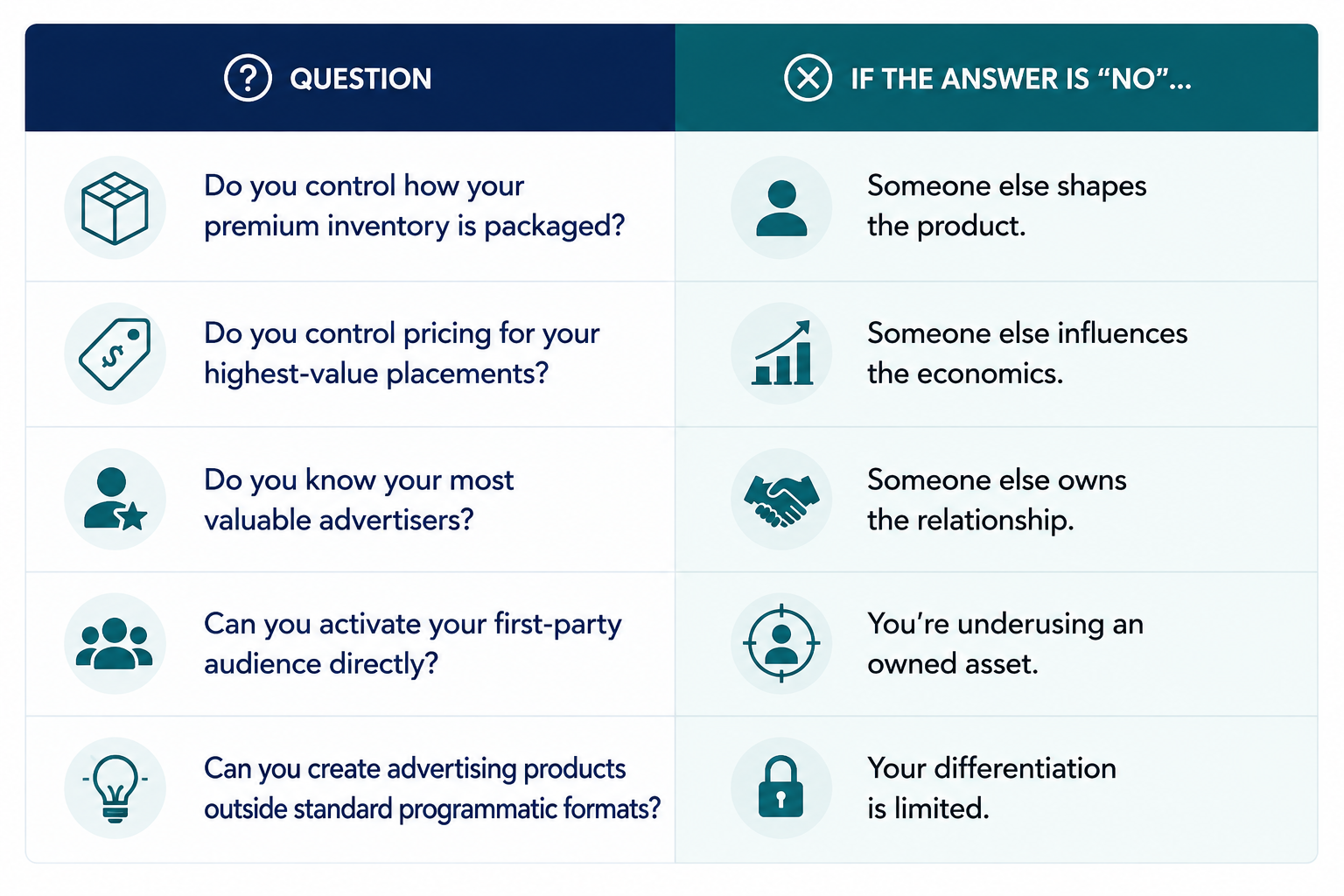
You don't need a "yes" to everything.
But if the answer is no across the board, you should ask a harder question:
How much of your monetization business do you actually own?
First-Party Data Makes Ownership More Important
This becomes even more important as publishers invest in first-party data.
In Digiday's Q1 2025 survey, 71% of publisher professionals said first-party data played the most significant role in generating positive ad revenue outcomes in 2025, up from 64% a year earlier. At the time, 85% expected first-party data to be the most significant in 2026.
But collecting first-party data isn't the end game. As we've explored before, the real opportunity is learning how to monetize first-party data without giving up control of the audience relationship.
The value comes from what publishers can do with it.
- Build audience segments.
- Create advertiser packages.
- Improve targeting.
- Develop premium products.
- Strengthen measurement.
- Build direct relationships around audiences competitors can't replicate.
If you've spent years building a proprietary audience only to make it available exclusively through someone else's transaction layer, you're leaving strategic value on the table.
This Isn't Programmatic vs. Direct
As we argued in Programmatic Solved Scale. It Didn't Solve Control, the goal isn't to choose between automation and ownership.
Programmatic should have a job.
So should direct.
Programmatic is excellent at creating scale, liquidity, automation, and broad demand.
Direct monetization is excellent at creating premium products, custom relationships, differentiation, and greater commercial control.
And even within programmatic, the choices aren't binary. Private marketplaces, preferred deals, and programmatic guaranteed can combine automation with different levels of control over inventory, buyers, pricing, and deal structure.
IAB Europe, for example, describes programmatic guaranteed as combining the predictability and transparency of traditional buying with programmatic's data, scale, and efficiency.
The smartest strategy is deciding which inventory belongs where.
Where AdButler Fits
This is exactly why we believe publishers need an enterprise ad tech stack that gives them more control over how their media business operates.
Your technology shouldn't dictate your monetization model.
It should give you the infrastructure to build the model you choose.
AdButler gives publishers an enterprise ad tech stack for managing direct campaigns, premium inventory, custom advertising products, audience targeting, reporting, automation, self-service, and programmatic integrations within a unified platform.
That means publishers can automate where automation makes sense while maintaining the ability to build differentiated products, manage direct advertiser relationships, control campaign delivery, and decide how premium inventory is packaged and monetized.
Programmatic becomes one part of the stack.
Not the entire strategy.
Because the goal isn't to eliminate intermediaries.
It's to make sure your media business doesn't become dependent on them.
The Real Unfair Truth
Programmatic isn't the problem. Dependence is.
If 100% of your monetization runs through systems where someone else controls the buyer relationship, transaction mechanics, and access to demand, you've built an efficient revenue stream.
But have you built a media business?
Publishers have spent years investing in audiences, content, communities, data, and trust.
Those are owned assets.
They deserve an owned monetization strategy around them.
Use programmatic for what it does exceptionally well.
- Automate.
- Scale.
- Fill.
- Compete.
But keep building the things only you can own.
Your audience. Your inventory. Your advertiser relationships. Your media business.
Ready to Own More of Your Monetization?
You don't have to choose between programmatic efficiency and direct control.
AdButler provides the enterprise ad tech infrastructure publishers need to manage direct campaigns, premium inventory, custom advertising products, self-service workflows, reporting, and programmatic integrations within a flexible technology stack.
FAQs
What is programmatic monetization?
Programmatic monetization uses automated advertising technology to sell publisher inventory through exchanges, private marketplaces, preferred deals, programmatic guaranteed transactions, and other automated buying mechanisms.
Should publishers stop using programmatic advertising?
No. Programmatic provides scale, efficiency, fill, and access to broad advertiser demand. The strategic question is whether it should represent a publisher's entire monetization model or operate alongside direct and premium revenue products.
What is direct-sold advertising?
Direct-sold advertising involves a publisher selling inventory or advertising products directly to an advertiser or agency. It can include sponsorships, premium placements, newsletter advertising, custom campaigns, audience packages, and other negotiated opportunities.
Can direct advertising and programmatic work together?
Yes. Publishers can combine direct campaigns with open-market programmatic, private marketplaces, preferred deals, and programmatic guaranteed transactions. The objective is to use each channel where it creates the most value.
Why does first-party data matter for publisher monetization?
First-party data can help publishers understand and segment their audiences, improve targeting and measurement, and create differentiated advertising products. In Digiday's Q1 2025 survey, 71% of publisher professionals said first-party data played the most significant role in generating positive ad revenue outcomes for 2025.
How can an enterprise ad tech stack give publishers more control?
An enterprise ad tech stack gives publishers centralized infrastructure for managing inventory, campaign delivery, targeting, reporting, direct sales, self-service, and programmatic integrations.
Instead of allowing a single demand channel to define the monetization strategy, publishers can build multiple revenue models around their audiences and inventory while maintaining greater control over how those products are sold and delivered.
