
Unfair Truth: Self-Service Isn't About Reducing Headcount. It's About Removing Growth Ceilings.
Key Takeaways
- Self-service is growth infrastructure. Its strategic value is increasing the business your team can support, not simply reducing administrative work.
- Smaller campaigns need different economics. Reducing manual handling can make advertisers with smaller budgets more practical to serve.
- Self-service and managed service should complement each other. Automate repeatable tasks while keeping people involved where expertise and relationships matter.
- Growth still needs governance. Evaluate self-service through campaign activation, cost to serve, repeat spending, and operational control—not just portal registrations.
Self-service is usually introduced with an efficiency pitch: fewer emails, less manual campaign setup, and less repetitive work for ad operations. Those benefits matter, but they undersell the opportunity.
At AdButler, we think the more useful question is not how many tasks your team can stop doing. It is how much more business they could support if those tasks stopped consuming their time.
The real value of self-service isn't fewer people. It's more room to grow.
That distinction matters in an expanding market. European on-site retail media spending reached €13.3 billion in 2025, up 16.7% year over year, according to IAB Europe’s AdEx Benchmark Report.
A growing market doesn't guarantee growth for every retailer. Your operation still needs to turn advertiser interest into campaigns it can deliver efficiently.
Managed Service Works... Until Everything Is Managed Service
Managed service has an important place. A strategic advertiser buying a bespoke campaign may need planning, creative collaboration, audience recommendations, and ongoing optimization. That is expertise worth providing.
The problem is applying that same operating model to every transaction. Picture a retailer where a small campaign, a routine budget change, and a major sponsorship all enter the same queue. Each requires someone to interpret an email, update a platform, and confirm the change.
Hiring can add capacity, but it doesn't change the underlying relationship between campaign volume and manual work. This is the retail media execution problem we explored in our earlier Unfair Truth: attracting more advertisers doesn't help much when operations cannot keep up with them.
Self-service gives you a way to change that relationship without removing the people who make your most valuable partnerships work.
Self-Service Changes the Economics of Who You Can Serve
Consider a regional supplier testing a modest advertising budget. Its campaign may not justify custom planning, repeated setup calls, and manually prepared reports. That doesn't make the supplier unimportant; it means the service model needs to fit the opportunity.
When routine buying and campaign management require less intervention, smaller budgets can become more economical to support.
Emerging brands, marketplace sellers, and existing suppliers testing new placements can then become realistic customers—not prospects your team cannot afford to spend time on.
Self-service can make previously uneconomical revenue economical to serve.
That is a stronger business case than saving a few hours on administration. But a portal doesn't create demand by itself. Advertisers still need a clear offer, useful inventory, and a reason to spend again.
Advertisers Want Less Friction Too
This isn't only an internal efficiency question. In IAB Europe’s 2025 discussion of retail media buying, committee contributors identified API access, self-service tools, and standardized measurement as ways to simplify activation and reduce friction.
For an experienced advertiser, checking campaign performance shouldn't require an account-manager request. Nor should every routine change become an email exchange. The service should help the advertiser make better decisions, not stand between them and basic functionality.
Advertisers also have multiple buying environments to navigate. IAB Europe reported that the share of surveyed brands working with four to six retail media networks rose from 10% in 2024 to 24% in 2025.
Your buying experience is part of your product. Make it useful enough that advertisers want to return—not merely functional enough to complete their first purchase.
The Retail Media Scalability Gap
Self-service doesn't have to mean leaving every advertiser to do everything alone. IAB Europe’s retail media guide distinguishes managed-service and self-service buying, alongside programmatic approaches.
Our view is that the right operating model assigns human attention deliberately. Use the following framework to decide where that attention creates the most value.
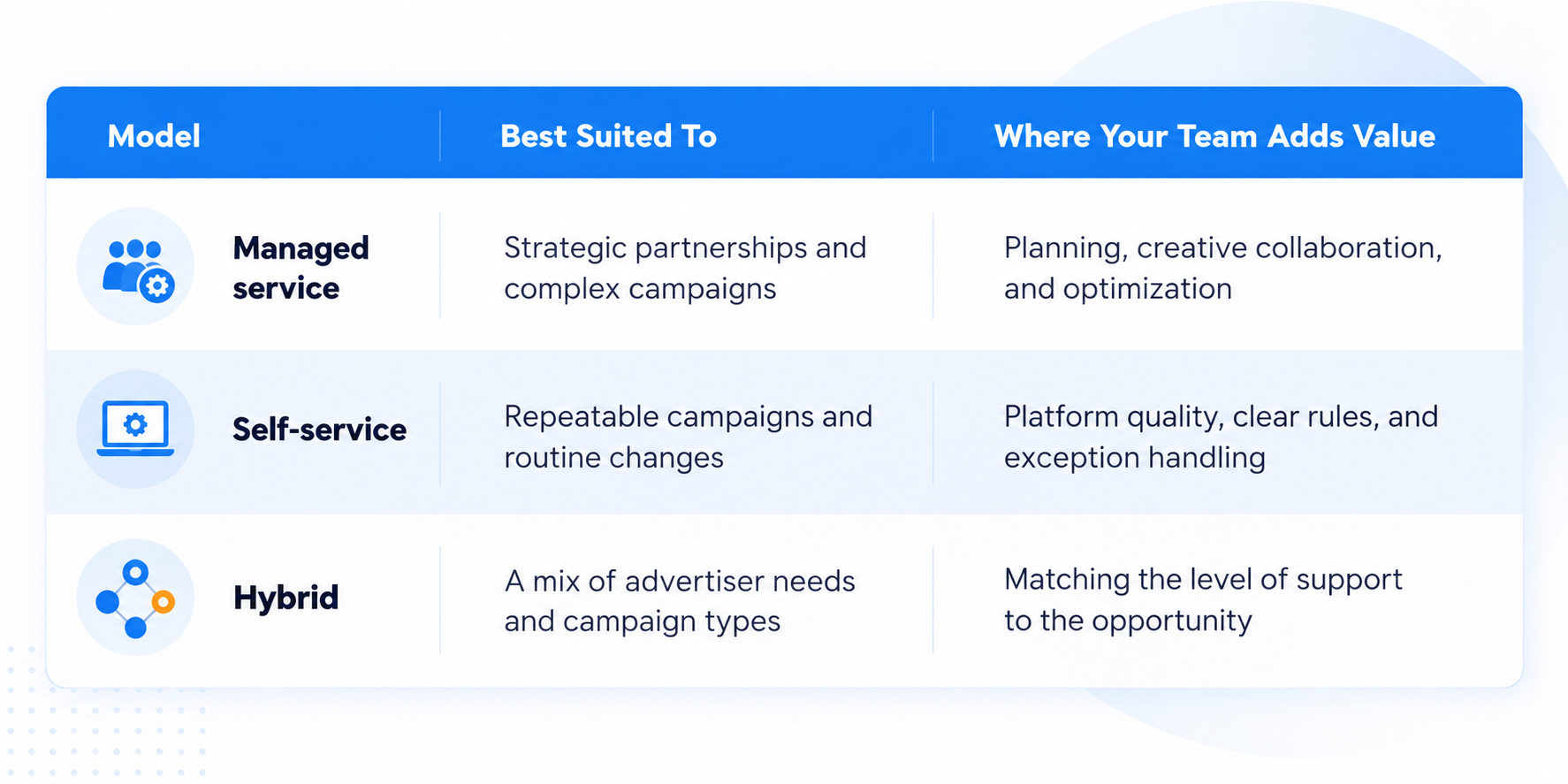
A large advertiser may want strategic support while managing everyday adjustments itself. A smaller supplier may need onboarding assistance before becoming a confident repeat buyer.
The point is not to divide advertisers rigidly by budget. It is to stop treating every campaign task as though it requires the same level of service.
Self-Service Shouldn't Mean Giving Up Control
Before opening advertiser access, decide what should be available and what should remain restricted. Your team should define inventory access, pricing rules, creative requirements, targeting options, and approval responsibilities.
Then design the workflow around those decisions. Routine activity should follow established rules, while exceptions reach the appropriate person. Removing manual steps should not mean removing accountability.
This also means making the interface understandable. Unclear inventory descriptions, confusing requirements, and difficult reporting can send advertisers straight back to your support team.
Moving work into a portal isn't an improvement if someone still needs to explain every screen.
Good self-service removes unnecessary intervention without removing necessary oversight.
The Goal Is More Value per Operational Hour
Headcount alone is a poor way to judge this investment. We would track staff time per standard campaign, time to first launch, support requests per advertiser, and repeat spending.
Look beyond gross revenue, too. Account for platform, payment, and support costs when assessing whether a new advertiser segment is worthwhile. A campaign that needs less manual setup can still be expensive to serve if it generates repeated support requests.
And distinguish migration from growth. Moving an existing managed campaign into self-service may improve efficiency, but it doesn't automatically create additional revenue.
The larger opportunity appears when that capacity helps you serve new advertisers, retain repeat buyers, or develop more valuable partnerships.
That is where your team should spend the time it gets back: improving the business, not simply processing more of it.
Where AdButler Fits
Self-service belongs inside the infrastructure running your media business, not beside it as another disconnected tool.
AdButler provides an enterprise ad tech stack that brings together campaign management, audience activation, reporting, self-service, and programmatic capabilities, with APIs for connecting the surrounding systems.
Within that stack, branded self-service portals let advertisers configure campaigns while media owners retain control over their inventory, pricing, and advertising standards. Self-service campaigns can operate alongside direct-sold and programmatic advertising.
The controls extend beyond the interface. AdButler’s publisher portal settings include public or invitation-only access, order-value limits, and configurable order-approval behavior.
The objective is straightforward: give advertisers more independence without making your team manage another disconnected operation.
The Real Unfair Truth
Hiring more people isn't a failure. Neither is offering managed service. The problem is making every additional campaign depend on another block of manual effort.
Strategic relationships deserve people. Complex campaigns deserve expertise. Routine execution shouldn't consume the same attention as either.
Self-service should create room for your team to build larger partnerships, improve advertising products, and support advertisers you previously couldn't serve economically.
The question isn't how few people you can operate with. It's how much more opportunity those people can unlock.
Ready to Remove Your Retail Media Growth Ceiling?
Start with the workflows holding your team back and the advertisers your current service model makes difficult to support.
Talk to AdButler about building self-service designed around your media business.
FAQs
What is self-service retail media?
Self-service retail media allows advertisers to buy and manage campaigns through a retailer’s platform. Depending on the implementation, they can select available inventory, set targeting, and manage campaign delivery without asking the retailer’s team to execute every step.
How does self-service differ from managed-service retail media?
With managed service, the retailer or its partner sets up and operates campaigns on the advertiser’s behalf. Self-service gives advertisers more direct control through a platform. IAB Europe’s guide explains both buying models, which retailers can offer to accommodate different campaign requirements.
Does self-service replace sales and ad operations teams?
It doesn't have to. The stronger business case is to shift people away from repetitive execution and toward strategic relationships, complex campaigns, optimization, and new advertising products. Staffing decisions should reflect the service your business needs—not become the sole measure of success.
Is self-service only useful for smaller advertisers?
No. Larger brands and agencies can also benefit from direct access to campaign controls and reporting. IAB Europe’s buy-side discussion highlights self-service and API access as ways to make retail media activation easier for brands and agencies.
Can retailers retain control over advertiser access and approvals?
Yes, when those controls are built into the platform and configured appropriately. For example, AdButler’s portal controls support invitation-only access, minimum and maximum order values, and order-approval settings. The retailer should define its access and review policies before opening the portal.
How should retailers measure self-service success?
Measure campaign activation, repeat spending, staff time per campaign, support demand, and profitability after relevant costs. Separate genuinely new revenue from existing campaigns that have simply moved into a different buying workflow.
How does AdButler support self-service retail media?
AdButler provides branded self-service managing within its broader enterprise ad tech stack. Advertisers can configure campaigns while media owners manage the commercial rules, and self-service can run alongside direct-sold and programmatic advertising.
