
Best Ad Servers for Publishers: How to Choose the Right Platform
An advertiser wants to sponsor your newsletter, reserve a homepage placement, and run a targeted campaign across three sections of your website.
Your sales team sees an opportunity. Your operations team starts calculating how many systems, spreadsheets, and manual checks it will take to deliver.
That is where choosing an ad server becomes a business decision. The platform needs to support the advertising you can sell and the team responsible for making it work.
This guide compares five options for publishers planning their 2027 stack. Our recommendations reflect different operating needs rather than a universal ranking.
At a glance
Start with your revenue model. Direct sales, programmatic monetization, and custom advertising products create different requirements.
Compare the work behind each campaign. Setup, reporting, integrations, and support matter alongside serving capabilities.
Separate infrastructure from demand. An ad server manages delivery; advertiser demand and buying-platform access need their own evaluation.
Look beyond the subscription price. Include implementation, staffing, maintenance, and migration in your comparison.
What does a publisher ad server do?
A publisher ad server manages advertising delivery across inventory such as websites and apps. It applies campaign settings, targeting, and delivery rules to select eligible ads and records activity for reporting.
It serves a different purpose from an ad network, which connects advertising demand with inventory. Understanding the difference between an ad server and an ad networkhelps publishers compare platforms with realistic expectations.
A publisher selling sponsorships may prioritize campaign control and advertiser reporting. A business relying heavily on auctions needs to examine demand integrations and yield management just as closely.
Publisher ad servers at a glance
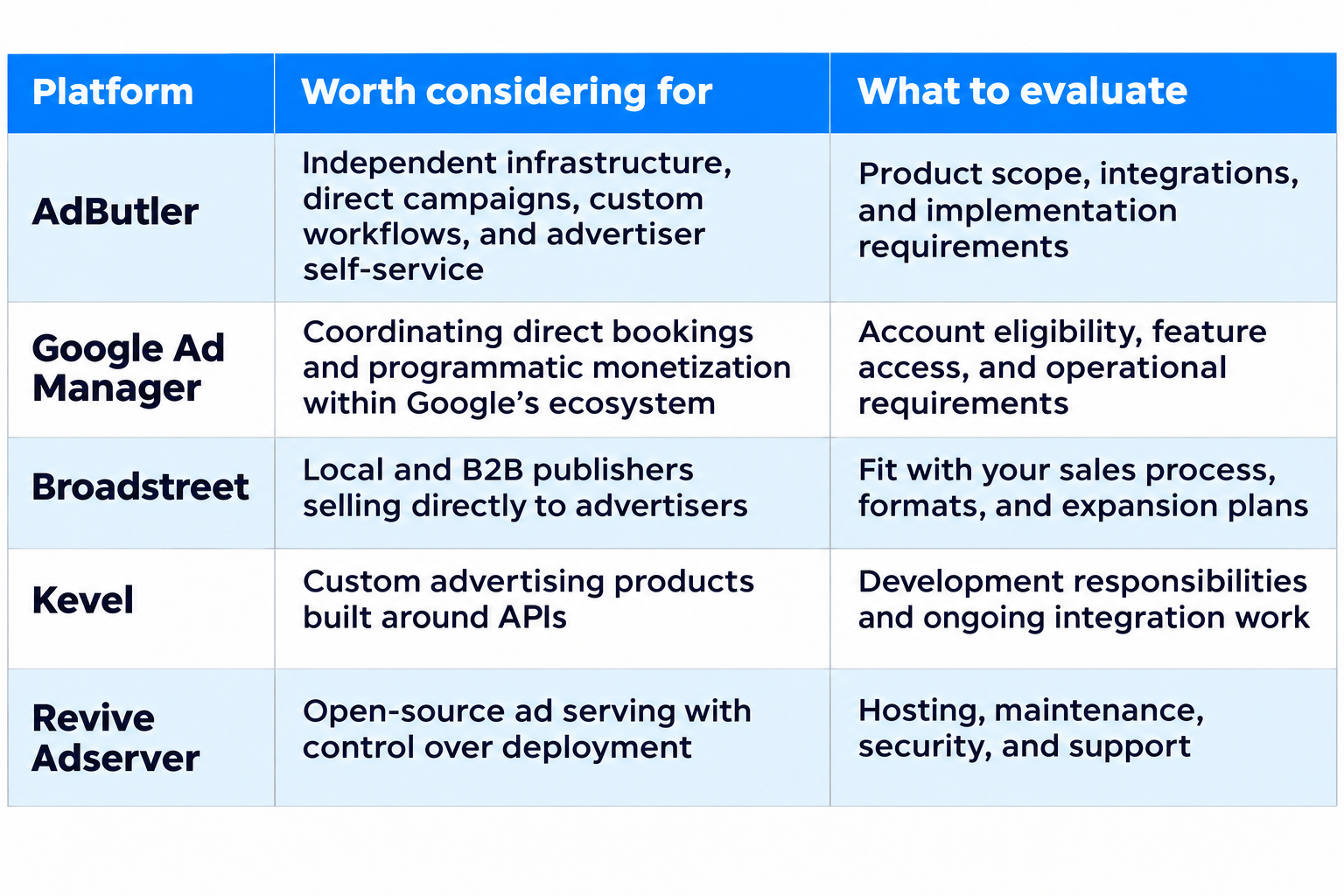
Use this as a shortlist, then verify the configuration and commercial terms available to your business.
1. AdButler: Independent infrastructure for a publisher-led advertising business
AdButler is an enterprise ad tech platform for publishers that want to operate their own advertising products and advertiser relationships.
Its display ad-serving capabilities support direct and programmatic campaigns. Self-service portal options provide another buying path, while API-based infrastructure supports custom integrations and workflows.
AdButler is worth evaluating when you want to sell across properties, introduce advertiser self-service, or connect advertising with existing business systems.
Be specific about scope. Establish which formats, integrations, and add-ons belong in the proposal, and which requirements involve development. Evaluate demand arrangements alongside the serving setup.
Our view is that publishers should be able to develop their commercial model without repeatedly rebuilding the infrastructure underneath it.
2. Google Ad Manager: Direct and programmatic monetization together
Google Ad Manager supports direct bookings and programmatic monetization. Its yield-management capabilities coordinate demand sources, while Programmatic Guaranteed supports automated reservation transactions.
It belongs on the shortlist when Google’s advertising ecosystem is central to your operation and you need to manage several transaction types.
Confirm feature availability, demand eligibility, support arrangements, and the expertise needed to operate your proposed setup. Ask for a demonstration using your campaign priorities rather than assuming every capability is available to every account.
3. Broadstreet: Direct advertising for local and B2B publishers
Broadstreet focuses on small publishers selling advertising to their own clients. Its offering emphasizes display formats, sponsored content, and workflows for local news, magazine, and B2B publishing teams.
That focus makes it relevant when advertiser relationships and repeat sponsorship sales drive the business.
Walk through creating an ad, sharing results, and renewing a campaign. If your roadmap includes more complex programmatic operations or additional media formats, ask how those requirements would fit.
4. Kevel: Custom advertising experiences built around APIs
Kevel’s ad-serving platform provides APIs and tools for custom advertising experiences, with its current positioning strongly focused on retail media. Its documented offering includes campaign management, reporting, targeting, and customizable self-service tools.
For publishers, it is worth considering when advertising needs to fit closely into a distinctive digital product, such as sponsored results within a specialist directory.
Clarify which interfaces are provided, which experiences need development, and who maintains the integration. Compare that work with your engineering capacity and launch timeline.
5. Revive Adserver: Open-source control with operational responsibility
Revive Adserver is free, open-source ad-serving software. Its documented features include campaign management, delivery rules, reporting, and contract, remnant, and override campaign types.
It is an option for publishers that value source-code access and have the resources to operate their own deployment.
For a self-hosted installation, budget for hosting, monitoring, upgrades, backups, and technical support. Assign responsibility for those tasks before comparing its cost with a hosted platform.
Compare platforms using a real campaign
Give shortlisted vendors the same brief: one guaranteed campaign, one sponsorship, and a demand source for remaining inventory.
Ask them to demonstrate setup, targeting, priority rules, delivery monitoring, and advertiser reporting. Then introduce a mid-campaign change, such as a replacement creative or revised end date.
This reveals how the system handles everyday work. Include implementation, staff time, integrations, and support in the cost comparison.
For a fuller evaluation, use our guide to choosing an ad server
FAQs
What is the best ad server for publishers?
The best fit depends on your sales model, inventory, and resources. AdButler is worth evaluating for independent infrastructure and configurable workflows. Google Ad Manager, Broadstreet, Kevel, and Revive address different needs across monetization, direct sales, customization, and deployment.
Can one ad server manage direct-sold and programmatic advertising?
Many can, but integrations and delivery rules differ. Verify how the proposed setup protects booked commitments, selects eligible demand, and reports results across both revenue sources.
Does an ad server bring advertisers to my website?
Ad serving and advertiser acquisition are separate functions. Some platforms offer demand connections, but buying an ad server does not automatically create advertiser relationships or guarantee revenue. Check what demand access is included and what requires separate agreements.
Is a free ad server cheaper than a paid platform?
It can be, depending on your resources and requirements. Compare the full operating cost, including hosting, maintenance, support, and staff time. Free software may still require substantial technical ownership.
What should publishers check before switching ad servers?
Map active campaigns, placement tags, targeting rules, reporting requirements, and demand integrations. Agree on migration responsibilities, test representative campaigns, and establish how delivery will be monitored during the transition.
Choose the platform your team can build a business on
The strongest choice should make existing campaigns manageable and the next advertising offer achievable.
For AdButler, that means giving publishers control over delivery, integrations, and how advertisers buy. Explore AdButler’s publisher ad-serving capabilities with the campaign or workflow you want to improve.
