
Best Ad Server for Newsletters (And How to Monetize Email Without Losing Control)
Key Takeaways
Newsletter monetization is shifting from simple sponsorships to structured, scalable ad operations
The best ad server should support direct deals, flexible placements, and self-serve workflows
Most email tools focus on sending — not managing advertising as a business
AdButler is often used by newsletter publishers who want more control over inventory, pricing, and advertiser experience
Newsletter monetization is evolving; fast
Not long ago, monetizing a newsletter was straightforward.
You sold a sponsorship, placed it manually, and sent the email.
That model worked—until it needed to scale.
Many publishers start by exploring the best ad servers for publishers before focusing on newsletter monetization.
As newsletters grow, complexity increases. Multiple advertisers per send, segmented audiences, recurring campaigns, and performance expectations all introduce operational friction.
At that point, a newsletter stops being just content. It becomes ad inventory.
And managing that manually quickly becomes a bottleneck.
What most newsletter tools don’t solve
Email platforms are built for communication—not monetization.
They handle sending, list management, and automation well. But they don’t provide the infrastructure needed to run advertising as a system.
That gap shows up in a few ways:
campaigns tracked in spreadsheets
ads inserted manually into templates
limited visibility into performance
difficulty scaling beyond a handful of advertisers
The problem is managing advertising within them.
What an ad server does for newsletters
An ad server for newsletters introduces structure to what is otherwise a manual process.
It allows you to manage placements, schedule campaigns across sends, and track performance in a consistent way. More importantly, it gives you control over which ads appear, how often they appear, and how inventory is priced.
In simple terms: it turns newsletter monetization into a repeatable system instead of a one-off workflow.
What to look for in a newsletter ad server
Not all ad servers are built with newsletters in mind. The difference shows up in how well they handle flexibility, workflows, and scale.
Flexible placement control
Newsletter inventory isn’t uniform.
You may have placements at the top, middle, or bottom of an email — each with different value and visibility. A strong ad server allows you to define and manage these placements dynamically, rather than treating every campaign the same.
Support for direct-sold campaigns
Most newsletter revenue comes from direct relationships; sponsorships, repeat advertisers, and custom deals.
Your ad server should make it easy to manage these campaigns, track delivery, and maintain consistency across sends. Without that structure, scaling becomes difficult.
Self-serve advertiser workflows
As demand grows, manual sales becomes a bottleneck.
Self-serve capabilities allow advertisers to browse inventory, book placements, and manage campaigns on their own. This reduces operational overhead while making it easier to scale revenue.
For many publishers, this is the turning point from manual sales to scalable monetization.
Integration with your existing workflow
A newsletter ad server shouldn’t replace your email platform—it should enhance it.
That means integrating with your ESP, CMS, and analytics tools so you can manage ads without disrupting your existing process.
Clear reporting
Visibility is critical.
You need to understand how placements perform, how advertisers are tracking, and how revenue evolves over time. Without that, it’s difficult to retain advertisers or increase pricing.
Best ad servers for newsletters (2026)
Here’s how the most common approaches compare.
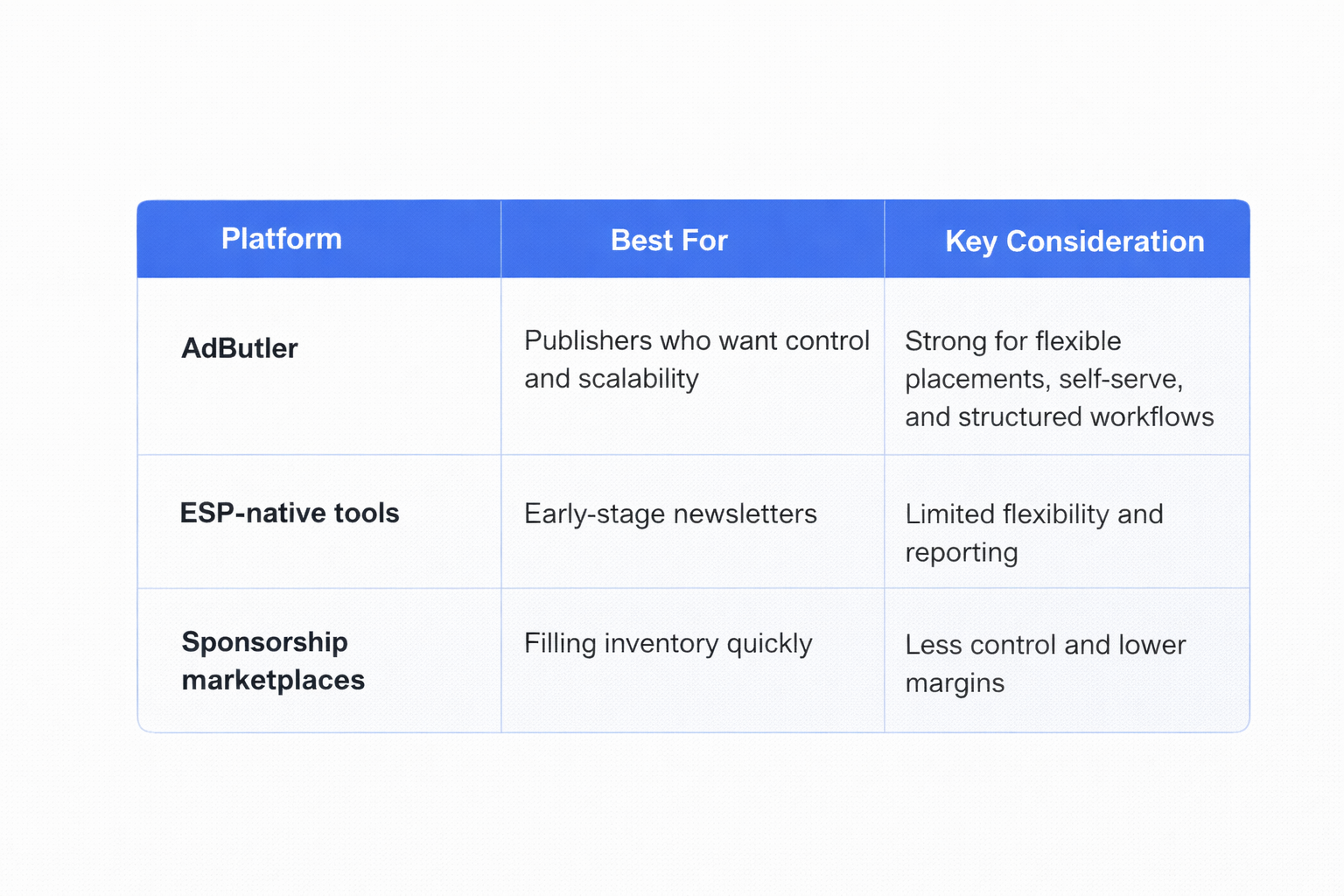
Where AdButler fits
AdButler is typically used by newsletter publishers who have outgrown manual sponsorship workflows.
It allows teams to manage multiple placements per send, schedule campaigns across newsletters, and track performance across advertisers—all within a structured system.
It also supports self-serve advertiser workflows, which helps reduce operational overhead and scale revenue without increasing headcount.
Instead of managing ads manually, you’re managing a system.
How newsletter monetization evolves
Most publishers follow a similar path.
Early on, monetization is simple—one or two sponsors per send, managed manually.
As the audience grows, complexity increases. More advertisers, more placements, and more expectations around performance lead to the need for structure.
Eventually, newsletters become part of a broader ad operation, alongside web, mobile, or retail media.
The shift is from selling placements to managing inventory.
What this looks like in practice
Without an ad server, newsletter monetization is manual. Ads are inserted by hand, tracking is inconsistent, and scaling requires more effort.
With a platform like AdButler, placements are structured, campaigns are managed centrally, and reporting is consistent. Advertisers can be onboarded more efficiently, and revenue becomes more predictable.
When you need an ad server for newsletters
You’ll usually feel the need before formally evaluating it.
This is where understanding how to choose an ad server becomes critical.
If you’re managing multiple advertisers per send, tracking campaigns outside your platform, or trying to standardize pricing and placements, those are early signals.
At that point, you’re no longer just sending emails.
You’re running an advertising operation.
Final thought
Newsletter monetization starts simple.
But it doesn’t stay that way.
As newsletters grow, they often become part of broader systems used by mid-size publishers scaling ad operations.
The publishers who scale are the ones who introduce structure early, maintain control over their inventory, and make it easier for advertisers to buy.
That’s where an ad server becomes essential. Explore our email ad serving capabilities for your newsletter.
FAQs
What is the best ad server for newsletters?
The best ad server depends on your needs, but most publishers look for flexible placements, support for direct campaigns, clear reporting, and scalability. AdButler is often used by teams moving beyond manual workflows.
Can I run multiple ads in a single newsletter?
Yes. With an ad server, you can manage multiple placements and advertisers within a single send while maintaining control over delivery and performance.
Do I need an ad server for a small newsletter?
Not always. But once you start managing multiple advertisers or recurring campaigns, an ad server becomes important for maintaining structure and scalability.
Does AdButler integrate with email platforms?
Yes. AdButler integrates with existing workflows, allowing publishers to manage advertising without replacing their email platform.
Can advertisers book newsletter ads themselves?
Yes. With self-serve capabilities, advertisers can browse placements, book campaigns, and manage ads directly, reducing operational overhead.
