
The Commerce Knowledge Gap: What AI Shopping Assistants Need Beyond Product Listings
Imagine asking a shopping assistant for a dishwasher under $700 that fits your kitchen and can arrive before the weekend.
It returns three convincing options. One is unavailable in your area. Another exceeds your budget once delivery is included. The third doesn’t fit.
The assistant understood the product category. It missed the conditions that would make the recommendation useful.
That is the commerce knowledge gap: the distance between the information an AI system can access and the context it needs to help someone make a suitable purchase.
For retailers, closing that gap means connecting accurate commerce data with the shopper’s actual requirements. At AdButler, we believe those requirements should also shape how advertising participates in the experience.
At a glance
- AI recommendations need reliable commerce data. Product descriptions may not establish current availability, total cost, compatibility, or delivery.
- Shopper context matters. A follow-up question can be more useful than an immediate shortlist when an essential requirement is missing.
- Data needs to be usable at decision time. Information must be accessible and sufficiently current to support the recommendation.
- Sponsored products should meet shopper requirements. Advertising eligibility should build on product suitability, with paid placements clearly identified.
Why the commerce knowledge gap matters now
Adobe reported that traffic from generative AI tools to U.S. retail sites grew 693% year over year during the 2025 holiday season. That measures referral growth, rather than AI’s share of all shopping, but it shows why retailers are paying attention.
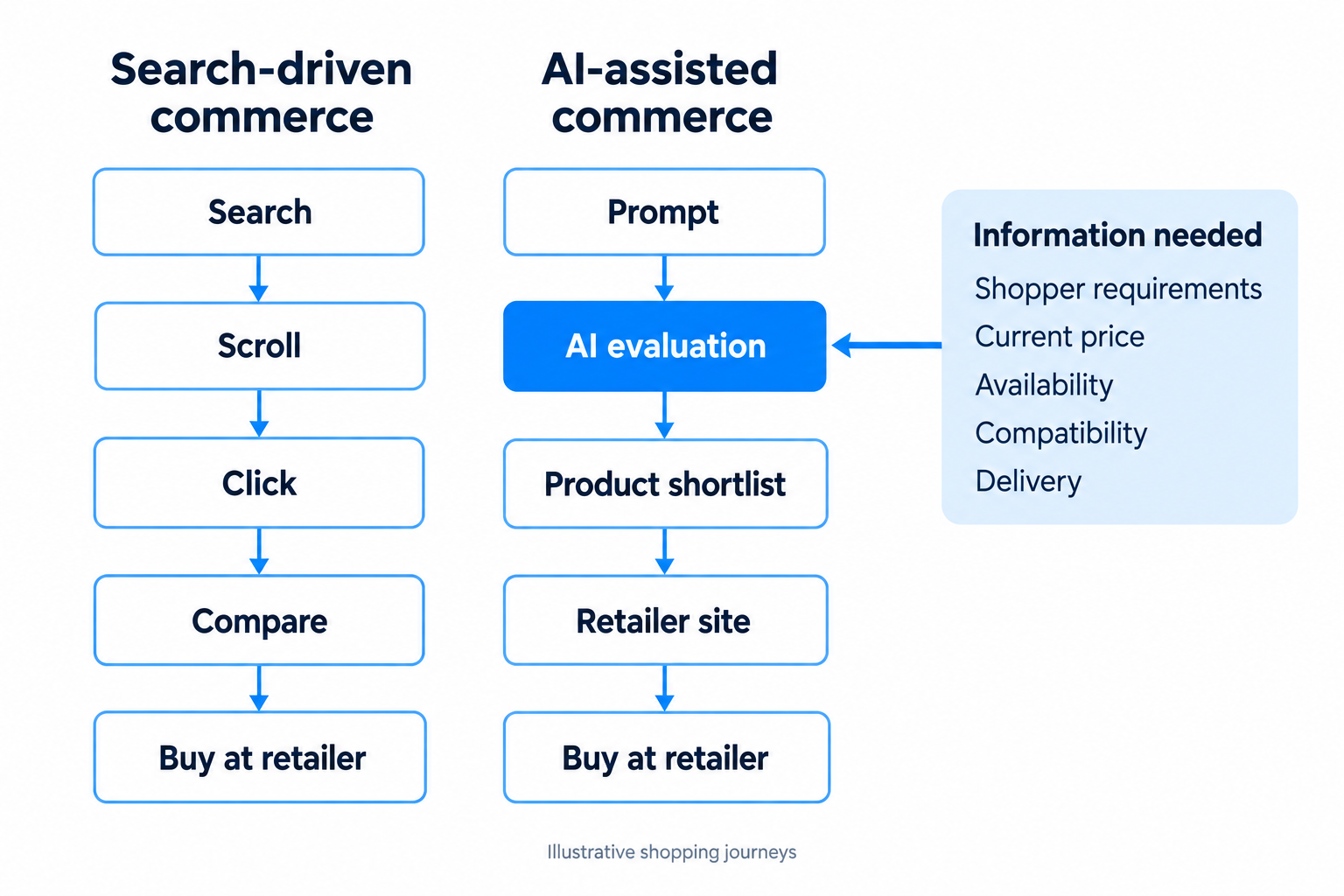
When an assistant builds a shortlist, some comparison work happens before the shopper reaches the retailer. The product page then has to support the recommendation that brought them there.
If the price differs or delivery takes too long, the shopper has to start again. For AdButler, the implication is straightforward: product visibility and the resulting shopping experience need to be considered together.
Knowing the product isn’t the same as understanding the shopper
“Find me a dishwasher under $700” leaves several questions unanswered. What space does it need to fit? Does the budget include installation? Is quiet operation essential or simply preferable?
Some answers must come from the shopper. Others need checking against retailer systems. Treating either set as obvious creates room for mistakes.
Retailers designing AI experiences should distinguish essential requirements from preferences. A preferred color might allow alternatives. An incompatible fitting usually does not.
Sometimes the most useful next step is a question. Asking for dimensions can save more time than producing a polished comparison of unsuitable appliances.
The information exists. Can the assistant use it?
Product descriptions, images, and reviews explain an item. The information needed to complete a purchase may sit across inventory, pricing, delivery, and customer systems.
Connected feeds and tools can make that information available to an assistant. But access alone does not establish whether it is current enough for the decision.
A dishwasher’s dimensions might stay unchanged for years. A delivery slot could disappear in minutes. Retailers need to decide which facts can come from a regularly refreshed catalog and which require another check before recommendation or checkout.
The experience also needs a useful response when information is missing. “Delivery needs to be confirmed” gives the shopper something actionable. An unverified arrival date creates a promise the retailer may not keep.
This reflects a broader challenge in activating first-party data: information becomes commercially useful when it can inform the decision happening now.
More data helps when it answers the right question
Purchase patterns, returns, and popularity can add context, but they need interpretation. A bestseller may be unsuitable for a particular shopper. Previous purchases may tell you little about someone buying a gift.
Start with the decision the shopper is trying to make. Then identify the information that would improve the answer.
Albertsons illustrates the potential. The company reported a 10% increase in basket size among customers using its Ask AI search capability. That is a result from its own implementation, rather than a benchmark every retailer should expect.
Basket size also tells only part of the story. Completed purchases, unsuitable substitutions, returns, and customer feedback help establish whether recommendations actually met shoppers’ needs.
Advertising should respect what the assistant has learned
These questions matter for retail media strategy, too. Once an assistant understands the shopper’s requirements, sponsored recommendations should work within them.
A dishwasher brand might have an active campaign and budget available. If its product cannot fit the kitchen or meet a firm spending limit, it should not qualify for that recommendation.
For retailer-owned AI shopping experiences, AdButler’s perspective is that product suitability should establish the eligible selection before advertising rules determine which sponsored option appears.
That requires connecting commerce facts with campaign eligibility. Paid placements should be clearly identified, and the experience should continue without an ad when no sponsored product meets the requirements.
The knowledge gained during the conversation should improve advertising relevance, too.
Where AdButler fits
AdButler provides enterprise advertising infrastructure that can support this commercial layer.
Commerce Catalyst brings campaign management, ad decisioning, catalog-related capabilities, and reporting into a platform for media networks. Its semantic matching capabilities support product-to-ad alignment beyond simple keyword matching.
For a retailer developing an AI shopping experience, that infrastructure needs connections to the systems responsible for product facts, stock, pricing, and fulfillment. The implementation must define how those inputs inform advertising eligibility.
Retailers also need visibility into poor results. If an unavailable product appears, teams should be able to investigate whether the cause was stale data, a mismatched variant, or a missed check.
Control means being able to set the rules, understand the outcome, and improve the next decision.
Start with one shopping problem
A focused use case—finding a compatible accessory or an available substitute—provides a practical starting point.
Map the questions the assistant must answer and the systems holding those answers. Define what happens when a requirement is unclear or information cannot be confirmed.
Then track unavailable recommendations, price discrepancies, completed purchases, and customer feedback alongside advertising performance. Expand when you have evidence that the experience works reliably.
FAQs
What is the commerce knowledge gap in AI shopping?
It is the gap between information available to an AI assistant and the context needed to recommend a suitable purchase. Missing information can include shopper requirements, current prices, local stock, compatibility, and delivery options.
Can AI shopping assistants access real-time commerce data?
They can retrieve current information through connected feeds, APIs, and other tools. Its usefulness depends on the integration, update frequency, and level of detail available for the shopper’s request.
How does the commerce knowledge gap affect retail media?
Missing information can produce sponsored recommendations that match a category but fail the shopper’s requirements. Connecting product suitability checks with campaign eligibility helps retailers avoid those mismatches.
Make the recommendation worth following
A useful AI shopping experience helps someone make a decision they can act on. That takes an understanding of their needs, reliable commerce information, and a buying experience that supports the recommendation.
Those same requirements should guide advertising within the journey. Explore Commerce Catalyst to discuss how.
