
Who Buys Restaurant Media? Building Packages Advertisers Want
A restaurant can have a busy ordering app, thousands of loyalty members, and screens across every location. An advertiser still needs a reason to buy.
A beverage partner might want guests to try a new drink. A regional attraction might want to reach families planning their weekend. A payment brand might want to promote an eligible offer.
Those objectives call for different placements, creative, and evidence of success. Building a restaurant media business means understanding those differences and turning them into campaigns buyers can evaluate.
In our introduction to restaurant media networks, we explored how guest-facing channels can become advertising inventory. Here, the question is who would pay for access—and what would make that investment worthwhile.
At a glance: Who buys restaurant media?
- Food and beverage partners may value opportunities to promote products available through the restaurant.
- Payment, delivery, and other commercial partners may have objectives that fit specific ordering or purchase moments.
- Local and regional advertisers may value access to guests across selected restaurants and markets.
- A useful package connects inventory to an objective, with clear delivery terms, pricing, and reporting.
- Repeat business depends on buyer value and workable economics, including the restaurant’s cost of selling and servicing campaigns.
Start with the buyer’s objective
“Reach our guests” is an opening proposition. A buyer needs more detail before committing a budget.
Which guests? In which locations? During what occasion? What should happen after someone encounters the campaign?
A restaurant’s audience may be relevant because of geography, meal occasion, menu context, or permitted customer attributes. The sales conversation should establish which of those signals matters to the advertiser.
From AdButler’s perspective, that is where packaging starts. A network needs a clear explanation of why a particular advertiser should buy a particular campaign.
Food and beverage partners: A natural starting point
Existing food and beverage partners are reasonable prospects because their products may already be part of the guest experience.
A beverage supplier could support a new drink launch. A packaged snack partner could promote an item available at participating locations.
These are often described as endemic advertisers: brands whose products are sold within the environment where the advertising appears.
The opportunity is specific. A buyer can promote something a guest may be able to purchase during that visit.
For a hypothetical beverage launch, the restaurant could offer a defined placement within its ordering app, supported by eligible restaurant screens during lunch. The package would specify participating locations, campaign dates, creative requirements, and reporting.
Existing supplier relationships still need careful commercial treatment. Establish what promotional support is already included in the agreement and what additional value the paid media package provides.
Building your first advertising offer? Download the Restaurant Media Network Playbook for guidance on potential buyers, campaign packages, and a staged approach to launching your network.
Payment and delivery partners: Match the placement to the offer
Payment and delivery brands may also have a reason to reach restaurant guests, particularly when there is an existing partnership.
A payment provider might support an eligible customer offer. A delivery partner might promote a service available through the restaurant. The campaign needs to fit the channel and the restaurant’s commercial priorities.
A restaurant promoting direct ordering, for example, should assess whether a proposed partner campaign supports that objective. A payment promotion needs clear eligibility and a customer journey that can fulfill the offer.
These buyers may care about tracked offer use or qualifying transactions. Establish what can actually be measured before making it part of the sales promise.
Local and regional advertisers: Sell a relevant market
A regional business may value a focused group of restaurants more than a chain’s entire footprint.
Potential buyers could include entertainment venues, attractions, local events, or other complementary businesses. Suitability depends on the restaurant’s audience, brand standards, and existing agreements.
Consider a hypothetical family attraction advertising across participating restaurants within its catchment area. A package could include pickup-area screens and an eligible newsletter placement, with creative adapted to each environment.
The restaurant should explain the geographic coverage and audience evidence it can support. Claims about reaching families or other groups need a defensible basis.
For smaller buyers, simplicity also matters. Clear locations, a manageable campaign period, straightforward creative specifications, and an understandable report make the offer easier to evaluate.
Turn those objectives into packages
A package should make the campaign easier to understand and deliver. Adding more channels only helps when each has a useful role. The examples below are illustrative starting points:
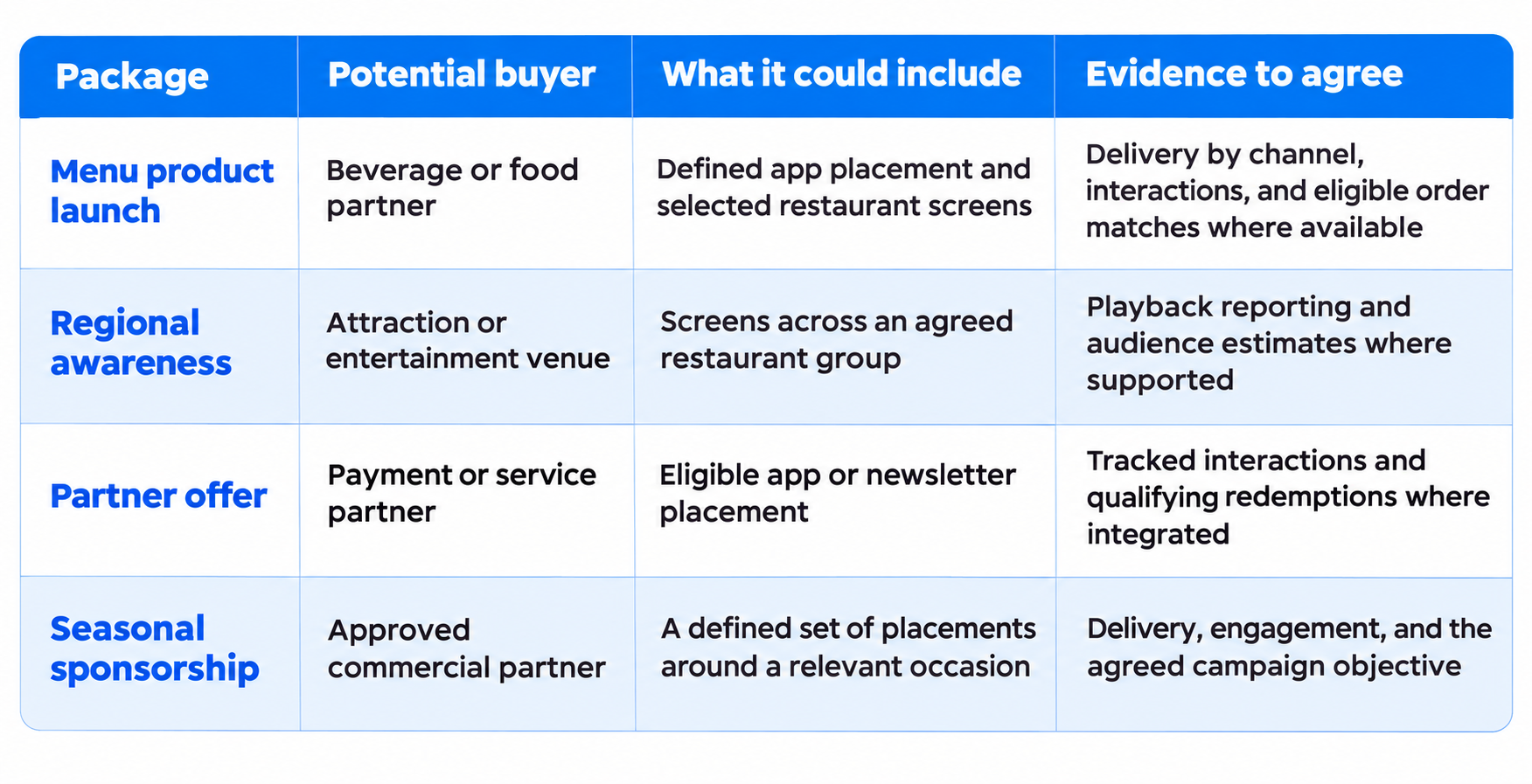
Each package needs a clear scope. State the locations, dates, placement availability, creative requirements, and delivery commitment. Explain what happens if inventory becomes unavailable or the campaign falls short of an agreed commitment.
Exclusivity should also be explicit. A sponsor may value category protection, but reserving that inventory affects what the restaurant can sell to other buyers.
Building your first advertising offer? Download the Restaurant Media Network Playbook for guidance on potential buyers, campaign packages, and a staged approach to launching your network.
Make pricing and reporting understandable
Pricing should reflect the product being sold and the evidence available to support it.
A defined sponsorship may suit a fixed fee. Digital inventory may be sold against an agreed impression commitment. Screen campaigns may use a time-based package or another clearly defined delivery model.
The restaurant also needs to account for creative support, approvals, campaign setup, reporting, and account management. A small campaign with extensive custom work can become expensive to fulfill.
Reporting is part of the offer from the outset. In IAB Europe’s 2026 Attitudes to Retail Media research, 61% of European buyers cited a lack of measurement and reporting as a barrier to investment.
Although the research covers retail media more broadly, it reinforces the importance of making campaign evidence clear to buyers.
Restaurants should explain what each channel can show. Screen playback, app interactions, and offer redemptions are different measures. Order attribution requires the relevant integrations, while proving incremental sales requires additional analysis.
Building your first advertising offer? Download the Restaurant Media Network Playbook for guidance on potential buyers, campaign packages, and a staged approach to launching your network.
Make the offer repeatable with AdButler
Once a package works commercially, the operating workflow should make it practical to sell again.
Commerce Catalyst builds on AdButler’s enterprise ad tech infrastructure with media network workflows for inventory and campaign operations. For a restaurant, those capabilities need to reflect the packages, permissions, and integrations behind its advertising offer.
A national partner may need a managed sales relationship and a tailored agreement. A repeat local buyer may be better served by a standardized package with a direct buying workflow.
AdButler’s branded Self-Serve Portal lets advertisers buy placements directly, with the media owner setting pricing and ad standards. Its value depends on having an offer buyers can understand and complete, supported by appropriate approvals.
Our view is that restaurant brands should retain control over those commercial choices. The technology should support how they want to sell, serve, and grow advertiser relationships.
Build an offer worth buying again
The first buyer may already be a partner. The next could be a regional business with a relevant audience objective.
Start by understanding what that advertiser wants to accomplish. Choose placements that fit, explain the delivery and reporting, and price the campaign so both sides can see its value.
Your restaurant’s audience is the starting point. A clear, reliable advertising offer gives buyers a reason to invest. Let’s explore what that offer could look like for your brand.
Building your first advertising offer? Download the Restaurant Media Network Playbook for guidance on potential buyers, campaign packages, and a staged approach to launching your network.
FAQs
Who are the most likely advertisers for a restaurant media network?
Potential buyers include food and beverage suppliers, payment and delivery partners, and relevant local or regional businesses. Existing relationships can provide a starting point, but each buyer still needs a clear advertising objective.
Can restaurants sell advertising to brands whose products are not on the menu?
Yes. These are often called non-endemic advertisers. Their suitability depends on audience relevance, placement context, brand standards, and existing commercial agreements.
Are franchise marketing funds the same as advertiser revenue?
Franchise marketing funds generally support the restaurant brand’s own marketing. Third-party advertising revenue comes from outside buyers paying for defined media access. Any use of co-op funds for network activity needs clear accounting and agreement on its purpose.
How should restaurants price media packages?
Pricing should reflect the agreed delivery, audience value, inventory availability, and cost of servicing the campaign. The buyer should understand whether the fee covers a sponsorship, impressions, a scheduled placement, or another defined commitment.
Should a restaurant launch self-service immediately?
Self-service is most useful when packages, pricing, creative requirements, and approvals are repeatable. Early managed campaigns can help establish those rules before opening a direct buying workflow.
