
Unfair Truth: More Ad Tech Doesn't Create More Revenue. It Creates More Complexity.
Key Takeaways
- Evaluate value, not vendor count. Every technology should justify its revenue contribution, unique capability, operational benefit, or role in protecting the business.
- Look beyond reported revenue. A partner's earnings aren't automatically additional publisher revenue. Evaluate what changes across the whole monetization operation.
- Count the operational cost. Include staff time, integrations, reporting, and maintenance—not just platform fees.
- Consolidate without closing off options. Bring core workflows together while keeping specialist partners that deliver measurable value.
A new demand partner promises better yield. A reporting platform promises clearer insights. An identity solution promises better audience reach. Each addition can look sensible on its own.
But the individual sales pitches don't tell you what the combined operation will look like. Someone still needs to connect the systems, maintain the integrations, reconcile the reports, and investigate what happens when the numbers disagree.
At AdButler, we think those responsibilities belong in the business case—not in the fine print after implementation.
More ad tech can create more revenue. It doesn't automatically create a better advertising business.
The goal isn't to build the smallest stack. It's to make sure every component earns its place.
Every Tool Starts With a Reason
There are legitimate reasons to work with multiple technology partners. IAB Europe's digital advertising supply-chain guidance identifies auction competition, access to unique demand, and specialized services as reasons publishers use multiple supply-side platforms.
Those benefits shouldn't disappear from the conversation just because consolidation becomes a priority. A partner that brings differentiated demand or supports an important format may justify the work required to operate it.
The problem begins when the original reason for adding a tool stops being questioned. Does it still provide something unique? Is the capability being used? Would you choose it again today?
A technology decision should remain accountable after the contract is signed.
Complexity Has a Cost Beyond the Invoice
Imagine an ad operations team reviewing several dashboards every morning, transferring campaign details between platforms, and manually reconciling results at month-end. None of those tasks necessarily appears in a vendor's pricing proposal.
Yet each consumes capacity that could go toward improving campaign performance, developing advertising products, or supporting valuable advertiser relationships.
We call this the Ad Tech Complexity Tax: the ongoing work required to make a collection of technologies function as one business.
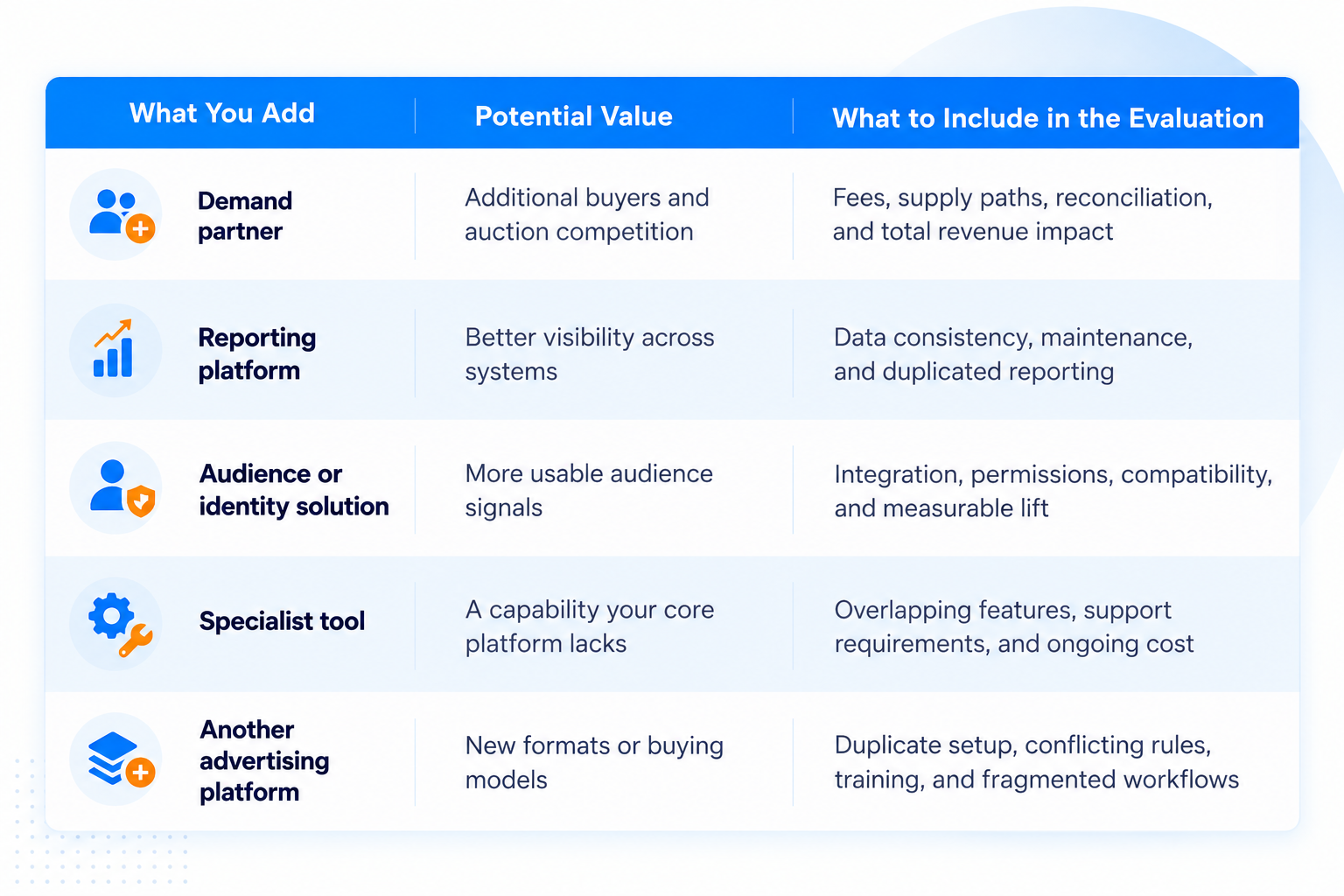
This a reminder to evaluate what a tool contributes and what it takes to keep that contribution working.
Reported Revenue Isn't the Same as Incremental Value
Revenue deserves attention. In Digiday's Q1 2025 survey, 86% of publisher professionals identified total ad revenue as a leading measure of advertising success, while 69% identified CPM or effective CPM. Those findings describe the surveyed publishers;not the entire industry.
But a business-level metric isn't enough to evaluate an individual partner.
Suppose a new demand partner reports $100,000 in revenue over a quarter. That is a hypothetical example, not proof of $100,000 in additional revenue. Some impressions might otherwise have sold through existing partners, and the new arrangement may introduce fees or operating costs.
Ask what happened to total net revenue across the business. Did the partner create additional value, or did it move existing spending through a different route?
Where practical, use controlled tests and comparable inventory. Account for changes in traffic, seasonality, and campaign mix before attributing an improvement to the new technology.
The useful question isn't “What did this platform report?” It's “What did our business gain?”
More Connections Don't Necessarily Mean More Valuable Demand
The same discipline applies to programmatic supply paths. IAB Europe describes supply path optimization as streamlining buying routes to improve the efficiency of advertising spend. Transparency helps buyers understand the intermediaries involved.
For publishers, that makes the commercial relationship worth examining. What demand does a partner bring? Which fees apply? What information is available to explain the difference between gross revenue and payment received?
IAB's 2026 discussion of supply-chain transparency highlights how bundled fees and limited visibility can make partner economics difficult to evaluate. Its recommendations include clearer publisher-side reporting of gross revenue, deductions, and net payments.
Intermediaries aren't inherently the problem. An unexplained chain of intermediaries is a problem worth investigating.
Build an Architecture, Not a Collection
Consider the difference between a deliberately designed stack and one that accumulates over time. In the first, each system has a defined job, each integration has an owner, and reporting follows agreed definitions.
In the second, one team buys a tool, another adds a platform, and a third introduces middleware to connect them. Eventually, nobody can explain the whole arrangement without calling several people.
Start your review with three questions: What unique value does this system create? Who is responsible for it? What would happen if we removed or replaced it?
IAB Europe's 2026 Supply Chain Transparency Guidance provides partner questions covering data, costs, inventory sources, and sustainability. It's a useful starting point for making those conversations more specific.
This builds on the distinction we explored in Programmatic Solved Scale. It Didn't Solve Control. Control requires understanding the infrastructure behind your revenue—not simply having access to more dashboards.
Consolidation Shouldn't Create a Different Dependency
Simplifying the stack doesn't mean moving everything into one closed environment. Fewer interfaces aren't much of an improvement if you lose access to your data or the ability to connect valuable partners.
Our approach is to consolidate overlapping core workflows while preserving specialist capabilities that justify their place. Keep the demand source that adds meaningful value. Keep the measurement or verification capability your business needs.
Evaluate exit options alongside integration options. Can you export the information you need? Can another component be introduced without rebuilding the operation?
And make changes deliberately. Test replacements, document dependencies, and protect live campaigns rather than treating vendor reduction as a target in itself.
Where AdButler Fits
AdButler shouldn't become another disconnected platform your team has to reconcile.
Our enterprise ad tech stack brings together campaign execution, audience activation, reporting, self-service buying, and programmatic capabilities.
Publishers can operate direct, self-service, and programmatic campaigns within a connected platform rather than treating each revenue model as a separate operation.
For enterprise implementations, AdButler also provides API-based integration and custom technology capabilities to connect with existing systems and business requirements.
The objective is to establish core infrastructure that makes the rest of your advertising business easier to operate.
Your monetization strategy should determine the architecture—not the other way around.
The Real Unfair Truth
The most sophisticated stack isn't the one with the most technology. It's the one where every component has a clear purpose.
A tool may earn its place through additional revenue, better execution, stronger measurement, or necessary protection. But “we've always used it” isn't a business case.
Before adding another platform, understand what your existing stack already provides—and where it genuinely falls short.
Complexity isn't a strategy. Every piece of ad tech should earn its place.
Ready to Simplify Your Ad Tech Stack?
Start with the workflows, duplicated capabilities, and unanswered revenue questions holding your team back.
Talk to AdButler about building an enterprise ad tech stack around your monetization strategy.
FAQs
What is a publisher ad tech stack?
A publisher ad tech stack is the set of technologies supporting its advertising business. It can include campaign delivery, supply-side platforms, audience data, verification, reporting, and advertiser-facing tools. The right combination depends on the publisher's inventory, commercial model, and operational requirements.
Does adding more SSPs increase publisher revenue?
It can. Multiple SSPs can provide additional demand, stronger auction competition, or specialized capabilities. IAB Europe identifies these as legitimate benefits. Publishers should still evaluate the effect on total net revenue and operating costs rather than assuming every additional connection creates additional value.
What is the Ad Tech Complexity Tax?
It's the term we use for the operational burden of making multiple technologies work together. When evaluating a stack, account for integration maintenance, staff training, duplicated workflows, reporting reconciliation, and troubleshooting alongside direct platform costs.
How should publishers evaluate an ad tech partner?
Define the partner's intended contribution before implementation. Then assess additional net revenue, unique capabilities, operating effort, transparency, and effects on the wider stack. Use controlled comparisons where practical, and revisit the business case at renewal rather than relying only on the partner's dashboard.
What is supply path optimization?
Supply path optimization evaluates and streamlines the routes through which programmatic inventory is purchased. It relies on visibility into the parties involved so buyers can assess supply paths and improve spending efficiency. It isn't simply a requirement to use the fewest possible partners.
Should publishers consolidate their ad tech stacks?
Consolidation is worth considering where tools duplicate capabilities or create avoidable operational work. It shouldn't remove valuable specialist technology or create a dependency that's difficult to unwind. Review functionality, integration requirements, data access, and migration risks before making changes.
How does AdButler help reduce ad tech complexity?
AdButler provides an enterprise ad tech stack connecting campaign execution, audience activation, reporting, self-service, and programmatic capabilities. Its APIs and enterprise integration options let publishers connect additional systems where needed, supporting consolidation without requiring every workflow to become a separate platform.
