
Why Third-Party Email Impression Tracking Doesn't Always Match Ad Server Reporting
Key Takeaways
Server-side impression tracking is commonly used in email ad serving because third-party tracking pixels cannot always be embedded directly into email creatives.
Geo-targeting decisions are made using the recipient's IP address—not the location of the server that fires third-party tracking pixels.
Third-party reporting platforms such as Campaign Manager 360 (formerly DoubleClick) may report the location of the data center that fired the impression pixel rather than the recipient's location.
Reporting discrepancies do not indicate incorrect targeting or campaign delivery.
First-party ad server reporting remains the authoritative source for campaign delivery and targeting validation.
The Question We Occasionally Hear
Imagine you're running an email advertising campaign that should only be delivered to recipients outside the United States. A subscriber in Toronto opens the email.
They receive the correct advertisement.
Later, you review Campaign Manager 360 (formerly DoubleClick) reporting and notice an impression that appears to have originated from Seattle.
Naturally, the question becomes:
Did someone in the United States receive the ad?
The answer is no.
What you're seeing is the difference between how email ad serving works and how some third-party reporting platforms record impressions.
Understanding that distinction can eliminate confusion when validating geo-targeted email campaigns.
How Email Ad Serving Works
Unlike websites, email clients have unique technical limitations.
When an email is opened, an ad server must first determine whether an advertisement should be displayed before the creative is returned.
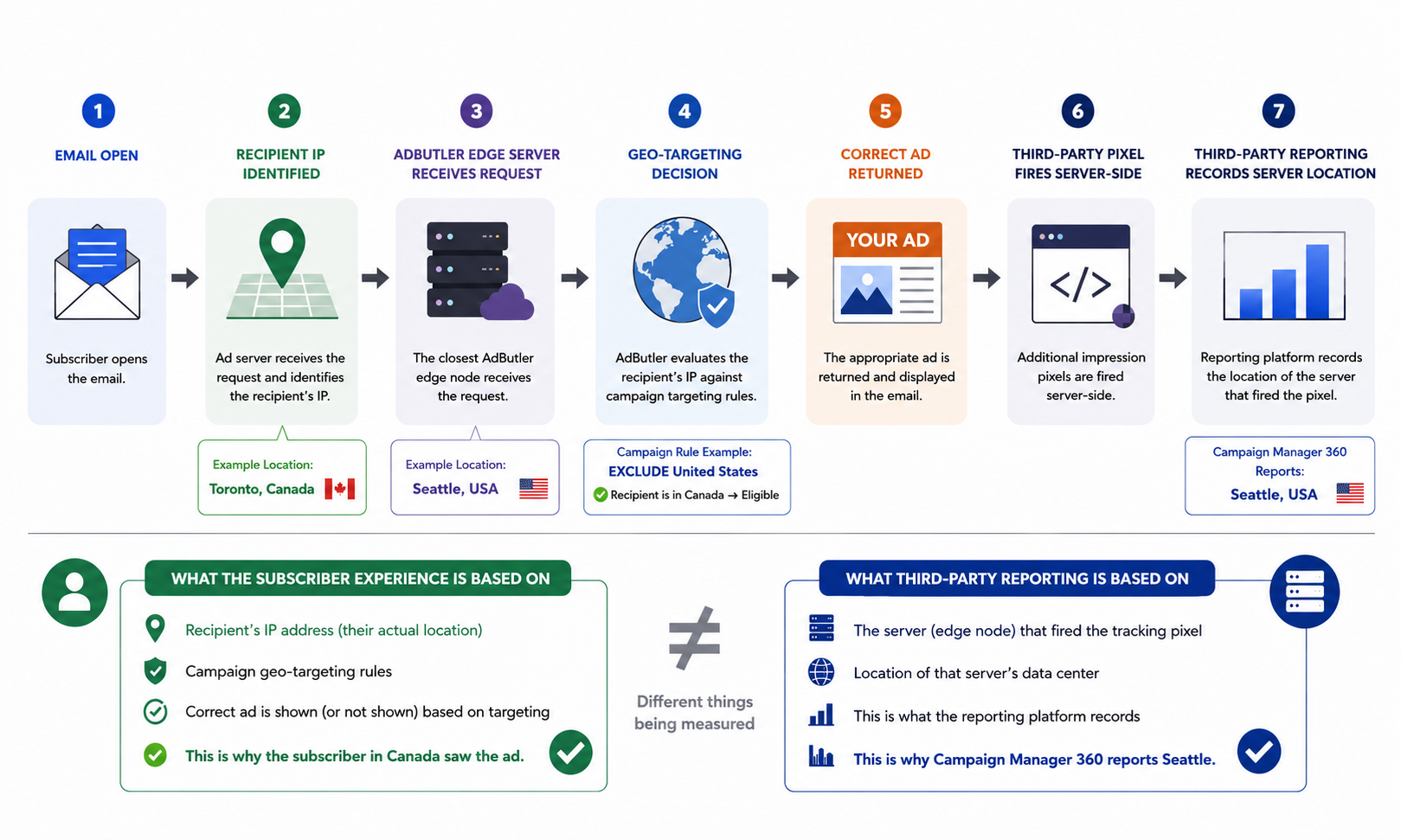
For geo-targeted campaigns, the process typically looks like this:
- A recipient opens the email.
- The ad server receives the request.
- The recipient's IP address is evaluated.
- Geo-targeting rules are applied.
- The appropriate advertisement is selected.
- The creative is returned to the email.
This decision is based on the recipient's location, ensuring that inclusive and exclusive geo-targeting rules are correctly enforced.
If the campaign excludes the United States, recipients in the U.S. won't receive the ad. If the campaign targets Canada, recipients in Canada will.
The targeting logic works exactly as intended
Where Third-Party Impression Tracking Fits In
Many advertisers also use third-party impression pixels for independent measurement.
Platforms such as Campaign Manager 360, Google Campaign Manager, or other verification tools provide an impression tracking URL that publishers or ad servers fire whenever an impression occurs.
In traditional web advertising, these pixels are typically executed directly in the user's browser. Email advertising is different.
Because of how email rendering works, these additional impression pixels are often executed server-side after the ad server has already determined which creative should be delivered
Why Reporting Can Look Different
Here's where confusion begins.
The geo-targeting decision uses the recipient's IP address.
However, the third-party impression pixel is executed by the server that made the ad-serving decision.
For example:
- Recipient location: Toronto, Canada
- AdButler edge server: Seattle, Washington
- Third-party reporting platform records: Seattle
From the reporting platform's perspective, the impression originated from Seattle because that's where the server-side request originated.
From the ad server's perspective, the recipient was correctly identified as being in Canada and received the appropriate advertisement.
Both systems are reporting accurately—they're simply measuring different things
What the Subscriber Actually Experiences
This distinction is important.
The reporting discrepancy does not affect campaign delivery.
The subscriber still:
- Receives the correct advertisement.
- Is evaluated against all geo-targeting rules.
- Is included or excluded according to campaign settings.
- Sees exactly what the advertiser intended.
The only difference is how the third-party reporting platform attributes the impression after it has been served.
Why First-Party and Third-Party Reports May Not Match
Because the two systems measure different parts of the delivery process, some variation is expected.
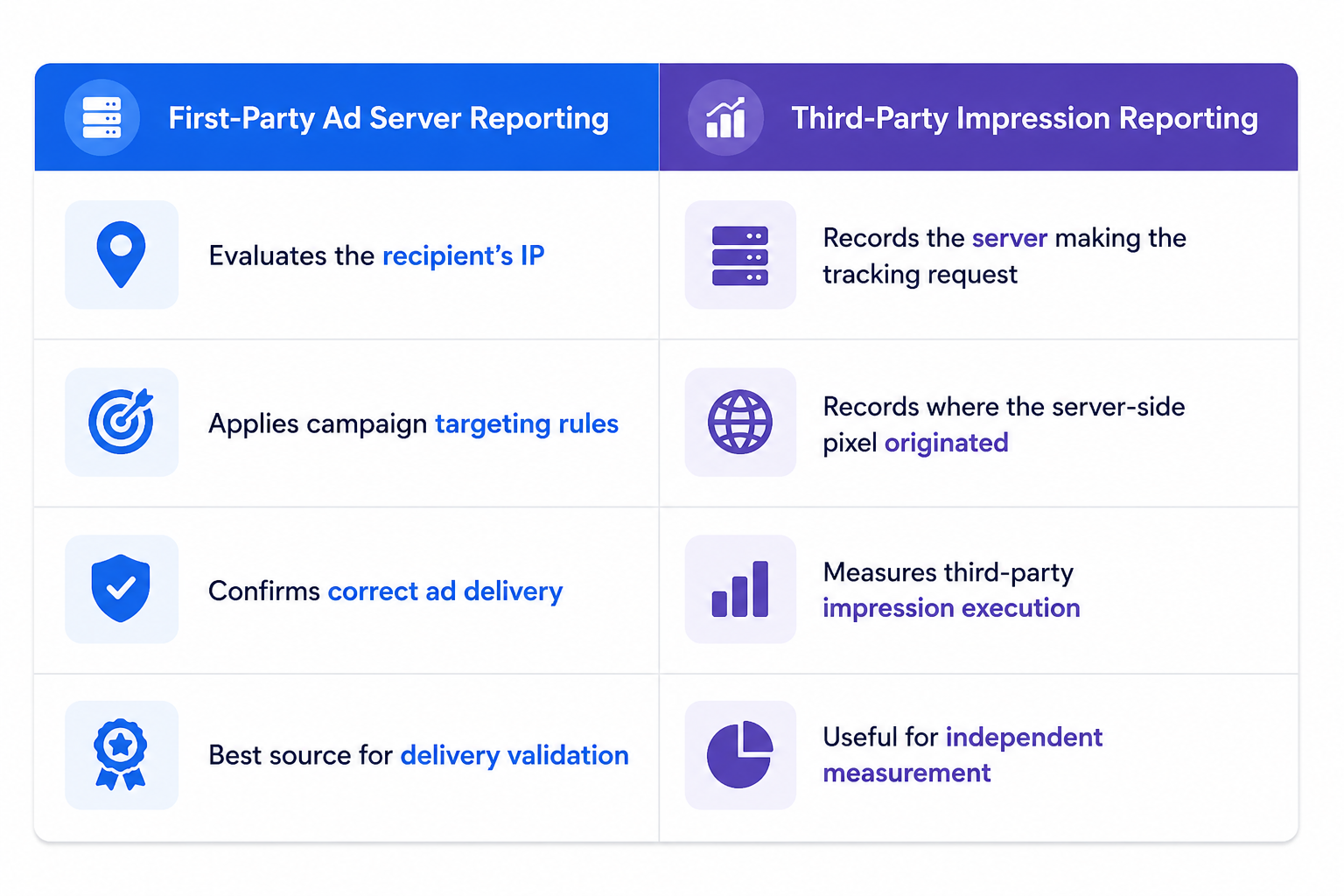
Neither report is necessarily "wrong."
They're simply answering different technical questions.
Why This Is Common in Email Advertising
Email advertising operates differently from web advertising.
Unlike a webpage, where multiple tracking scripts can execute directly within the browser, email clients impose strict rendering and security limitations.
As a result, server-side impression tracking is a common architectural approach across email advertising platforms.
When independent measurement tools are designed primarily around browser-based execution, differences in geographic reporting can naturally occur when server-side infrastructure is involved.
Best Practices for Interpreting Reports
When validating geo-targeted email campaigns:
- Use your ad server's first-party reporting to verify campaign targeting and delivery.
- Understand that third-party impression reporting may reflect server infrastructure rather than recipient geography.
- Investigate significant discrepancies, but recognize that some geographic differences are an expected consequence of server-side tracking.
- Compare multiple reporting sources before concluding that a targeting issue exists.
The Bottom Line
If your third-party reporting platform shows impressions originating from a different country than your campaign's intended audience, it doesn't necessarily mean the wrong people saw the advertisement.
In server-side email ad serving, geo-targeting decisions are made using the recipient's location, while third-party impression pixels may be executed from the edge data center that delivered the ad.
The result is a reporting discrepancy—not a targeting discrepancy.
Understanding that distinction allows marketers, ad operations teams, and advertisers to interpret campaign reports with greater confidence and focus on what matters most: whether the intended audience actually received the correct advertisement.
Learn more about AdButler's Email Ad Serving.
FAQs
Why doesn't my third-party reporting match my ad server's reporting?
Third-party platforms may record the location of the server that fired the impression pixel, while your ad server reports based on the recipient evaluated during ad serving.
Does this mean geo-targeting failed?
No. Geo-targeting decisions are made before the ad is delivered using the recipient's IP address. The recipient still sees (or doesn't see) the advertisement according to your campaign rules.
Why are server-side impression pixels used for email advertising?
Email clients have technical limitations that make client-side tracking more difficult than on traditional websites. Server-side execution ensures impression tracking can still occur after the ad-serving decision.
Should I trust first-party or third-party reporting?
For validating campaign delivery and targeting, first-party ad server reporting is the authoritative source. Third-party reporting remains valuable for independent measurement but should be interpreted within the context of server-side email architecture.
Can this affect user experience?
No. The subscriber experience is unchanged. Reporting differences occur after the ad-serving decision and do not impact which advertisement is displayed.
