
How Airlines Partner with Hotels, Rental Cars & Travel Brands to Generate New Revenue
Key Takeaways
- Airlines can turn traveler intent into valuable advertising opportunities for hotels, rental cars, tourism organizations, financial services providers, and other travel brands.
- The strongest partnerships connect an advertiser’s offering with a specific traveler need, destination, or journey moment.
- First-party signals such as destination, itinerary, loyalty status, traveler count, and booking window can make partner campaigns more relevant.
- Airlines can package traveler audiences and journey moments into premium advertising products rather than simply selling individual placements.
- AdButler provides the enterprise ad tech stack airlines need to activate audiences, manage advertisers and inventory, deliver campaigns across owned channels, and measure performance.
A Flight Booking Is the Beginning of a Much Bigger Purchase Journey
Buying a flight rarely completes a trip.
A traveler flying to Tampa may still need a hotel.
A family arriving in Queensland may need a larger rental vehicle.
A business traveler may want airport transportation or lounge access.
An international traveler may still need travel insurance.
Every unfinished part of the trip creates an opportunity for an airline to connect the traveler with a relevant commercial partner—and represents another way airlines can monetize their existing media inventory.
For airlines, that means the value of the customer relationship can extend well beyond the ticket itself.
That opportunity is becoming increasingly important. IATA expects airline ancillary and other revenues to reach $165 billion in 2026, reflecting the industry's continued focus on generating more value beyond the base fare.
The opportunity to connect traveler needs with relevant partners at the right moment.
Why Travel Brands Want Airline Audiences
Travel advertisers want to reach people while they're actively planning and purchasing trips.
Airlines already have direct relationships with those travelers.
Once someone books a flight, the airline may have access—subject to its data policies, permissions, consent requirements, and applicable privacy law—to first-party signals such as:
- Destination
- Travel dates
- Flight number
- Number of travelers
- Loyalty status
- Cabin class
- Booking window
- Existing ancillary purchases
- Elements already included in the itinerary
This broader shift extends well beyond airlines. IAB identifies airlines, hotels, and other travel companies among the consumer-facing businesses capable of building commerce media networks around first-party customer relationships, owned media, and transactional data.
That context can make an airline audience particularly valuable to travel advertisers.
A hotel doesn't necessarily want to reach people interested in Florida.
It wants to reach travelers who are actually going to Florida and may still need accommodation.
A rental car company doesn't simply want families.
It may want to reach families arriving at a specific destination who haven't yet arranged ground transportation.
The closer an airline can bring an advertiser to real traveler intent, the more valuable the media opportunity becomes.
And this model is already taking shape. United Airlines' Kinective Media, for example, uses first-party loyalty data and airline-owned media to connect advertisers with traveler audiences across different stages of their journey.
Want to go deeper?
Meet Bob: Turning a Trip to Tampa Into a Partner Opportunity
Consider a simple example.
Bob is an Acme Airlines Gold Rewards member traveling from Seattle to Tampa with his wife for a week-long vacation. His flights are confirmed.
But Bob hasn't booked a hotel.
Acme Airlines has a commercial partnership with Holiday Schminn Hotel Group, which operates several properties throughout Florida.
A generic advertising strategy might promote Holiday Schminn to everyone visiting the airline's website.
A journey-based targeting strategy works differently.
Acme already knows:
- Origin: Seattle
- Destination: Tampa
- Travelers: 2
- Trip length: 7 days
- Loyalty: Gold Rewards
- Accommodation: Not yet booked
Those signals create a clear commercial opportunity.
Rather than showing Bob an unrelated advertisement, Acme can promote a relevant Holiday Schminn property in Tampa.
And it can do so across multiple moments in Bob's journey.
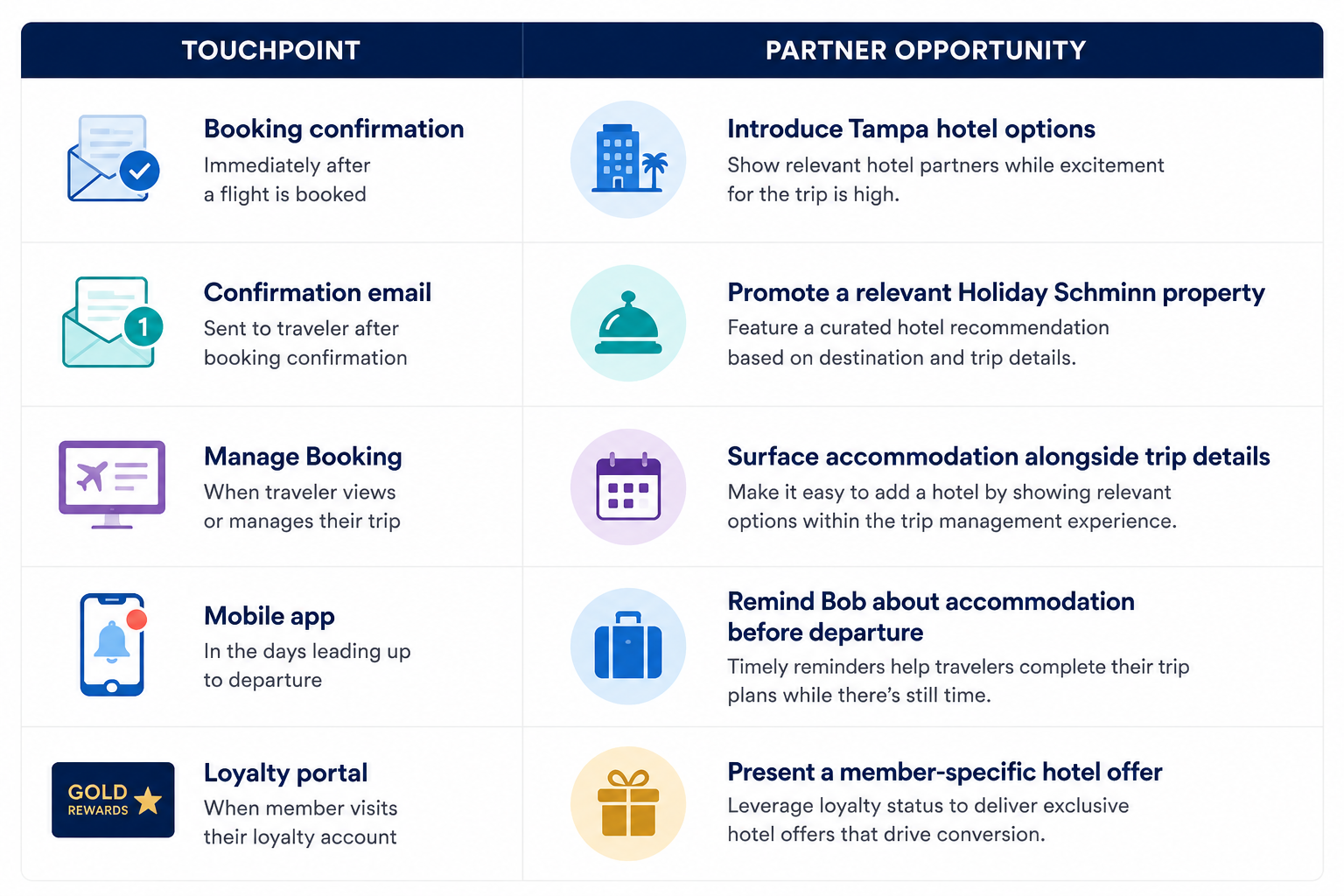
One traveler. One partner. Multiple relevant opportunities.
Why This Campaign Works
The effectiveness comes from context.
Bob isn't being targeted because he happens to fit a broad demographic profile.
He's being targeted because his actual itinerary indicates a potential need.
For Bob, the offer can help complete his trip.
For Holiday Schminn, the campaign reaches a traveler with genuine purchase intent.
For Acme Airlines, the partnership creates incremental revenue from a customer relationship the airline already owns. That's the foundation of a strong airline media partnership.
Hotels Are Only One Opportunity
The same model can extend across the broader travel ecosystem.
Rental Cars
A family of five arriving for a week-long vacation may be a strong audience for an SUV or larger rental vehicle.
A solo business traveler staying downtown for one night may not be.
Passenger count, destination, trip duration, and itinerary can help determine when a rental car campaign makes sense.
Tourism Organizations
Destination marketing organizations can reach travelers before they arrive with:
- Attractions
- Events
- Local experiences
- Restaurants
- Destination content
- Regional tourism campaigns
Instead of advertising broadly to people who might visit, tourism partners can reach travelers whose actual journey indicates interest in the destination.
Airport Services
As departure approaches, the commercial opportunity changes.
Relevant partners may include:
- Airport parking
- Ground transportation
- Lounges
- Dining
- Retail
- Fast Track services
The closer travelers get to departure, the more valuable convenience can become.
Financial Services
Airline audiences can also create opportunities for:
- Airline rewards credit cards
- Travel-focused credit cards
- Travel insurance
- Foreign exchange services
- Other relevant financial products
Loyalty status and travel frequency can help airlines determine which offers are appropriate for different audiences.
Different Travelers Create Different Partner Opportunities
The same advertiser shouldn't necessarily reach every traveler.
Consider four journeys:
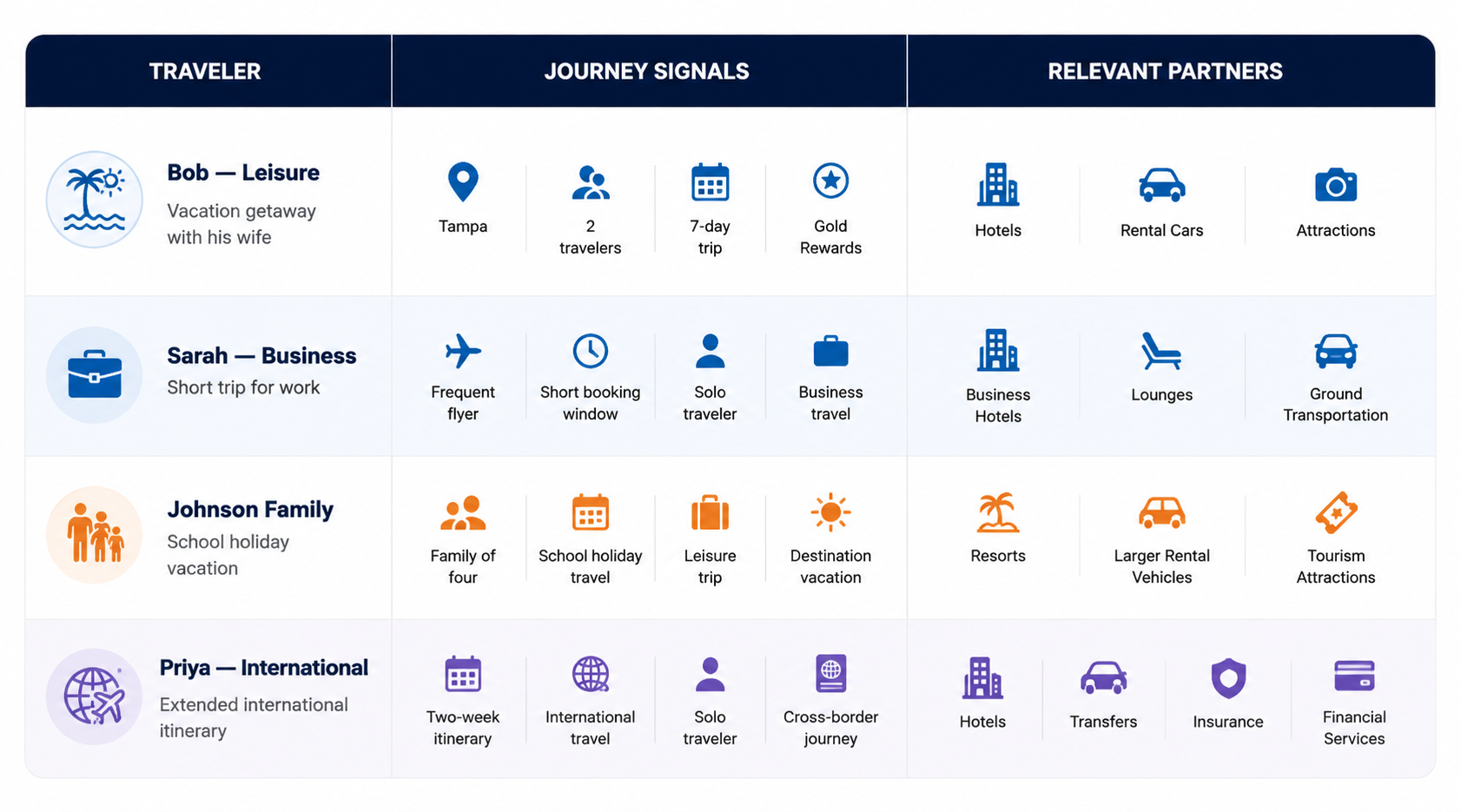
This audience-based approach reflects a broader shift in commerce media.
IAB notes that commerce media is expanding beyond retail into industries including travel, where businesses can use first-party data to create addressable audiences and integrate media into customer journeys across digital and physical touchpoints.
This is where airline media monetization becomes more sophisticated than simply selling banner inventory.
The airline can create advertising products around audiences and moments.
See how airlines can turn traveler intent into valuable commercial partnerships across every stage of the journey.
From Advertising Placements to Commercial Products
Instead of approaching a hotel group and saying:
“Would you like to buy banner ads on our website?”
An airline could build a product around a much more valuable proposition:
“Reach travelers flying into your markets who are actively planning their trips.”
That changes the commercial conversation.
Airlines could package products such as:
Destination Arrival Audiences
Reach travelers flying into selected destinations.
Family Vacation Audiences
Reach groups traveling together during high-intent leisure periods.
Premium Traveler Audiences
Reach high-value loyalty members and premium cabin travelers.
Pre-Departure Audiences
Reach travelers shortly before departure with convenience-focused products.
Destination Experience Audiences
Reach arriving travelers with attractions, restaurants, transportation, and local experiences.
The inventory is no longer just the placement.
The product is the combination of audience, intent, moment, and media.
That's consistent with the broader evolution of commerce media. IAB defines the model around the combination of first-party data, technology, media, targeting, and measurement—not simply the sale of advertising space.
One Partnership Can Span Multiple Channels
Commercial partners don't necessarily need to be confined to a single placement.
Airlines can activate partner campaigns through multiple advertising formats, including display, sponsored listings, email, mobile experiences, and booking-flow placements.
A hotel campaign could appear in:
- Booking flows
- Confirmation emails
- Manage Booking
- Mobile apps
- Loyalty portals
- Destination content
A rental car campaign might begin immediately after booking and remain relevant until arrival.
An airport lounge campaign may become increasingly relevant as departure approaches.
The channel changes.
The partner may remain the same.
What matters is matching the campaign to the traveler's needs at each stage.
Relevance Protects the Traveler Experience
There is an important distinction between monetizing an audience and overloading an audience with advertising.
Airlines have trusted customer relationships.
Protecting that trust matters.
The goal shouldn't be to maximize the number of advertisements a traveler sees.
It should be to maximize the relevance of the opportunities presented.
A traveler who has already booked a hotel doesn't need repeated hotel advertising.
A family of five shouldn't receive an offer designed for a solo business traveler.
A customer arriving at their destination doesn't need an airport parking promotion for the airport they just left.
Strong airline media programs use context to determine not only what to show, but also what not to show.
This is the principle behind journey-based targeting: using traveler context and timing to determine when an advertising opportunity is genuinely relevant.
Responsible data use matters here too. IAB's guidance for commerce media emphasizes privacy, governance, and the responsible activation of first-party data as foundational considerations when building these networks.
How AdButler Powers the Airline Media Stack
As the number of advertisers, traveler segments, formats, channels, and commercial partnerships grows, airlines need more than campaign delivery.
They need the infrastructure to operate a scalable media business.
AdButler provides an enterprise ad tech stack for activating and managing airline media across owned digital channels—giving airlines control over audiences, inventory, campaigns, advertiser relationships, and reporting from a unified platform.
Airlines can use AdButler to:
- Deliver campaigns using destinations, travel dates, loyalty status, itineraries, and audience segments
- Manage display, sponsored listings, email, mobile, and partner campaigns
- Package inventory for hotels, rental car companies, tourism organizations, financial services providers, and other partners
- Manage direct advertiser relationships
- Control inventory, approvals, pricing, and reporting
- Promote airline-owned ancillary products alongside external campaigns
- Measure campaign performance across multiple advertising experiences
- Expand their media business as new advertisers, inventory, channels, and revenue models are introduced
AdButler's travel media technology is designed to help airlines and other travel businesses turn high-intent traveler audiences into scalable advertising revenue across booking flows, search experiences, partner placements, and other digital touchpoints.
Whether an airline is working with a handful of strategic partners or building a larger media business, the objective remains the same:
Connect the right partner with the right traveler at the right moment—while maintaining control of the media business.
Airline Partnerships Can Become Media Products
Airlines have always worked with hotels, rental car companies, credit card providers, tourism organizations, and other travel businesses.
What's changing is how those relationships can be activated.
Instead of treating partnerships as isolated promotions, airlines can build repeatable advertising products around their traveler relationships, first-party signals, and owned media.
A hotel partner doesn't simply gain an ad placement.
It gains access to relevant moments in the travel planning process.
A rental car provider doesn't simply reach website visitors.
It can reach travelers whose itineraries indicate a potential transportation need.
And airlines create a scalable commercial model around assets they already possess.
IATA itself teaches a customer-journey approach to ancillary revenue strategy, including both airline and partner products and the use of data and e-commerce methods to maximize revenue.
The future of airline partnerships isn't about showing travelers more advertising.
It's about making every partnership more relevant to the journey.
The Bob example is only the beginning.
Our Airline Media Monetization Executive Guide explores how different traveler profiles create different commercial opportunities—and how airlines can turn journey signals, advertising formats, and partner relationships into a scalable media business.
Download the Airline Media Monetization Executive Guide
FAQs
How can airlines generate revenue from travel partnerships?
Airlines can create advertising and promotional products that connect hotels, rental car companies, tourism organizations, financial services providers, and other brands with relevant traveler audiences across owned digital channels.
Why are airline audiences valuable to hotels and rental car companies?
Airline traveler signals can indicate real travel intent, including destination, travel dates, passenger count, booking timing, and itinerary details. That can allow partners to reach customers closer to a relevant purchasing decision.
What types of companies can advertise through airline media?
Potential partners include hotels, rental car companies, tourism organizations, attractions, airport services, ground transportation providers, financial institutions, travel insurers, restaurants, and other travel-related businesses.
Where can partner advertising appear?
Partner campaigns can appear across booking flows, airline websites, confirmation emails, Manage Booking experiences, mobile apps, loyalty portals, airport channels, and other airline-owned media.
How does AdButler support airline partner campaigns?
AdButler provides the enterprise ad tech stack airlines can use to manage audiences, inventory, partner advertising, targeting, campaign delivery, advertiser relationships, and reporting across multiple formats and owned channels.
