
The Real Math Behind Switching Ad Servers Mid-Contract
“We still have six months left on the contract.”
That can feel like the end of a conversation about changing ad platforms. Your team might be spending too much time on campaign setup, struggling to launch new products, or working around reporting limitations. But switching means migration work and potentially paying for two systems.
Those costs are real. So is the cost of spending another six months with the same limitations.
The useful comparison is what your business would earn and spend under each option: stay until renewal, or move sooner. Once those numbers are laid out, the decision becomes much clearer.
At a glance
Remaining contract payments may apply whether you stay or switch. Include them in your budget, but distinguish unavoidable commitments from additional switching costs.
The benefits need a credible commercial basis. Use incremental contribution, demonstrable savings, and realistic implementation timing.
A migration should prove both delivery and economics. Test the new setup before treating projected improvements as dependable returns.
Start with the costs that actually change.
Suppose your existing platform costs $3,000 a month, with six months remaining. If the full $18,000 remains payable under either option, it belongs in both budgets.
You still need the cash to cover it. But charging that $18,000 only to the switching option would distort the comparison: staying also requires the payment.
The additional costs of moving could include the new platform’s fees, implementation work, training, and any exit charges triggered by the change. If reducing usage lowers your existing bill, that saving also belongs in the comparison.
Have the person responsible for the contract confirm the actual obligations, including notice dates, minimum commitments, and any restrictions affecting a transition. Build the calculation around those terms.
Count the value you can realistically unlock.
A more capable platform does not automatically create more advertising revenue. You need to connect its capabilities to something your business can sell, retain, or operate more efficiently.
Perhaps advertisers have requested a sponsorship package your current setup cannot deliver economically. Perhaps manual reporting requires outside support. Or campaign setup is consuming capacity that could support additional bookings.
Each opportunity needs its own evidence. A signed commitment is stronger than general advertiser interest. A removable contractor expense is a cash saving; hours freed within an existing salaried team are capacity unless they reduce spending or produce additional business.
Use incremental contribution rather than gross revenue when assessing new sales. That means additional revenue after the associated sales commissions, revenue shares, creative costs, and other variable expenses.
Avoid counting the same benefit twice—for example, treating freed staff time as both a cash saving and the full source of additional revenue.
Put both options into the same time window.
Your numbers will depend on your contract, campaign volume, team, and advertiser demand. The example below shows how to compare the options. Replace these assumptions with your own costs and evidence-backed estimates; they are not industry benchmarks, AdButler pricing, or expected results.
All figures are in US dollars (USD). The comparison covers the six months remaining on the existing contract.
Assume the new platform is billed from the start of month one. Implementation takes that first month, with commercial benefits beginning in month two.
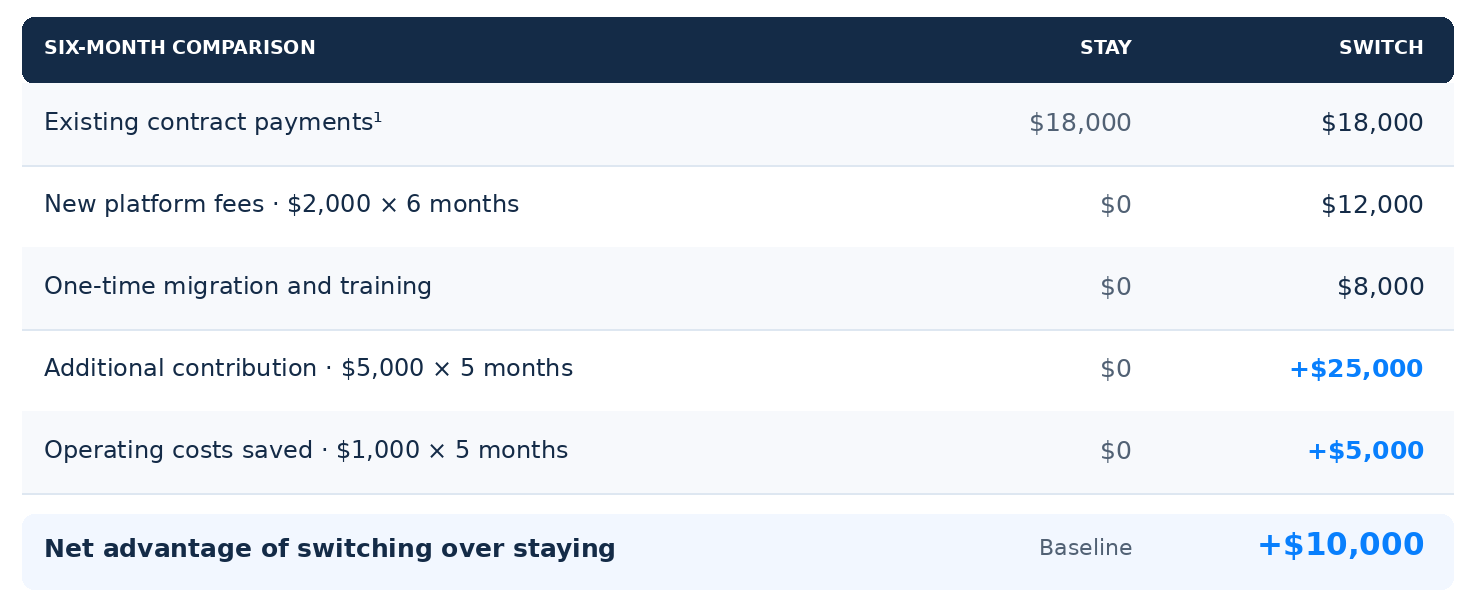
The calculation is straightforward:
$25,000 additional contribution + $5,000 savings − $12,000 new platform fees − $8,000 migration = $10,000.
The existing $18,000 commitment cancels out of the comparison because it is identical under both options. It remains part of the cash budget.
In this example, month one creates a $10,000 disadvantage: $8,000 for migration and $2,000 for the new platform. Each subsequent month improves the position by $4,000 after the new platform fee. Switching therefore moves ahead during month four, assuming the benefits arrive as projected.
This answers whether moving now pays off before the existing contract ends. A longer-term decision should also compare renewal pricing and the costs and benefits of migrating later.
Test the assumptions that could change the answer.
The positive result depends heavily on the $5,000 monthly contribution estimate.
If that contribution reaches only $2,000 a month, the six-month result becomes:
$10,000 additional contribution + $5,000 savings − $12,000 platform fees − $8,000 migration = −$5,000.
The same migration now leaves the business $5,000 behind staying through the remaining term.
Timing matters too. If benefits begin in month three rather than month two, while platform billing still starts in month one, the original example loses one month of contribution and savings: $6,000. Its advantage falls from $10,000 to $4,000.
That is why a useful business case needs a cautious scenario alongside the expected one. Test slower implementation, weaker advertiser demand, and higher migration costs. If the decision only works when every assumption goes right, the case for moving immediately is fragile.
Treat migration as part of the calculation.
Migration effort depends on what your business runs today: placements, active campaigns, targeting rules, integrations, reporting, and the people who maintain them.
Start with an inventory of those dependencies. Give engineering, ad operations, and commercial teams specific responsibilities, then budget their time. AdButler’s guide to switching and setting up an ad server covers auditing the existing setup, testing, and gradually moving placements.
A controlled rollout should establish that campaigns deliver correctly before more inventory moves. Keep campaign goals coordinated across systems so a transition does not create duplicate delivery or conflicting pacing.
Reporting also needs validation. AdButler’s documentation explains that differences in counting methods, time zones, and other factors can produce discrepancies between systems. A higher impression count alone is therefore insufficient evidence of better monetization.
Judge success using comparable delivery measures, advertiser commitments, net revenue, and actual operating effort.
FAQs
Is switching ad servers mid-contract always more expensive?
It can increase near-term spending because you may pay for both platforms. Whether it improves the overall result depends on the additional contribution and savings achieved after migration, compared with the additional costs.
Should remaining contract payments be included in switching costs?
Include them in the cash budget. When comparing options, payments that remain identical whether you stay or switch cancel out; additional exit charges or changes to existing fees do affect the decision.
When does waiting until renewal make more sense?
Waiting can make sense when the remaining term is short, migration capacity is limited, or the expected benefits are not yet supported by evidence. You can use that period to validate requirements, test integrations, and prepare a transition.
Bring the business case to DMEXCO.
At AdButler, we believe greater control should translate into something your business can measure: a product you can sell, a process you can improve, or an expense you can reduce.
AdButler is an enterprise ad tech platform, and evaluating a move should start with those outcomes. A useful discussion includes your current costs, the opportunities you want to pursue, and the work needed to make the transition.
Join Rajiv Khaneja, Founder, Bogdan Oros, Director of Operations, and Rob Janes, Chief of Product, at Booth B-057 in Cologne, Germany on September 23–24, 2026.
Bring the limitation you want to solve and the contract timeline you’re working with. Let’s talk through what a move would need to deliver to make financial and operational sense.
