
Retail Media in the Agentic Era: AI Isn’t Taking Over-It’s Taking Orders
Key Takeaways
AI agents are transforming commerce into intent-driven conversations, where users delegate product discovery and purchasing decisions to intelligent assistants.
Retailers are not being replaced by AI agents but becoming critical infrastructure, providing the trust, fulfillment, and inventory that AI systems rely on to complete transactions.
Product discovery is shifting from browsing interfaces to conversational interactions, replacing search-and-scroll journeys with dialogue-based recommendations.
Retail media is evolving from static ad placements to dynamic, AI-generated recommendations, including sponsored answers, product bundles, and contextual suggestions.
First-party data is the primary advantage in agentic commerce, enabling retailers to deliver more accurate, personalized recommendations than generic AI models.
Ad placements are moving from fixed inventory slots into intelligent responses, where monetization happens inside AI-generated outputs rather than banners or listings.
Organic and paid recommendations are converging into unified decision systems, optimizing simultaneously for relevance, margin, inventory, and customer satisfaction.
Brands must optimize for AI agents as decision-makers, ensuring their products are visible, understandable, and prioritized within algorithmic recommendations.
Retail media is becoming “SEO for AI agents,” where structured product data and signals determine discoverability in automated buying journeys.
Flexible, API-driven ad infrastructure is essential for agentic retail media, as rigid systems cannot support real-time personalization and AI-driven experiences.
The future of commerce is augmented, not autonomous, with AI accelerating decisions while retailers continue to provide trust, curation, and brand experience.
For years, we’ve been told that the next disruptor in commerce is around the corner. Voice assistants… Metaverse stores… Social commerce… And now: AI agents—autonomous digital shoppers that compare, shortlist, and even buy for us.
Yes, this shift is real. But it won’t erase retailers from the equation.
Retailers have survived the rise of D2C, marketplaces, and comparison engines because they hold the enduring advantages consumers rely on:
- Curation and trust
- Distribution and fulfillment
- Physical experience and service
- Brand relationships and exclusive inventory
AI agents won’t replace those moats—they’ll route through them.
The retailers who win are the ones who power these new journeys rather than get filtered out of them.
From Carousels to Conversations
Today’s shopping journey is still mostly: Search ➜ Scroll ➜ Carousel ➜ Cart.
AI disrupts that.
Shoppers will increasingly tell an assistant:
“I need reef-safe sunscreen for a trip next week. Under $25.”
Or:
“Buy the protein powder I ordered last month — but get the best price you can find.”
Suddenly, product discovery is a dialogue.
That means retail media must evolve too:
Old retail media:
Sponsored slots
Category pages
Static placements
Agentic retail media:
Contextual recommendations inside AI conversations
Smart bundles based on stock + margin + loyalty data
AI-native shoppable video and dynamic experiences
Retailers who personalize their discovery engines using their first-party data—loyalty, purchase history, returns, location — will deliver more accurate guidance than any generic LLM can hallucinate.
This is where the future of monetization lives.
3 Big Retail Media Shifts You Can’t Ignore
Here’s what changes as AI starts doing the browsing for us:
1. Ad placements move from inventory slots → intelligent responses
Sponsored results won’t be confined to:
Search results pages
Banner positions
They will be embedded within AI recommendations, in formats like:
Sponsored answers
Conversational product pairings
Store-aware bundles
Margin-optimized suggestions
To do this well, retailers need flexible ad infrastructure.
Rigid ad stacks break here.
2. Organic and paid recommendation engines will converge
No more parallel systems optimizing in conflict.
In the agentic era:
The same model should determine which product appears
Sponsored or not
Goals blend:
✔ Relevance
✔ Margin
✔ Inventory
✔ Placement demand
✔ Customer satisfaction
3. Brands must influence agents — not just humans
Shoppers will increasingly say:
“Buy detergent. Pick the best value.”
If their personal agent never learns your brand, that sale is lost forever.
Brands need retail media to:
- Feed agents the right product signals
- Communicate differentiators in structured formats
- Maintain visibility where choice happens
- Reach both human and bot shoppers
This is SEO for agents—and it starts now.
How AdButler Powers Agentic Retail Media
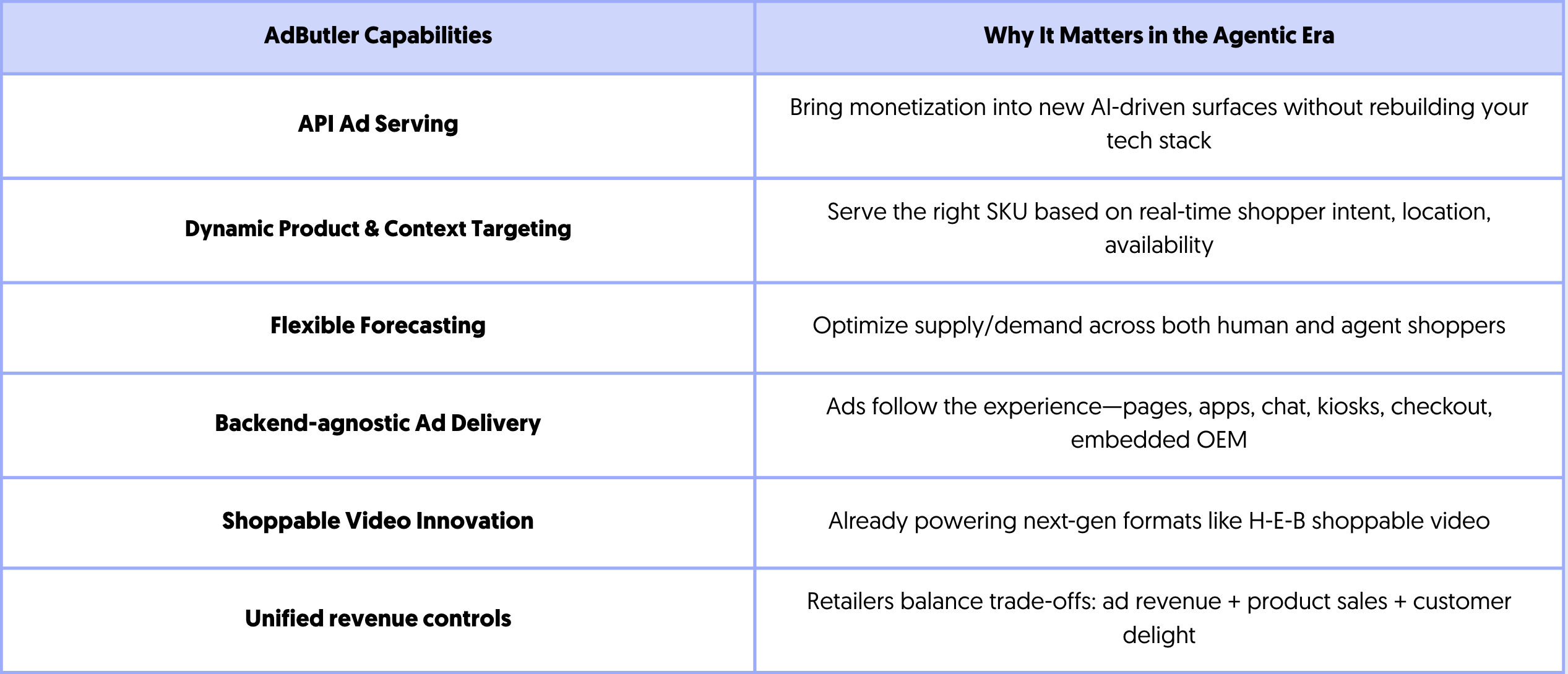
So what should retailers and brands do next?
For Retailers
Audit where AI assistants could accelerate the journey
Break monetization out of fixed inventory slots
Use first-party signals to power personalized responses
Ensure product metadata is agent-readable
Partner with tech providers who support fast experimentation
For Brands
Invest in structured retail media where algorithmic choice happens
Optimize messaging for missions (“buy again”, “find the fastest delivery”, etc.)
Push deeper into product education + storytelling (video, PDP content)
The Future Isn’t Fully Autonomous—It’s Augmented
People still want to feel inspired.
Still want confidence in a retailer’s curation.
Still want quality validated by a trusted banner above the aisle.
AI will help them get there faster—but won’t choose without signals.
Retail media is how those signals are sent.
AdButler’s promise: We’ll help retailers and brands remain discoverable, measurable, and profitable—no matter who’s doing the shopping.
To learn more about the power of our AI solutions, get in touch with our team today.
FAQs
What is agentic retail media?
Agentic retail media refers to advertising and monetization strategies designed for AI-driven shopping environments, where AI agents recommend, compare, and purchase products on behalf of users.
Will AI agents replace retailers in the commerce ecosystem?
AI agents will not replace retailers because they depend on retailer infrastructure for inventory, fulfillment, and trust, making retailers essential to completing transactions.
How is product discovery changing in the agentic era?
Product discovery is shifting from traditional browsing and search-based journeys to conversational interactions where users express intent and AI systems deliver recommendations.
What happens to traditional ad placements in AI-driven commerce?
Traditional ad placements such as banners and sponsored listings are evolving into embedded, conversational formats like sponsored answers and dynamic product recommendations.
Why is first-party data critical for retailers in AI-driven shopping?
First-party data enables retailers to personalize recommendations using real customer signals, which leads to more accurate and relevant outcomes than generic AI models.
How are organic and paid recommendations changing?
Organic and paid recommendations are merging into unified systems where a single model determines visibility based on multiple factors, including relevance, margin, and demand.
Why do brands need to optimize for AI agents?
Brands need to optimize for AI agents because these systems increasingly make purchasing decisions, and without strong product signals, brands risk being excluded from recommendations.
What does “SEO for AI agents” mean in retail media?
SEO for AI agents refers to optimizing product data, content, and signals so that AI systems can understand, prioritize, and recommend products during automated shopping journeys.
What kind of infrastructure is required for agentic retail media?
Agentic retail media requires flexible, API-driven ad platforms that support real-time personalization, structured data integration, and rapid experimentation.
Is the future of commerce fully automated by AI?
The future of commerce is augmented rather than fully automated, as AI accelerates decision-making while human trust, brand perception, and retail experience remain essential.
