
What Is Brand Safety? A Practical Guide for Advertisers
You approve the creative, choose your audience, and launch the campaign. Then someone sends a screenshot of your ad beside content you would never have approved.
The creative hasn’t changed. Its surroundings have changed what it communicates.
Brand safety helps advertisers manage that risk. The challenge is protecting your reputation while preserving access to relevant audiences and quality publishers.
At AdButler, our perspective is that brand standards need to become clear delivery rules, supported by reporting and people who can act when something goes wrong.
At a glance
- Brand safety helps prevent harmful ad placements. It covers the policies and controls used to avoid damaging content associations.
- Brand suitability adds advertiser-specific judgment. Content can be acceptable for advertising but inappropriate for a particular campaign.
- Context matters more than isolated words. Broad exclusions can block legitimate reporting and useful content.
- Protection needs operational ownership. Define who sets the rules, checks delivery, and responds to incidents.
What is brand safety?
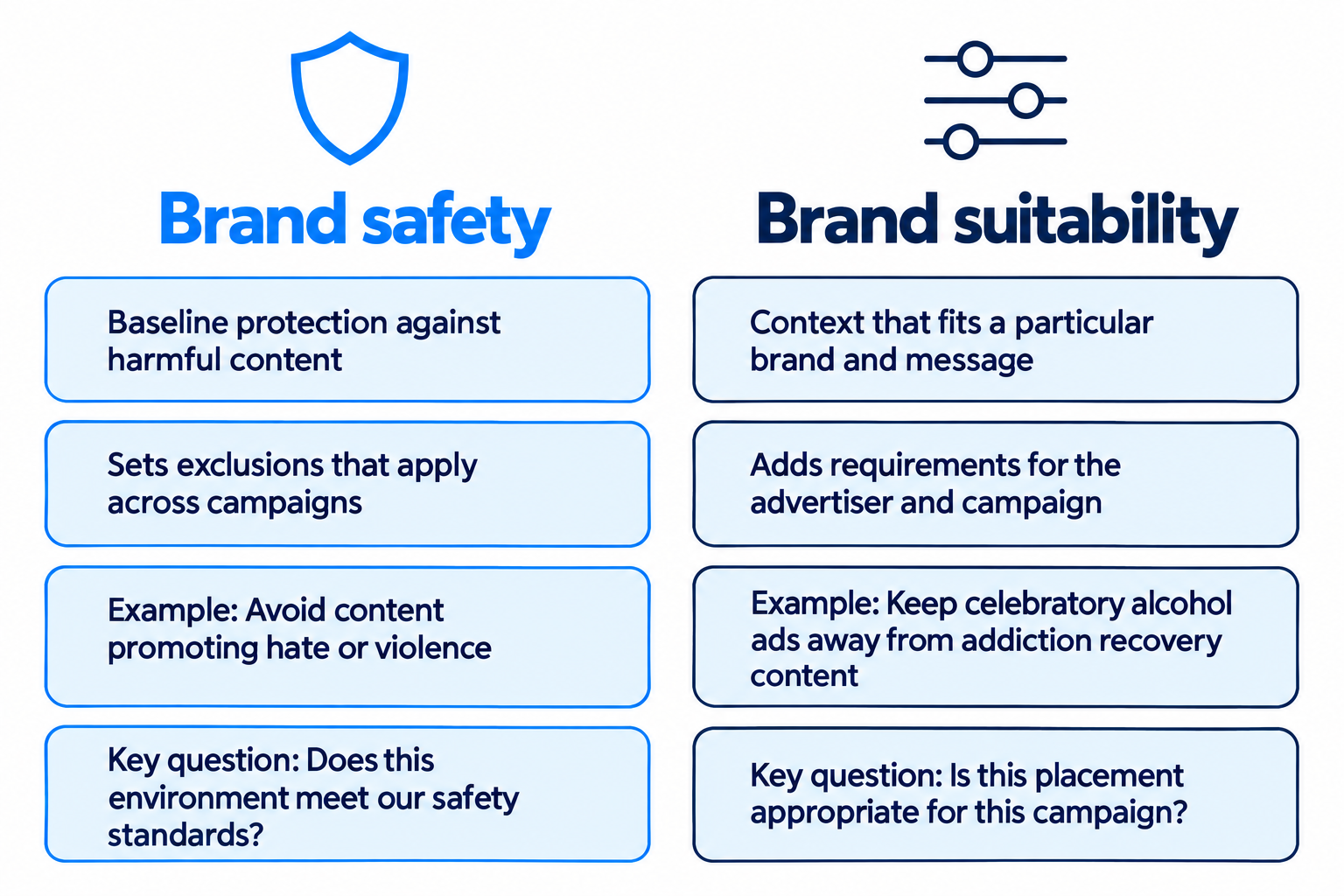
Brand safety is the practice of reducing the risk that advertising appears alongside harmful or inappropriate content. Examples include hate speech, terrorist propaganda, and content promoting illegal activity.
It combines advertiser policies, inventory controls, content assessment, and monitoring. The aim is to prevent associations that could damage trust in the brand.
The IAB distinguishes this baseline protection from brand suitability, which considers the circumstances and preferences of individual advertisers.
Brand safety vs. brand suitability
Brand safety asks whether an environment meets basic standards for advertising. Brand suitability asks whether it fits this advertiser, message, and audience.
A responsibly produced documentary about addiction may be suitable for a public-health campaign. A celebratory alcohol advertisement alongside it could feel deeply inappropriate.
The content itself has not changed. The relationship between the message and its surroundings creates concern.
Advertisers should document these distinctions. A policy that treats every sensitive topic as unsafe can exclude valuable journalism, education, and support resources.
Where brand safety risks appear
Harmful content is the obvious concern, but campaign teams should also examine how placements are selected and maintained.
Content can change after approval. A reviewed page may gain unmoderated comments, or a live stream may move into unexpected territory. Approval should account for how dynamic the environment is.
A trusted publisher can contain different contexts. Knowing the website or app is useful, but it may not establish whether a particular article, episode, or placement suits the campaign.
Missing information can weaken controls. If content labels or placement details are unavailable, the team needs an agreed response. Otherwise, different partners may handle the same uncertainty differently.
There is also a separate question of media quality. A placement can avoid harmful content while attracting invalid traffic or offering little opportunity for an ad to be seen. Brand safety checks should sit alongside fraud, viewability, and performance evaluation.
Protect reach by making the rules more precise
Blocking more inventory does not automatically mean making better decisions.
A keyword such as “shooting” could describe a violent incident, a basketball technique, or a photography lesson. The word alone cannot establish the context. The IAB’s brand safety and suitability guidance discusses both keyword limitations and the importance of reviewing false positives.
Use exclusion lists for known problems, then assess where more detailed contextual information can improve the decision. Contextual tools also need checking; classification is not infallible.
The useful question is: what exactly makes this placement unacceptable?
If the concern is graphic imagery, blocking every news article about the subject may be unnecessarily broad. If the concern is an unmoderated live environment, a topic filter alone may not address it.
Review exclusions alongside delivery. Ask partners what was blocked and why, where that reporting is available. This helps identify controls that are restricting suitable inventory without adding meaningful protection.
Turn brand standards into delivery rules
“Protect our reputation” is an objective. Campaign teams still need instructions they can apply.
Define the environments you will avoid, the contexts requiring additional review, and any campaign-specific restrictions. Include examples so agencies, publishers, and technology partners interpret the policy consistently.
Then establish where each rule is enforced. A buying platform, publisher, ad server, and verification provider may each handle different parts of the process.
For direct campaigns, advertisers can ask publishers how inventory is organized and how sensitive content is identified. For programmatic buying, ask which protections operate before purchase and which detect issues after delivery.
Our view is that every important rule needs an owner, a place where it takes effect, and a way to check whether it worked.
Where AdButler fits
AdButler is an enterprise ad tech platform that gives teams control over campaign delivery.
Its campaign and targeting controls let operators assign campaigns to defined ad zones and apply rules using signals such as keywords, data keys, geography, and device type.
For a publisher or media network, these capabilities can support an implementation in which approved inventory and supplied content labels determine campaign eligibility. The quality and coverage of those labels remain essential.
AdButler’s API-based infrastructure also supports custom advertising workflows and integrations. Content classification, specialist verification, and incident handling need to be defined within the broader setup.
The practical value is being able to translate agreed requirements into delivery controls. An ad-serving rule is only useful when it receives the information needed to enforce it.
A short pre-launch checklist
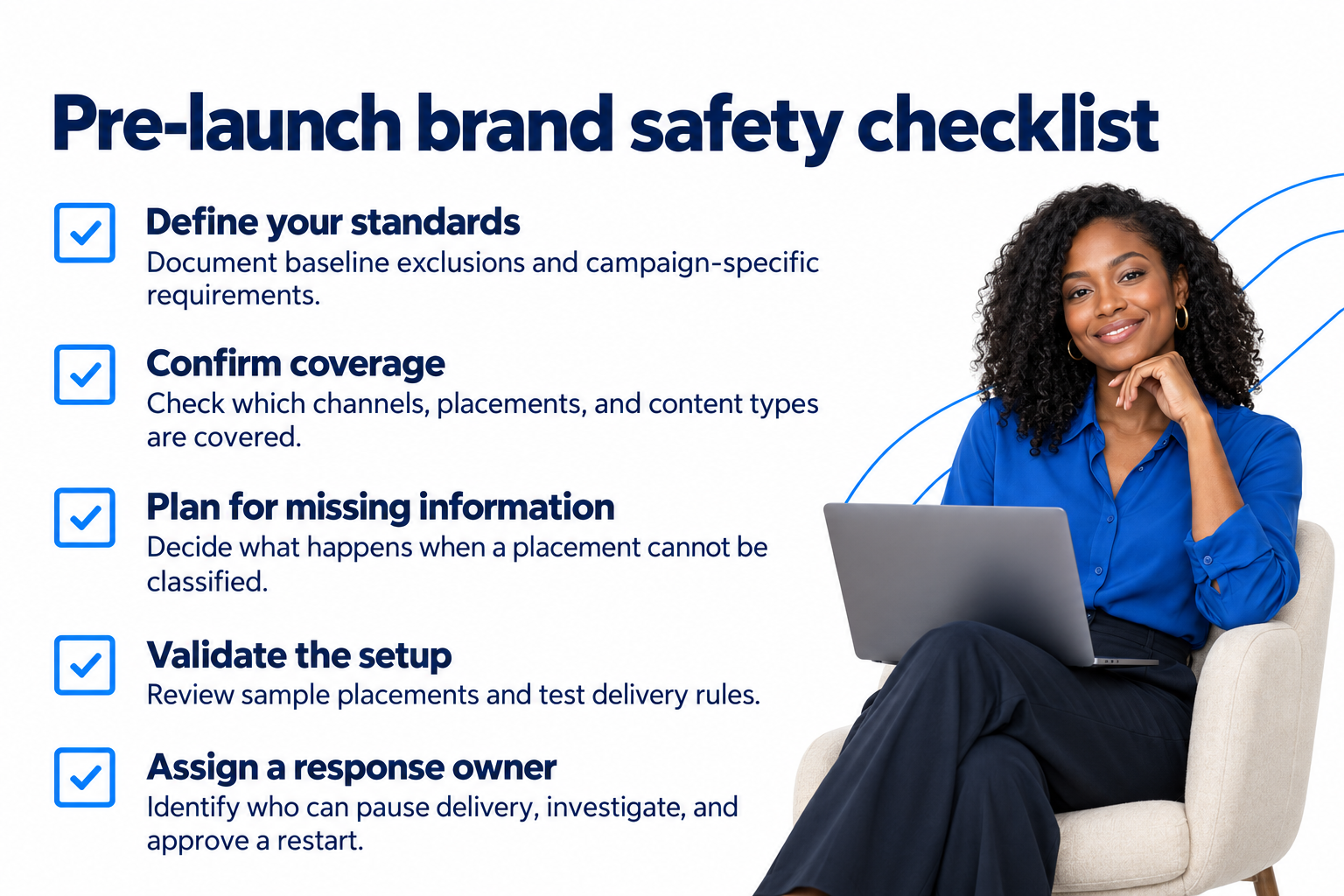
Before a campaign goes live, confirm:
- Standards: Are baseline exclusions and campaign-specific suitability requirements documented?
- Coverage: Do partners understand which channels, placements, and content types the controls cover?
- Missing information: What happens when a placement cannot be classified?
- Validation: Have sample placements and rule behavior been checked?
- Response: Who can pause delivery, investigate an incident, and authorize a restart?
After launch, review both incidents and unnecessary exclusions. When something goes wrong, capture the placement, creative, and timing, contain the affected delivery, and investigate the cause before resuming.
FAQs
Are brand safety and brand suitability the same?
No. Brand safety establishes baseline protections against harmful environments. Brand suitability considers whether otherwise acceptable content fits a particular advertiser, campaign, or audience.
Does buying directly from a publisher guarantee brand safety?
No. Direct relationships can improve transparency and coordination, but advertisers still need agreed placement rules, content review processes, and a response plan.
Can keyword blocking protect a campaign on its own?
Keyword blocking can help enforce specific exclusions, but words can have multiple meanings. Combine it with contextual information, inventory controls, and ongoing review.
Make brand safety part of campaign operations
A workable brand safety approach connects policy with what happens when an ad is delivered. Teams need clear standards, dependable signals, and the ability to investigate and change course.
That is also how advertisers can protect reach: by making better-informed placement decisions and correcting unnecessary exclusions.
