
Ad Fatigue Isn’t Just About Too Many Ads. It’s About Too Little Relevance
Key Takeaways
- Ad fatigue is often visible in the creative, but targeting, pacing, frequency, and placement may be the underlying causes.
- High frequency is not inherently harmful; it becomes a problem when additional impressions stop creating value.
- Relevance depends on aligning the audience, context, message, placement, timing, and customer journey.
- New creative will provide only temporary relief if the same delivery problems remain.
- AdButler helps media owners operationalize relevance through targeting, frequency capping, pacing, reporting, campaign controls, and APIs.
Ad fatigue may appear to be a creative problem, but lasting performance depends on how intelligently ads are targeted, paced, delivered, and measured.
Your best-performing ad will not remain your best-performing ad forever.
Click-through rates decline. Conversion costs rise. Once-responsive audiences begin ignoring the message. The usual diagnosis is ad fatigue, and the usual response is to produce new creative.
That can work—but sometimes only temporarily.
If every refresh delivers a shorter performance lift, the creative may not be the real problem. The campaign may still be reaching the same people, in the same placements, at the same frequency, regardless of what the new advertisement looks like.
Changing the creative changes what the audience sees. It does not necessarily change why, where, or how often they see it.
That is why ad fatigue should not be treated solely as a creative challenge. It is also a relevance, targeting, and delivery challenge.
For advertisers, that means more impressions will not automatically create more influence. For publishers and media owners, it means maximizing ad volume can eventually weaken campaign performance, audience experience, and the value of the inventory itself.
The better objective is not to serve the greatest possible number of ads. It is to create the greatest possible value from every appropriate impression.
What Is Ad Fatigue?
Ad fatigue is a decline in audience response caused by repeated exposure to the same advertisement, message, offer, or creative pattern.
It usually develops when campaigns continue serving impressions without introducing enough variation in the creative, audience, context, or customer journey.
Common causes include:
- Running the same creative beyond its effective lifespan
- Repeating the same offer or message across multiple campaigns
- Targeting an audience too narrow for the planned impression volume
- Over-serving retargeting audiences
- Allowing campaigns to reach overlapping audience segments
- Using weak frequency caps or pacing controls
- Concentrating delivery across too few placements
- Continuing acquisition messaging after someone converts
- Showing generic advertisements when more relevant contextual signals are available
Creative is often where fatigue becomes visible, but the underlying cause may sit elsewhere in the advertising system.
If the audience is too narrow, the retargeting window is too long, or delivery is too aggressive, a new creative asset will eventually encounter the same problem.
Why Ad Fatigue Hurts Performance
As audiences become less responsive, every additional impression creates less value.
Advertisers may start to see:
- Lower click-through and conversion rates
- Rising cost per click or acquisition
- Reduced return on ad spend
- Weaker video completion or engagement rates
- Poorer retargeting performance
- Negative reactions to repetitive advertising
Publishers and media owners also feel the impact.
When audiences repeatedly encounter irrelevant or overly familiar ads, the wider experience can begin to feel cluttered or intrusive. Engagement may decline, advertisers may question the value of the inventory, and premium placements can appear less effective than they actually are.
This is particularly important for retail media networks, marketplaces, travel platforms, streaming services, and other businesses monetizing their own digital environments.
Adding more sponsored products, display placements, or video inventory can increase short-term ad capacity. But if those ads interfere with discovery or repeatedly deliver irrelevant messages, greater ad load will not necessarily produce sustainable revenue.
More ads and better monetization are not the same thing.
Relevance Changes the Value of Frequency
High frequency is not automatically bad.
Some purchases require repeated exposure. Brand campaigns may need time to build recognition, while longer buying cycles may benefit from several carefully sequenced messages.
The problem begins when repetition no longer adds anything useful.
A traveler who has just booked a flight may welcome a relevant hotel or airport-transfer offer. A shopper researching running shoes may find a suitable sponsored product helpful. A business reader exploring supply-chain risk may pay attention to a relevant industry solution.
Show those same people an unrelated message repeatedly, and the impressions quickly become noise.
Research from Google and Ipsos found that relevant video ads earned three times the attention of an average video ad. Although the study is from 2017 and should not be treated as a universal current benchmark, its underlying lesson remains valuable: relevance affects whether an advertisement earns attention.
Relevance is the alignment between:
- The audience
- The current context
- The available intent signal
- The placement and format
- The message
- The stage of the customer journey
- The timing of the exposure
When those elements align, advertising can feel useful. When they do not, increasing volume simply scales the mismatch.
How to Detect Ad Fatigue
There is no universal frequency number at which every campaign becomes fatigued. Appropriate frequency depends on the audience, objective, format, buying cycle, and environment.
Instead of relying on a single benchmark, compare performance against the campaign’s own history and look for connected warning signs.
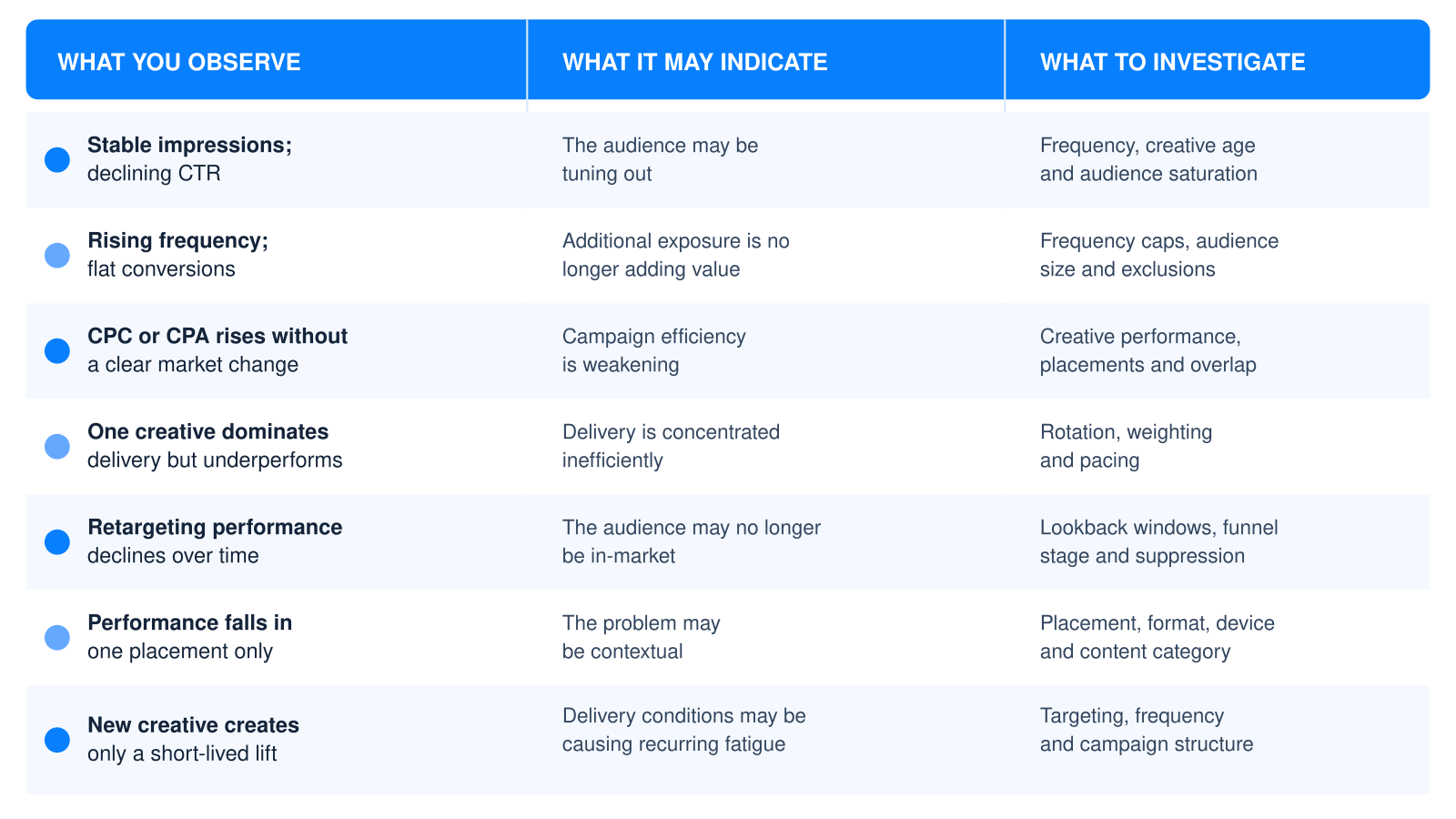
The strongest diagnosis usually comes from a combination of signals. Rising frequency alongside declining engagement, increasing costs, and weaker conversions is more meaningful than any one metric alone.
A Smarter Way to Prevent Ad Fatigue
Preventing ad fatigue requires coordination across creative, targeting, delivery, inventory, and measurement.
1. Establish a performance baseline
Record early performance by creative, audience, placement, format, and device.
This gives you something meaningful to compare against as the campaign matures. Without a baseline, it can be difficult to determine whether performance is genuinely deteriorating or simply fluctuating.
2. Measure exposure, not just impressions
Total impression volume does not show how delivery is distributed.
Monitor unique reach, frequency, impression concentration, and the percentage of delivery going to highly exposed audience segments. An acceptable campaign-wide average can still hide overexposure within a smaller group.
3. Use frequency caps intentionally
Frequency caps should reflect the objective, format, audience, and buying cycle.
A short promotional campaign may require different controls from a long-term sponsorship. A high-impact video placement may also need a lower cap than a smaller display unit.
Treat the cap as a campaign policy to test and refine—not a universal number.
4. Pace delivery across the campaign
Aggressive early delivery can exhaust an audience before the campaign has time to generate meaningful results.
Pacing distributes impressions more evenly across the scheduled period, preserving budget and audience attention while giving teams time to identify emerging performance issues.
5. Build meaningful creative variation
Creative rotation is most effective when each asset introduces a genuinely different message.
Changing the image or background color while repeating the same offer is unlikely to reset audience interest for long. Develop variations for different needs, contexts, funnel stages, objections, product categories, and customer types. The goal is not endless creative production. It is a more relevant messaging system.
6. Sequence instead of repeating
Repetition shows the same idea again. Sequencing moves the conversation forward.
An awareness message can introduce a challenge. A later exposure can explain the solution, provide proof, address an objection, or present an appropriate offer.
This gives each impression a distinct purpose.
7. Suppress outdated audiences
Someone who has converted should not continue receiving the same acquisition message.
Use exclusions, updated audience states, and appropriate retargeting windows to stop campaigns from acting on outdated intent. Depending on the journey, the next best message may be a complementary recommendation, support content, or no advertisement at all.
- Evaluate context and placement
If fatigue appears in one placement but not another, the creative may not be the problem.
Compare performance across content categories, pages, formats, devices, and channels. A strong message can still underperform when it appears in the wrong environment.
How AdButler Helps Make Relevance Operational
Managing ad fatigue requires more than a steady supply of creative. Media owners need infrastructure that controls how campaigns are targeted, paced, delivered, and measured.
AdButler provides those capabilities as part of a broader enterprise ad tech platform.
With AdButler, publishers, retailers, marketplaces, and other media owners can use:
- Frequency capping to control how often an ad is delivered within a defined period
- Campaign pacing to distribute impressions more evenly instead of exhausting inventory or attention too early
- Granular targeting based on signals such as keywords, data keys, geography, device, audience, and context
- Creative and campaign management to coordinate multiple assets, schedules, placements, and delivery rules
- Cross-format ad serving across display, native, video, mobile, email, CTV, and digital out-of-home environments
- Granular reporting to compare performance across campaigns, creatives, placements, and delivery periods
- APIs and custom integrations to connect advertising decisions with first-party data and internal workflows
AdButler does not impose one definition of relevance on every media business.
A retailer may use product searches, category views, cart activity, and purchase history. A publisher may rely on content categories, newsletter preferences, or reader behavior. A travel platform may use destination interest, loyalty status, or journey stage.
AdButler provides the infrastructure to translate those signals into controlled campaign execution.
That means deciding not only which advertisement is eligible, but which message is most appropriate, where it should appear, and whether another impression is likely to add value.
Better Advertising Starts With Better Decisions
Ad fatigue does not mean audiences have stopped responding to advertising.
It means they stop responding when advertising becomes repetitive, poorly timed, or disconnected from what they are doing.
Refreshing creative remains important, but it cannot compensate indefinitely for weak targeting, excessive frequency, poor pacing, or irrelevant placements.
The long-term solution is to improve the system around the creative.
Before serving another impression, advertisers and media owners should be able to ask:
- Is this the right audience?
- Is this the right context?
- Is this the right message?
- Has this person already seen enough?
- Will another impression add value?
More ads cannot rescue an irrelevant campaign. Better decisions can.
AdButler gives media owners the targeting, pacing, frequency controls, campaign management, reporting, and extensibility needed to turn relevance from a creative ambition into an operational capability.
Ready to deliver more relevant advertising without overwhelming your audience?
FAQs
What is ad fatigue?
Ad fatigue is a decline in audience response caused by repeated exposure to the same advertisement, offer, message, or creative pattern. It may result in lower engagement, weaker conversions, rising acquisition costs, or reduced return on ad spend.
What causes ad fatigue?
Common causes include repetitive creative, narrow audiences, excessive retargeting, overlapping campaigns, poor pacing, high frequency, irrelevant placements, and messages that do not change throughout the customer journey.
How can you detect ad fatigue?
Look for connected trends such as rising frequency alongside declining click-through or conversion rates, increasing costs, concentrated delivery, and weaker performance from older creatives. Compare results with the campaign’s historical baseline rather than relying on one universal frequency benchmark.
Can changing the creative fix ad fatigue?
It can improve performance temporarily. However, if the campaign continues reaching the same people too often or in the wrong context, the new creative may fatigue as well. Sustainable improvement also requires better targeting, pacing, frequency management, and placement decisions.
How does AdButler help reduce ad fatigue?
AdButler provides frequency capping, campaign pacing, granular targeting, creative management, placement-level reporting, and APIs. These capabilities help media owners control which advertisements appear, where they are delivered, and how often audiences see them.
